
By University of Montreal February 27, 2025
Collected at: https://scitechdaily.com/a-2000c-inferno-that-still-shimmers-an-ultra-hot-neptunes-mystery/
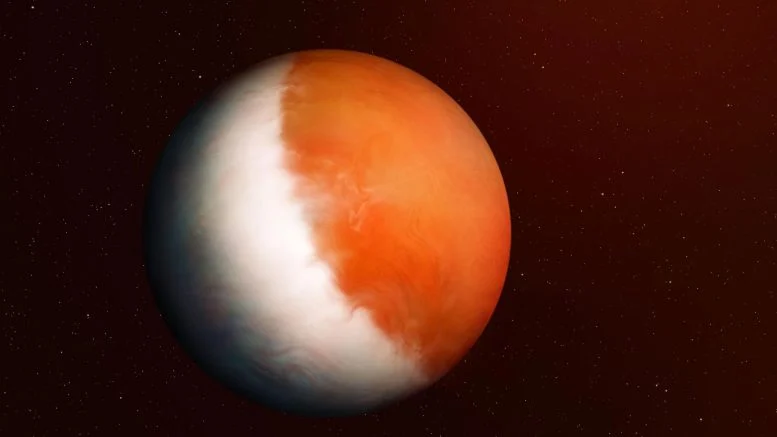
LTT 9779 b, an ultra-hot Neptune, is defying expectations. With temperatures soaring to nearly 2,000°C and a tidally locked orbit, one side faces eternal fire while the other remains in shadow. Yet, reflective clouds on its western hemisphere provide a surprising twist, revealing complex atmospheric dynamics.
The James Webb Space Telescope’s latest observations shed new light on this extreme world, showcasing powerful winds, unexpected cloud formations, and even traces of water vapor—offering a rare glimpse into the extreme weather of distant exoplanets.
Unlocking the Secrets of an Ultra-Hot Neptune
The James Webb Space Telescope has provided a closer look at LTT 9779 b, a rare and extreme “ultra-hot Neptune.” Led by Louis-Philippe Coulombe, a graduate student at Université de Montréal’s Trottier Institute for Research on Exoplanets (IREx), the observations reveal new details about the planet’s atmosphere and weather patterns.
Published on February 25 in Nature Astronomy, the study highlights the intense conditions on LTT 9779 b, which orbits its star in less than a day. With daytime temperatures soaring close to 2,000°C, the planet is tidally locked, meaning one side is in constant daylight while the other remains in permanent darkness.
Despite these harsh conditions, Coulombe and his team found that the planet’s dayside features reflective clouds, particularly on its cooler western hemisphere. This creates a stark contrast to the hotter, cloud-free eastern side.
“This planet provides a unique laboratory to understand how clouds and the transport of heat interact in the atmospheres of highly irradiated worlds,” said Coulombe.
Asymmetry on the Dayside
Using the James Webb Space Telescope (JWST), his team uncovered an asymmetry in the planet’s dayside reflectivity. They propose that the uneven distribution of heat and clouds is driven by powerful eastward winds that transport heat around the planet.
These findings help refine models describing how heat is transported across a planet and cloud formation in exoplanet atmospheres, thereby also bridging the gap between theory and observation.
A Closer Look at the Atmosphere
The research team studied the atmosphere in detail by analyzing both the heat emitted by the planet and the light it reflects from its star. To create a clearer picture, they observed the planet at multiple positions in its orbit and analyzed its properties at each phase individually.
They discovered clouds made of materials like silicate minerals, which form on the slightly cooler western side of the planet’s dayside. These reflective clouds help explain why this planet is so bright at visible wavelengths, bouncing back much of the star’s light.
By combining this reflected light with heat emissions, the team was able to create a detailed model of the planet’s atmosphere. Their findings reveal a delicate balance between intense heat from the star and the planet’s ability to redistribute energy.
Water Vapor and Alien Weather Patterns
The study also detected water vapor in the atmosphere, providing important clues about the planet’s composition and the processes that govern its extreme environment.
“By modeling LTT 9779 b’s atmosphere in detail, we’re starting to unlock the processes driving its alien weather patterns,” said Coulombe’s research advisor Björn Benneke, an UdeM professor of astronomy and co-author of the study.
An Incredibly Powerful Telescope
With this study, the JWST has once again demonstrated its incredible power, allowing scientists to study the atmosphere of LTT 9779 b in unprecedented detail.
Its Canadian instrument, the Near Infrared Imager and Slitless Spectrograph (NIRISS), was used to observe the planet for nearly 22 hours. The data captured the planet’s full orbit around its star, including two secondary eclipses (when the planet passes behind its star) and a primary transit (when the planet passes in front of its star).
Mapping a Mysterious World
For an exoplanet like LTT 9779 b, which is tidally locked to its star, the amount and type of light that’s observed changes as the planet rotates, showing us different parts of its surface. The dayside reflects and emits more light due to intense heating, while the cooler nightside emits less light. By capturing spectra at various phases, researchers can map out variations in temperature, composition, and even cloud coverage across the planet’s surface.
Michael Radica, a former PhD student at UdeM and now a postdoctoral researcher at the University of Chicago, was the second author of this study. Earlier this year, he published a detailed analysis of the planet’s light spectrum during transit. “It’s remarkable that both types of analyses paint such a clear and consistent picture of the planet’s atmosphere,” he noted.
The research was conducted as part of the NEAT (NIRISS Exploration of Atmospheric Diversity of Transiting Exoplanets) Guaranteed Time Observation program, led by IREx’s David Lafrenière, an UdeM astrophysic professor.
The study highlights the importance of JWST’s ability to observe exoplanets across a wide wavelength range, allowing scientists to disentangle the contributions of reflected light and thermal emission, he said.
“This is exactly the kind of groundbreaking work JWST was designed to enable.”
Remarkably Rare Hot Neptunes
LTT 9779 b resides in the “hot Neptune desert,” where exceptionally few such planets are known to exist. While giant planets orbiting very close to their host stars — often called “hot Jupiters” — are commonly detected using current exoplanet-finding methods, ultra-hot Neptunes like LTT 9779 b remain remarkably rare.
“Finding a planet of this size so close to its host star is like finding a snowball that hasn’t melted in a fire,” said Coulombe. “It’s a testament to the diversity of planetary systems and offers a window into how planets evolve under extreme conditions.”
A New Window into Planetary Evolution
This rare planetary system continues to challenge scientists’ understanding of how planets form, migrate, and endure in the face of unrelenting stellar forces. LTT 9779 b’s reflective clouds and high metallicity may shed light on how atmospheres evolve in extreme environments, too.
LTT 9779 b is a remarkable laboratory for exploring these questions, offering insights into the broader processes that shape the architecture of planetary systems across the galaxy, said Coulombe.
“These findings give us a new lens for understanding atmospheric dynamics on smaller gas giants. This is just the beginning of what JWST will reveal about these fascinating worlds.”
Reference: “Highly reflective white clouds on the western dayside of an exo-Neptune” by Louis-Philippe Coulombe, Michael Radica, Björn Benneke, Élyse D’Aoust, Lisa Dang, Nicolas B. Cowan, Vivien Parmentier, Loïc Albert, David Lafrenière, Jake Taylor, Pierre-Alexis Roy, Stefan Pelletier, Romain Allart, Étienne Artigau, René Doyon, Ray Jayawardhana, Doug Johnstone, Lisa Kaltenegger, Adam B. Langeveld, Ryan J. MacDonald, Jason F. Rowe and Jake D. Turner, 25 February 2025, Nature Astronomy.
DOI: 10.1038/s41550-025-02488-9

Leave a Reply