
By ESA/Hubble November 11, 2024
Collected at: https://scitechdaily.com/when-galaxies-collide-unraveling-the-forces-of-cosmic-evolution/
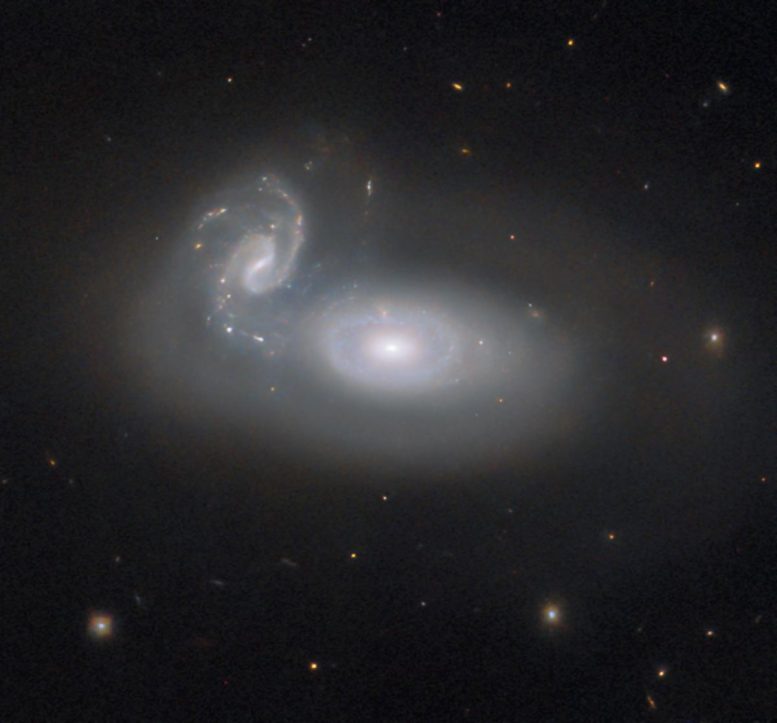
Hubble’s recent capture, MCG+05-31-045 in the Coma cluster, illustrates the evolution of galaxies under extreme gravitational forces. This interaction, typical for dense galaxy clusters, demonstrates the shift from spiral galaxies to gas-depleted elliptical galaxies over millions of years.
The Hubble Picture of the Week series has previously highlighted a beautiful spiral galaxy in the constellation Coma Berenices—a grouping named after the legendary Egyptian queen’s hair. But this galaxy is just one of many in the constellation. This week, the Hubble Space Telescope presents a new image featuring MCG+05-31-045, a cosmic duo of interacting galaxies located 390 million light-years away in the expansive Coma galaxy cluster.
The Dynamic Coma Galaxy Cluster
The Coma cluster is particularly rich, containing over a thousand known galaxies, many visible even with amateur telescopes. Most of these galaxies are elliptical, which is common in dense galaxy clusters like Coma. Elliptical galaxies often form from close encounters or direct collisions that disrupt and reshape galaxies.
While stars in interacting galaxies tend to remain intact, the gas within is different—it’s twisted and compressed by gravitational forces and quickly consumed to create new stars. Once the bright, massive blue stars burn out, there’s little gas left to form a new generation of young stars.
In interacting spiral galaxies, this gravitational turmoil also disrupts the ordered paths of their spiral arms. After enough mergers or near collisions, the result is often an elliptical galaxy, marked by a chaotic, gas-poor structure with aging stars moving in uncoordinated orbits.
Transformations in the Cosmos: The Life Cycle of Galaxies
It’s very likely that a similar fate will befall MCG+05-31-045. As the smaller spiral galaxy is torn up and integrated into the larger galaxy, many new stars will form, and the hot, blue ones will quickly burn out, leaving cooler, redder stars behind in an elliptical galaxy much like the others in the Coma cluster. But this process won’t be complete for many millions of years — until then, Queen Berenice II will have to suffer the knots in her hair!
Leave a Reply