
October 11, 2024 by Brian Koberlein
Collected at: https://www.universetoday.com/168864/a-black-hole-has-destroyed-a-star-and-used-the-wreckage-to-pummel-another-star/
When a supermassive black hole consumes a star, it doesn’t just swallow it whole. It shreds the star, ripping it apart bit by bit before consuming the remains. It’s a messy process known as a tidal disruption event (TDE). Astronomers occasionally catch a glimpse of TDEs, and one recent one has helped solve a mystery about a type of transient X-ray source.
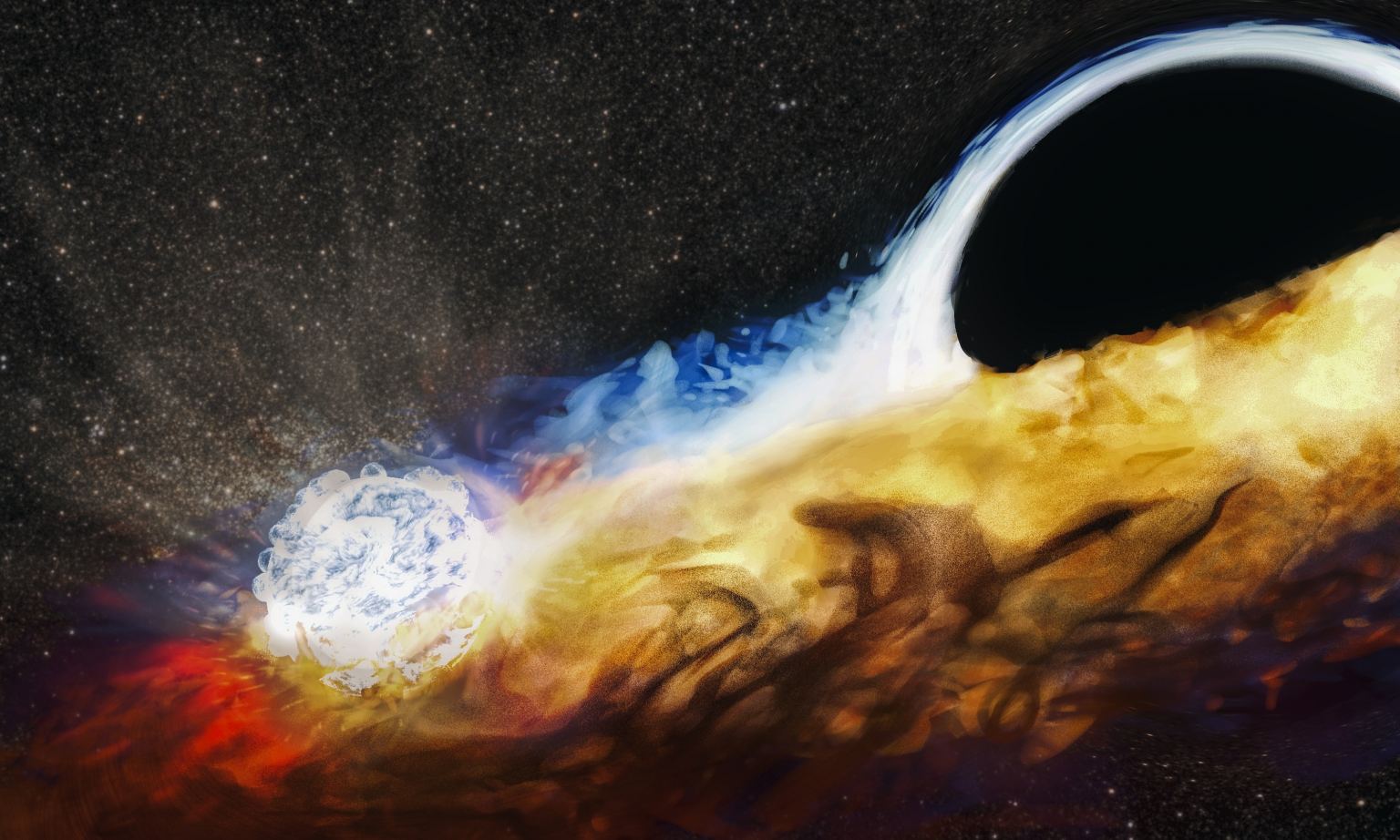
Known as quasi-periodic eruptions (QPEs), they are soft X-rays that emanate from the centers of galaxies every few hours or a few weeks. QPEs are rare, so they are difficult to study, and we aren’t sure what causes them. One idea is that they are caused by a large star or stellar black hole orbiting the supermassive black hole in such a way that its orbit intersects with the accretion disk of the supermassive black hole. Each time the smaller object passes through the disk, it triggers superheated plasma to release X-rays. We’ve seen a similar effect with blazars, for example.
Given the short periodicity of QPEs the companion object would need to orbit the black hole very closely, just on the edge of a stable orbit distance. And when it starts intersecting with accretion disk material, its orbit will decay on a short cosmic timescale. This would explain why QPEs are so rare. But to prove this model, astronomers would need to observe this happening in real time, which is what a team of astronomers has recently done. The results will be published in Nature later this month.

The story begins with an observation by the Zwicky Transient Facility back in 2019. The ZTF captured an optical flare that had all the markings of a tidal disruption event. It came to be known as TDE AT2019qiz. According to black hole models, when a star is ripped apart, much of the material forms an accretion disk around the black hole within a few years. This would make for perfect QPE conditions if there was a close companion object. So the team aimed the Chandra X-ray Observatory at AT2019qiz occasionally, hoping to capture a quasi-periodic eruption. Sure enough, in 2023, the team started to observe X-ray flashes erupting about every 48 hours. Observations from the Swift and AstroSAT telescopes further confirmed the result.
It isn’t known whether the companion is a star or small black hole, and the team would like to capture more QPEs occurring after known tidal disruption events, but this initial result is pretty clear.
Reference: Nicholl, M., et al. “Quasi-periodic X-ray eruptions years after a nearby tidal disruption event.” arXiv preprint arXiv:2409.02181 (2024).
Leave a Reply