
April 25, 2026 by Sam Jarman, Phys.org
Collected at: https://phys.org/news/2026-04-response-materials.html
For some time, researchers have assumed that solid materials could gain more useful properties by making their microscopic components more active. Now, a team led by Jack Binysh at the University of Amsterdam has found that this idea doesn’t always hold.
Writing in Physical Review X, the researchers show that in certain active materials, cranking up the activity of individual components can actually weaken the material’s overall response: an insight which could prove vital for future engineering of advanced materials.
Increased activity, more response?
Found in systems ranging from bacterial swarms to self-organizing polymers, active materials are composed of microscopic units that consume energy to generate their own motion or forces. These materials are especially interesting as they can readily exist far from their equilibrium states, allowing them to exhibit properties that can’t be found in conventional materials.
One striking example is “odd elasticity”: squeeze or shear an oddly elastic material in one direction, and rather than responding in the expected way, it pushes back at a perpendicular angle. These kinds of exotic properties allow active materials to crawl over rough terrain or perform mechanical work in cycles.
For researchers trying to engineer these behaviors, a question then emerges: can a stronger, more useful response be engineered at the scale of the whole material, simply by making individual components more active?
Metamaterial probe
To explore this idea, Binysh’s team built a robotic metamaterial from hexagonal cells connected by motorized hinges. The hinges were designed to be nonreciprocal: push a joint one way, and the motor drives neighboring parts in an asymmetric, directional response.
In their experiment, the researchers increased the strength of these motorized interactions and tracked what happened to the material’s overall mechanical behavior—specifically, whether the unusual perpendicular stress response grew stronger as expected.
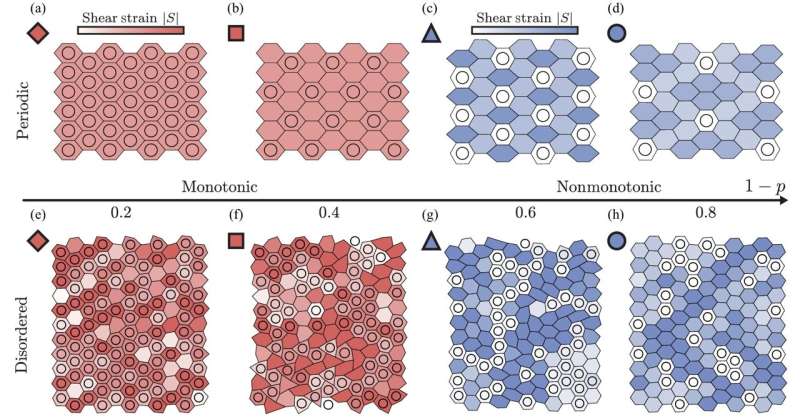
Surprisingly, it didn’t. Beyond a certain threshold, increasing the strength of the motorized interactions caused the large-scale odd response to diminish and eventually vanish.
Breakdown in connectivity
By combining their experiments with simulations and theoretical models, Binysh’s team traced this counterintuitive behavior to a concept borrowed from network theory, called “percolation.” Their models revealed that the unusual mechanical response only emerged when the active units formed a connected, system-spanning network.
When activity was too high, the active components effectively locked up and decoupled from one another, leaving their individual contributions trapped locally—rather than propagating across the material as a whole.
The results suggest that engineering useful properties in active materials isn’t simply a matter of turning up the activity: connectivity matters as much as the strength of activity itself.
Better active materials
By controlling the spatial arrangement of active units alongside their individual activity level, the team now hopes that researchers in future studies could be able to switch materials between a strong collective response and one where activity remains invisible at large scales.
In turn, this could open up new routes for designing programmable robotic materials, and for understanding the mechanics of biological systems such as tissues and cytoskeletal networks.
Publication details
Jack Binysh et al, More is Less in Unpercolated Active Solids, Physical Review X (2026). DOI: 10.1103/flhb-kjyd
Journal information: Physical Review X
Leave a Reply