
April 24, 2026 by Ingrid Fadelli, Phys.org
Collected at: https://techxplore.com/news/2026-04-artificial-retina-doesnt-aim-sight.html
The retina, the thin layer of tissue at the back of the eye, is made up of photoreceptor cells that convert visible light into electrical signals, which is essential for human vision. Some diseases, such as retinal degeneration, cause these photoreceptor cells to stop working, which results in blindness. Researchers at Yonsei University, the Institute for Basic Science (IBS) and other institutes in the Republic of Korea have recently developed a new artificial retina that could partly restore vision in people with damaged retinas.
The new device, introduced in a paper published in Nature Electronics, works by detecting near-infrared light and converting it into electrical signals, which stimulate another type of cells in the retina that are undamaged.
“Many people suffer from blindness due to retinal diseases that cause photoreceptor degeneration,” wrote Won Gi Chung, Inhea Jeong and their colleagues in their paper. “Electrical stimulation of retinal neurons can recreate the action potentials associated with seeing that are generated by these cells. We report a thin artificial retina that can be adhered to the epiretinal surface and can convert near-infrared (NIR) light into electrical stimuli that selectively stimulate ganglion cells.”
How the artificial retina works
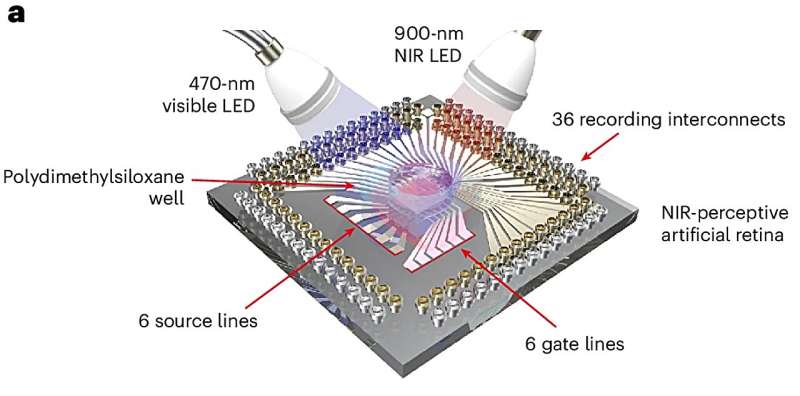
The artificial retina developed by this research team has two primary components: a phototransistor array and a set of liquid metal micropillar electrodes. The phototransistor array is a grid of tiny, light-sensitive devices that can detect near-infrared light (i.e., light that is just beyond visible wavelengths) and convert it into electrical signals.Schematic of the NIR-perceptive artificial retina with the NIR-transmission filter and phototransistor arrays. Credit: Nature Electronics (2026). DOI: 10.1038/s41928-026-01601-8
Liquid metal micropillar electrodes, on the other hand, are pillar-shaped structures made of a soft liquid metal that conducts electricity. These structures deliver the electrical signals produced by the phototransistors directly to cells in the retina that send visual information to the brain, known as retinal ganglion cells. In most cases of retinal degeneration, these cells are less affected than photoreceptor cells, thus they might still be able to transmit information to the brain.
“The artificial retina consists of a NIR-sensitive phototransistor array and three-dimensional liquid metal micropillar electrodes,” wrote the authors. “The liquid metal electrodes enhance proximity to retinal ganglion cells, providing effective charge injection while minimizing tissue damage, owing to their low Young’s modulus.”
The researchers tested their artificial retina by attaching it to tissue extracted from retinas and to the retinas of living blind mice. Their findings were very promising, as the device did not appear to have any obvious harmful effects on the tissue or the mice. Moreover, the blind mice’s behavior and brain activity suggested that the device had partly restored their ability to perceive light in their surroundings.
“Ex vivo studies demonstrate its biocompatibility, and in vivo studies using healthy and blind mice demonstrate perception of both visible and NIR light, as indicated by cortical recordings and behavioral tests,” wrote the team. “The retina could, in the future, be used to create a NIR visual channel in patients with photoreceptor degenerative blindness without interfering with their remaining natural vision.”
Initial results and future potential
The team’s findings are still preliminary, and further tests will be needed before their device can be tested in humans or used in clinical settings. If it is found to be safe and effective in humans, the new artificial retina could be truly ground-breaking, as it could open new possibilities for some blind individuals.
The human retina naturally relies on photoreceptor cells to convert visible light into electrical signals. The visual perceptions that would arise from artificially stimulating ganglion cells with signals derived from infrared light are still unknown.
The researchers’ artificial retina could thus not only restore lost vision, but it might also expand people’s sensory capabilities, unlocking a new “vision channel” to draw signals from infrared light.
Publication details
Won Gi Chung et al, An implantable epiretinal device for near-infrared light perception, Nature Electronics (2026). DOI: 10.1038/s41928-026-01601-8
Journal information: Nature Electronics
Leave a Reply