
April 21, 2026 by The Korea Advanced Institute of Science and Technology (KAIST)
Collected at: https://phys.org/news/2026-04-boost-strange-magnetic-rewrites-chips.html
A new technology has been proposed that could fundamentally solve the issue of smartphones overheating during high-spec gaming or extended video streaming. Researchers at KAIST have discovered the principle of processing signals using the minute vibrations of magnets (spin waves) instead of electrons. This method significantly reduces heat generation and power consumption while enabling instantaneous frequency switching within the several GHz range. This breakthrough is expected to pave the way for smart devices with less heat and longer battery life, as well as ultra-low-power, high-speed computing.
A research team led by Professor Kab-Jin Kim from the Department of Physics successfully achieved significant signal speed (frequency) changes at the nanoscale using spin waves—minute vibrations occurring within magnets. These vibrations are explained in units called “magnons.” This achievement is being evaluated for presenting a signal control method that can drastically reduce power consumption even at extremely small scales, which was difficult to implement using conventional electron-based methods. The paper is published in the journal Nature Communications.
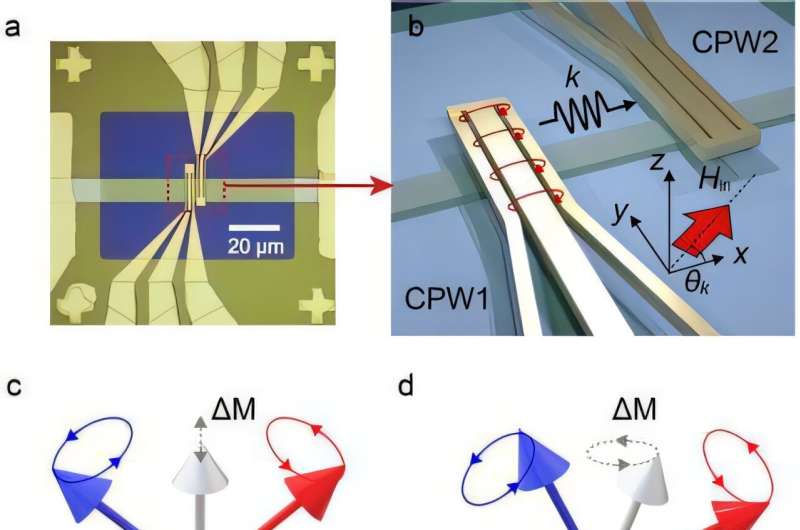
The material used by the research team is a Synthetic Antiferromagnet (SAF), created by stacking magnetic materials much thinner than a human hair in multiple layers. Within this structure, the spin waves manifest in two ways: acoustic mode and optic mode. The researchers were the first to identify a “mode hopping” phenomenon, where these movements suddenly switch under specific conditions.
Unlike conventional methods where signal states change continuously, this phenomenon involves a sudden shift to a completely different state at a specific moment, causing a sharp jump in frequency. This suggests a new way to control signal frequencies through the state changes of spin waves alone, without the need for complex circuits.
The core of this research is the ability to abruptly change the frequency by more than 5 GHz through this mode hopping. This effect is comparable to switching a radio channel completely with the single press of a button.
The team generated spin waves inside the magnet by sending electromagnetic signals through tiny antennas. Upon adjusting the strength of the external power and magnetic field, the vibration speed (frequency) did not change linearly but instead “jumped” suddenly. This change occurs during the “three-magnon interaction” process, where the fundamental unit of the spin wave, the magnon, either splits from one into two or merges back into one.
Notably, these rapid frequency changes are possible without complex electronic circuitry. By simply adjusting the signal intensity, the frequency can be changed freely, allowing for simpler device structures and significantly reduced power consumption.
Furthermore, this phenomenon can be used as a switch to distinguish between “on (1)” and “off (0),” making it applicable to new types of semiconductors and neuromorphic computing technology that mimics the human brain.
This research marks a significant step forward in the feasibility of “spin-wave-based information processing technology.” It is expected to be utilized in various fields, including ultra-low-power computing, high-speed signal processing, and spintronic devices—a next-generation semiconductor technology that utilizes spin (magnetic properties) instead of electrons.
Professor Kim stated, “This study is a case that proves we can implement and control the nonlinear dynamics of magnons—the principle of information processing using magnetic vibrations—in actual nano-devices, which had previously only been proposed in theory. It will serve as an important foundation for the development of a new information processing paradigm using spin waves instead of electrons.”
Publication details
Mujin You et al, Mode hopping via nonlinear magnon-magnon coupling in a synthetic antiferromagnet, Nature Communications (2026). DOI: 10.1038/s41467-026-70298-2
Journal information: Nature Communications
Leave a Reply