
April 21, 2026 by Daegu Gyeongbuk Institute of Science and Technology (DGIST)
Collected at: https://techxplore.com/news/2026-04-batteries-wearable-semiconductor-fabric-health.html
A research team led by Prof. Kim Bong-hoon from the Department of Robotics and Mechatronics Engineering at the Daegu Gyeongbuk Institute of Science and Technology has developed a semiconductor fiber-based wearable sweat sensor that can collect sweat automatically and analyze various biosignals simultaneously without an external power source. They have reported their achievement in Small Structures.
Sweat is a useful indicator for real-time health monitoring because it contains various biological information, such as electrolytes and metabolites. However, conventional wearable sweat sensors use microchannel (minute tube) structures or forcefully induce sweating through external stimuli, resulting in unstable skin contact and difficulty reliably collecting the required amounts of sweat.
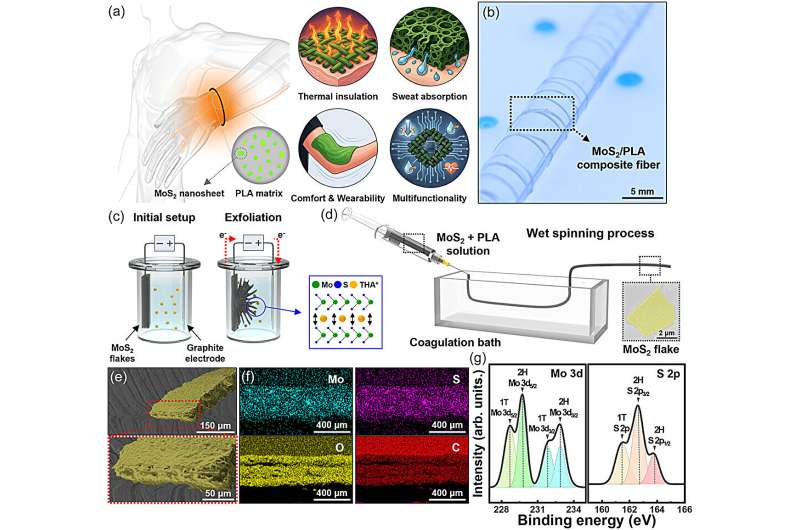
To overcome these limitations, Prof. Kim’s research team developed a special composite fiber by combining molybdenum disulfide (MoS2), a two-dimensional nanomaterial, with a polymer material (polylactic acid). This fiber has a porous structure with many microscopic pores inside, allowing it to naturally absorb sweat via capillary action—similar to how plant roots draw up water—without the need for a separate pump or power source. It can then deliver the sweat to the sensor. Furthermore, the fibers insulating effects prevent heat loss between the skin and sensor, ensuring that even tiny amounts of sweat remain undried and can be analyzed.
The newly developed sensor has a multimodal sensing function, which enables it to detect sweat components and bodily movements simultaneously using a single thread (single fiber). The sensor can easily distinguish various health indicators without complex calculations by utilizing the contrasting electrical responses triggered when electrolytes (increased conductivity) and metabolites (decreased conductivity) come into contact.
Furthermore, experiments have proven that the sensor detects body movements by incorporating the property whereby electrical characteristics change depending on pressure and operates reliably even with extremely small amounts of sweat—as little as a few microliters (μL: one-millionth of a liter).
“The core of this research lies in the fact that the fabric is designed to collect and analyze sweat simultaneously,” said Prof. Kim. “We expect the applications of this technology to expand not only to personalized health care and sports monitoring, but also to platforms that track patients’ physiological conditions in real time and diagnose diseases early.”
More information
Jun Hyun Park et al, Multifunctional Sweat Sensors Using Semiconductor Fibers Based on Two‐Dimensional Nanomaterials, Small Structures (2026). DOI: 10.1002/sstr.202500905
Leave a Reply