
By Light Publishing Center, Changchun Institute of Optics, Fine Mechanics And Physics, CAS April 17, 2026
Collected at: https://scitechdaily.com/quantum-breakthrough-unhackable-keys-sent-over-120-km-using-quantum-dots/
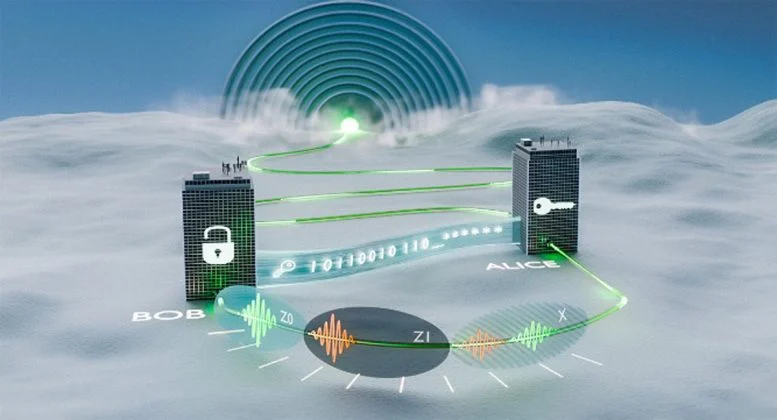
Quantum dot–based time-bin QKD achieves stable, long-distance secure communication with practical performance.
Quantum key distribution is the most advanced area of quantum cryptography and offers fundamentally secure communication for the future quantum internet. Solid-state light sources such as semiconductor quantum dots (SQDs) have drawn significant attention because they can generate high-quality non-classical photons for quantum communication. These sources can support higher key generation rates and may enable the use of quantum repeaters.
Another promising approach involves encoding information in the timing of photonic qubits, known as time-bin encoding, which is well-suited for long-distance communication. Time-bin qubits are especially resilient to environmental disturbances that typically disrupt optical fiber networks.
In research published in Light: Science & Applications, an international team from German and Chinese institutions reports the first true demonstration of time-bin quantum key distribution using an on-demand telecom semiconductor quantum dot device.
High-Speed Quantum Dot System Achieves Record Key Rates Over 120 km
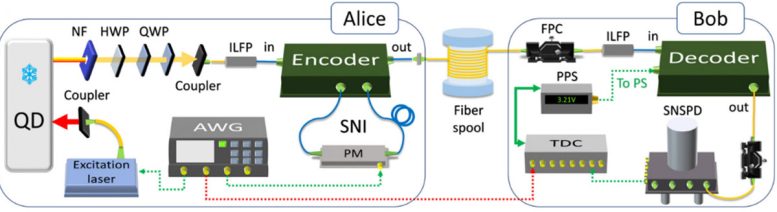
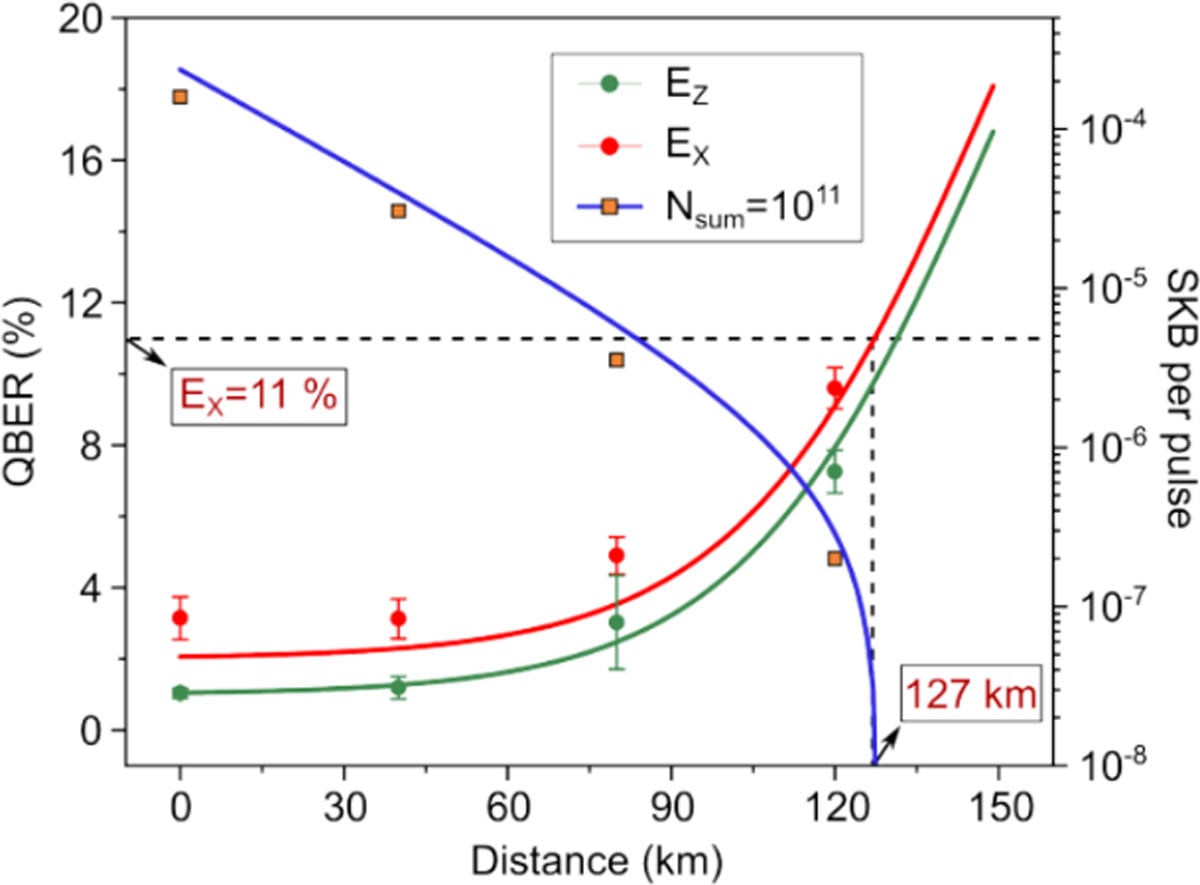
The researchers generated three distinct time-bin qubit states both deterministically and randomly using a self-stabilized encoder that converts polarized single photons from a telecom C-band quantum dot. At the receiving end, the qubits are decoded with an actively stabilized interferometer that includes a phase shifter, allowing continuous operation without manual adjustments. The system successfully transmitted signals over distances greater than 120 km (about 75 miles) through optical fiber while maintaining stable performance for more than 6 hours.
This proof of concept achieved the highest secure key rate reported for time-bin QKD systems using a high-performance quantum dot source. The device produces bright, high-purity single photons at an operating rate of about 76 MHz. Even after transmission across 120 km (about 75 miles) of standard optical fiber, the system keeps the average quantum bit error rate below 11%. Under realistic finite key conditions, it delivers an average secure key rate of approximately 15 bits per second, which is sufficient for practical uses such as encrypting text messages.
Stability, Performance, and Real-World Quantum Communication Impact
The researchers emphasize the significance of these results: “Telecom-band QDs with Purcell enhancement can provide high-brightness photons suitable for intercity fiber communication, making them promising candidates for integration into practical QKD systems.”
“Most existing QD-based QKD systems are vulnerable to changes in the practical quantum channel caused by environmental factors, such as turbulence, temperature, and vibrations. This necessitates active compensation. In contrast, time-bin encoding, where qubits are encoded in the temporal position of single photons, offers intrinsic stability against such channel fluctuations even without any complex compensation protocols.”
They continue, “The system is operated continuously for 6 hours, highlighting the intrinsic robustness of the time-bin scheme enabled by the system, including the Sagnac interferometer (SNI), active feedback control, etc.”
“This result underscores the feasibility of integrating QD single-photon sources into stable and field-deployable time-bin QKD systems, marking an important step toward scalable, quantum-secure communication networks based on solid-state single-photon emitters.”
Reference: “Time-bin encoded quantum key distribution over 120 km with a telecom quantum dot source” by Jipeng Wang, Joscha Hanel, Zenghui Jiang, Raphael Joos, Michael Jetter, Eddy Patrick Rugeramigabo, Simone Luca Portalupi, Peter Michler, Xiao-Yu Cao, Hua-Lei Yin, Lei Shan, Jingzhong Yang, Michael Zopf and Fei Ding, 25 February 2026, Light: Science & Applications.
DOI: 10.1038/s41377-026-02205-9
This study was funded by the German Federal Ministry of Education and Research (BMBF) within the project QR.X, German Federal Ministry of Education and Research (BMBF) within the project QR.N, German Federal Ministry of Education and Research (BMBF) within the project SQuaD, German Federal Ministry of Education and Research (BMBF) within the project SemIQON, European Research Council, QuantERA II Programme, German Federal Ministry of Education and Research (BMBF), Deutsche Forschungsgemeinschaft (DFG, German Research Foundation), InterSync, and Germany’s Excellence Strategy (EXC-2123) Quantum Frontiers.
Leave a Reply