
April 18, 2026 by Ingrid Fadelli, Phys.org
Collected at: https://phys.org/news/2026-04-link-metallicity-superconductivity-uncovered-trilayer.html
Superconductivity is a state of matter characterized by an electrical resistance of zero, typically at very low temperatures. Past studies have found that in various materials, this unique state is accompanied by unusual electron arrangements.
In some superconductors, for instance, electrons spontaneously align in a preferred direction, breaking a property known as rotational symmetry. This directional arrangement of electrons is also known as electronic nematicity.
Moreover, some superconductors also exhibit a strange metallicity. This is a phase characterized by unusual changes in a material’s electrical resistance, which cannot be explained by standard physical theories.
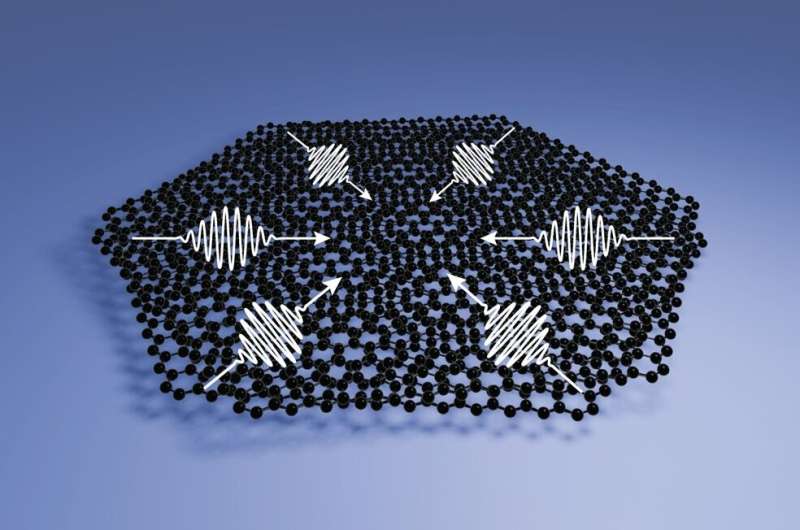
Researchers at Brown University, Harvard University and the National Institute for Materials Science in Japan recently carried out a study aimed at investigating the interplay between superconductivity, nematicity and strange metallicity in magic-angle twisted layer graphene. Their findings, published in Nature Physics, offer new interesting insight into the fundamental mechanisms underpinning the unconventional superconductivity observed in this three-layered material.
“Our recent paper grew out of a long-standing question in the field of unconventional superconductivity: how the emergence of superconductivity influences the angular symmetry of electronic transport,” J.I.A. Li, senior author of the paper, told Phys.org. “In our work, we focused on a material known as magic-angle twisted trilayer graphene, where electrons interact very strongly and form a wide range of unusual quantum states. The central theme of this study is transport anisotropy, which describes how electrical current behaves differently depending on the direction in which it flows.”
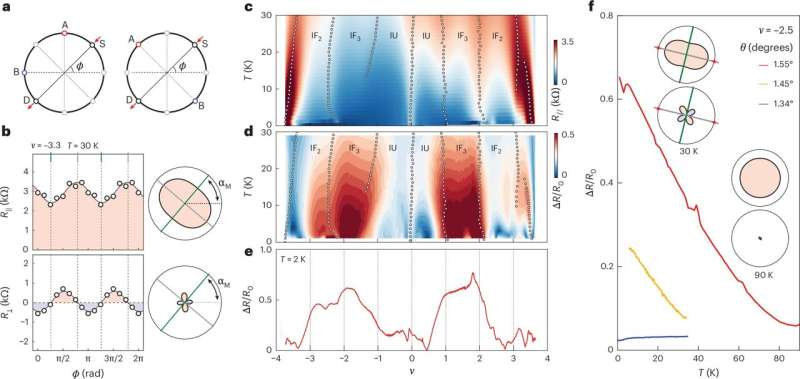
Transport anisotropy in the metallic state. Credit: Nature Physics (2026). DOI: 10.1038/s41567-026-03202-w
Probing the interplay between metallicity and superconductivity
Magic-angle twisted trilayer graphene is a material that consists of three layers of graphene stacked on top of each other at a specific angle. Li and his colleagues set out to explore how the directional properties of the metallic phase of this material that emerge just before its transition into a superconducting state, are linked to the superconducting phase that emerges at lower temperatures.
“Historically, scientists have understood that the angular symmetry of superconductivity contains important clues about its underlying mechanism,” said Li. “However, interpreting that symmetry has been challenging because the normal metallic state above the superconducting transition is often already anisotropic. This raises a fundamental question: does the anisotropy of the metallic phase influence the superconducting phase that emerges from it? This question was the primary inspiration for our work.”
Before this study, the link between the directional properties of the metallic phase and those of the superconducting phase of materials remained widely unexplored. The researchers wanted to develop a new experimental framework that would allow them to track how a material’s directional electronic properties evolve continuously from the metallic state into the superconducting state.
“By doing so, we discovered a striking relationship: the direction in which superconductivity is strongest is directly linked to the anisotropy already present in the metallic phase,” said Li. “This finding provides new insight into how superconductivity forms in strongly interacting electronic systems and opens a new pathway for probing the nature of unconventional superconductivity.”
Li and his colleagues carried out a new type of quantum experiment that allowed them to measure how electrons flowed through a twisted trilayer graphene sample, while systematically changing the direction of the current flowing through it. Rather than measuring the material’s electrical resistance along a single direction, which most previous experiments did, they rotated the direction in which current flows, recording changes in the material’s resistance.
“This allowed us to map out the angular symmetry of the electronic response with high precision,” explained Li. “Using this approach, we examined how electrical transport behaves in three closely related regimes: the metallic phase above the superconducting transition, the superconducting phase at low temperatures, and a so-called strange metallic phase that shows unusual temperature dependence. This directional measurement technique enabled us to directly compare how the electronic properties evolve as the system transitions between these phases.”
The researchers’ measurements led to the discovery of a surprising relationship between the metallic and superconducting states in magic-angle twisted trilayer graphene. Specifically, the team observed that the most robust superconductivity occurs along the direction in which the metallic phase is the most resistive.
“In other words, the direction that looks least favorable for current flow in the metallic state turns out to be the most favorable direction for superconductivity to form,” said Li.
“This directional relationship provided a powerful clue that these different phases—nematicity (directional electronic order), strange metallicity, and superconductivity—are not independent phenomena, but they are instead deeply connected. By developing and applying this angle-resolved transport method, we were able to reveal how these phases are intertwined in a way that had not been directly observed before.”
A new experimental approach
The novel experimental methods introduced by the researchers have proved to be highly promising for exploring quantum phenomena in two-dimensional (2D) materials. In the future, the same approach could be used to study superconductivity, nematicity, metallicity and other phenomena in other materials.
“By developing angle-resolved transport measurements that track how electronic behavior changes with direction, we created a tool that allows researchers to directly probe the angular symmetry of complex quantum states,” said Li. “This approach provides a new way to study how different electronic phases are connected to one another, rather than examining them in isolation.”
The approach introduced by Li and his colleagues could be particularly promising for the study of unconventional superconductivity. This is a type of superconductivity that does not follow the standard mechanisms observed in ordinary superconductors.
“The nature of unconventional superconductivity remains one of the major open questions in condensed-matter physics,” said Li. “Our results show that angular symmetry is a powerful constraint—by carefully tracking how electronic properties depend on direction, we can narrow down the range of possible theoretical explanations for how superconductivity emerges.”
Future research directions
The experimental methods developed by the researchers could soon be used to study a broad range of other materials, including moiré systems and high-temperature superconductors. These are strongly interacting quantum materials that also exhibit directional electronic behavior.
“Using angular symmetry as a guiding principle, researchers may be able to uncover new connections between electronic phases and gain deeper insight into the mechanisms that drive superconductivity and other correlated quantum phenomena,” said Li.
“Going forward, we plan to apply this angular measurement technique to study other superconducting phases in a wide range of graphene multilayer structures. These materials host many distinct types of superconductivity, and each provides a new opportunity to test how directional electronic behavior reflects the underlying quantum state.”
In the future, Li and his colleagues hope to gain an even deeper understanding of unconventional superconductors. In particular, they would like to shed new light onto how parameters describing how electrons pair together in unconventional superconductors are reflected in angle-resolved transport measurements.
“By systematically comparing different multilayer graphene systems, we hope to identify universal patterns that link the symmetry of superconductivity to measurable transport signatures,” added Li.
“More broadly, we envision this angular approach becoming a general tool for exploring complex quantum materials. As new superconducting phases continue to be discovered in graphene-based systems, applying this method may help reveal hidden connections between symmetry, electronic interactions, and the mechanisms that give rise to superconductivity.”
Publication details
Naiyuan J. Zhang et al, Angular interplay of nematicity, superconductivity and strange metallicity in magic-angle twisted trilayer graphene, Nature Physics (2026). DOI: 10.1038/s41567-026-03202-w. On arXiv: DOI: 10.48550/arxiv.2503.15767
Journal information: Nature Physics , arXiv
Leave a Reply