
April 14, 2026 by Sam Jarman, Phys.org
Collected at: https://phys.org/news/2026-04-droplet-impacts-reveal-physics-thickening.html
From ketchup to quicksand, non-Newtonian fluids have long fascinated and puzzled scientists. Unlike ordinary fluids, their flow properties change depending on how much force is applied, but the precise mechanics governing this behavior remain poorly understood—particularly under rapid deformation. Now, a team led by Xiang Cheng at the University of Minnesota has used droplet impacts to probe these dynamics in new detail, uncovering behaviors which have eluded physicists so far. Their findings appear in Physical Review Letters.
Force-dependent viscosity
While ordinary Newtonian fluids maintain a constant viscosity regardless of the forces acting on them, non-Newtonian fluids behave very differently: with viscosities that can increase or decrease in response to stress. One classic example is a “shear-thickening” fluid, which can be made simply by mixing cornstarch into water. At high enough concentrations, these suspensions can jam almost completely solid under sudden impacts, even allowing a person to run across them without sinking.
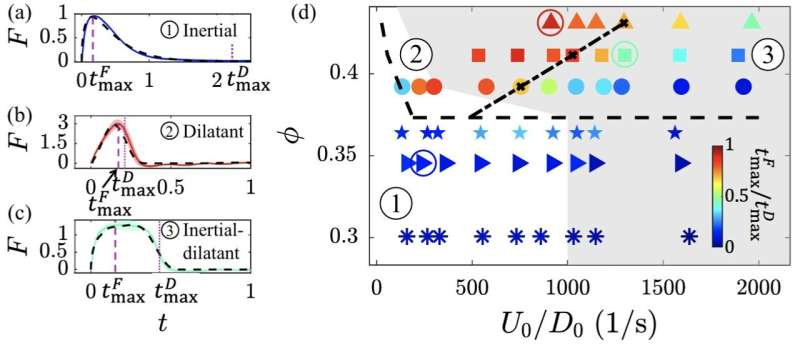
Chen’s team reveal three distinct regimes for shear-thickening when non-Newtonian droplets impact a surface. Credit: Anahita Mobaseri et al.
In their study, Cheng’s team prepared cornstarch-water suspensions ranging from 30% to 43% cornstarch by volume, spanning regimes from mild to dramatic shear thickening. They then dropped millimeter-scale droplets of the fluids onto a metal plate at high speeds, producing particularly extreme shear thickening.
Using a high-speed camera, the team then captured the spreading dynamics of each droplet following its impact. Simultaneously, they measured the force imparted on the plate during each impact—which becomes higher for impacts with solids than with liquids traveling at the same speed. Together, these measurements revealed dynamic features which had been invisible to previous studies.
Differing impacts
Altogether, Cheng’s team identified three distinct impact regimes. At lower cornstarch concentrations, droplets behaved like ordinary liquids, with impact dynamics driven purely by inertia. At higher concentrations and lower impact velocities, the droplets behaved more like solid spheres, consistent with the expected shear-jamming response.
The surprise came in a third regime: at high concentrations and high impact velocities, where shear rates were greatest, the droplets initially responded like a liquid—only transitioning to solid-like behavior later, as the shear rate dropped during spreading. This reversal ran against previous assumptions that stronger shear thickening produces a more solid-like response at higher shear rates.
To make sense of all three regimes, Cheng’s team developed a unified model combining classical drop-impact theory with a mechanism describing how shear-induced dilation drives fluid out of the porous cornstarch network.
With this theoretical framework in place, the work could now offer a more complete picture of how shear-thickening fluids respond to ultrafast deformation. This could have implications for a diverse array of applications where materials experience sudden, high-speed forces: from body armor to soft robotics.
Publication details
Anahita Mobaseri et al, Inertia-Dilatancy Interplay Governs Shear Thickening Drop Impact, Physical Review Letters (2026). DOI: 10.1103/fyx7-jb1d. On arXiv: DOI: 10.48550/arxiv.2601.12642
Journal information: Physical Review Letters , arXiv
Leave a Reply