
April 14, 2026 by Escuela Superior Politecnica del Litoral
Collected at: https://techxplore.com/news/2026-04-concrete-shrimp-sustainable.html
Cement production is responsible for around 8% of global carbon dioxide emissions, primarily due to the production of Portland cement. In response to this environmental challenge, geopolymers—materials obtained through the alkaline activation of natural aluminosilicates—have emerged as a sustainable alternative with a lower carbon footprint and comparable mechanical properties in non-structural applications.
In this context, researchers at the Escuela Superior Politécnica del Litoral (ESPOL), in collaboration with the University of Buenos Aires (UBA), developed a new composite material made from Ecuadorian natural zeolite reinforced with chitosan, a biopolymer extracted from shrimp shell waste.
The paper is published in the journal Construction and Building Materials.
From marine waste to smart materials
Chitosan is a natural polymer derived from chitin, widely recognized for its biodegradability and antibacterial properties. In this study, the biopolymer was obtained through a controlled chemical process using waste from the shrimp industry, thereby directly contributing to the utilization of agro-industrial byproducts.
The researchers incorporated very low concentrations of chitosan (between 0.075% and 0.20% by weight) into geopolymer matrices made from zeolite sourced from the coastal region of Ecuador. They then evaluated the structural, thermal, microstructural, and microbiological properties of the resulting materials.
Durable and protective materials
The results showed that the addition of chitosan increased compressive strength by up to 67%, rising from 2.10 MPa in the base material to maximum values of nearly 3.51 MPa in the optimized formulations. Although these strengths do not match those of conventional structural concrete, they are suitable for applications such as panels, cladding, tiles, and non-load-bearing architectural elements.
From a health perspective, the reinforced geopolymers exhibited significant antibacterial activity against Klebsiella aerogenes and Staphylococcus aureus, two of the bacteria most associated with hospital-acquired infections and surface contamination in urban and industrial environments.
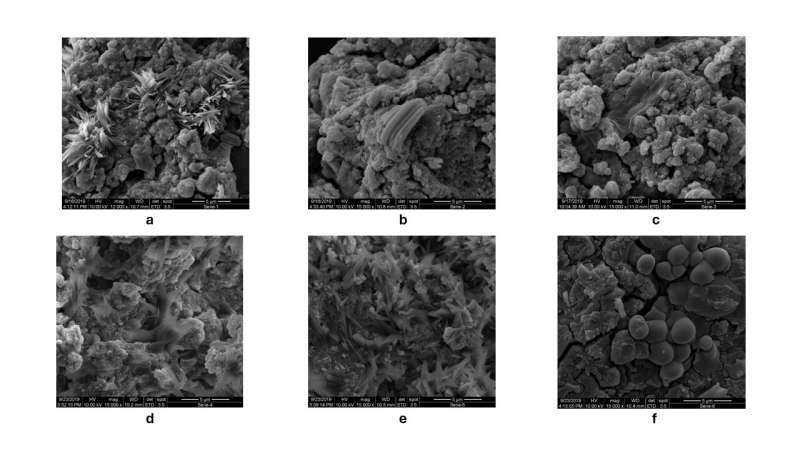
Microscopic analyses revealed that chitosan modifies the internal microstructure of the material, promoting the cohesion of the inorganic matrix when used in moderate amounts. However, excessive concentration can lead to agglomerations that partially reduce mechanical efficiency, which allowed for the identification of an optimal formulation range.
The circular economy applied to civil engineering
This work represents a convergence of materials engineering, waste recovery, and environmental sustainability. The use of locally sourced natural zeolites reduces dependence on imported raw materials, while the utilization of shrimp waste reduces the environmental impact of the fishing industry.
Furthermore, the development of materials with intrinsic antibacterial properties opens new opportunities for high-touch surfaces in hospitals, schools, commercial kitchens, and public spaces, where reducing the microbial load is critical.
Sustainable construction with an Ecuadorian identity
The authors emphasize that this technology can be easily adapted to Latin American contexts due to the abundance of natural resources used and the relatively simple manufacturing processes. In the long term, these functional geopolymers could be integrated into national sustainable construction strategies, contributing both to climate change mitigation and to improvements in public health.
This breakthrough positions Ecuadorian research at the forefront of the development of smart, sustainable, and functional materials for the construction of the future.
More information
Veronica Salas-Gomez et al, Evaluation of mechanical and antibacterial properties of chitosan-reinforced zeolite-based geopolymers, Construction and Building Materials (2025). DOI: 10.1016/j.conbuildmat.2025.144368
Leave a Reply