
April 10, 2026 by Cody Mello-Klein, Northeastern University
Collected at: https://phys.org/news/2026-04-highway-widening-cities-faster-curb.html
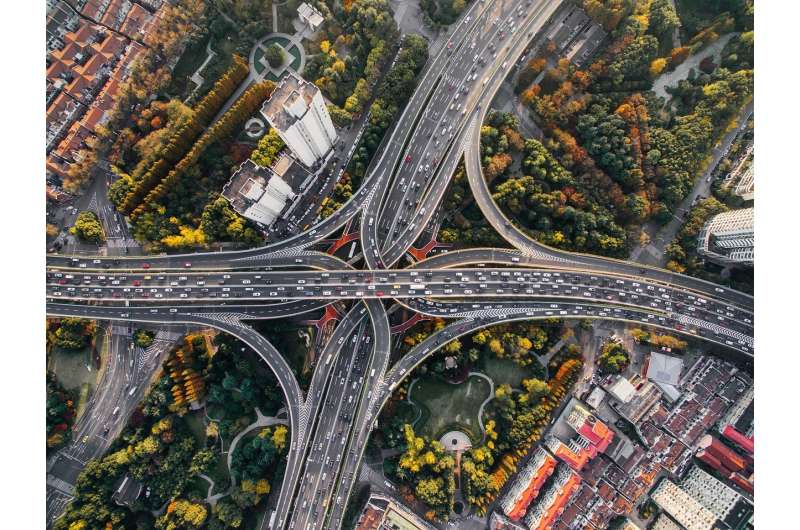
U.S. cities are rapidly becoming urban heat islands, where these cities are significantly warmer than their surrounding area. Vast expanses of asphalt and concrete trap heat, while large, densely packed buildings disrupt wind flow and intensify the effect. But beyond parking lots and skyscrapers, recent research points to highways as another cause behind America’s urban heat islands.
By studying satellite-based temperature data before and after 11 major highway expansion projects in the San Francisco Bay Area, researchers found all the projects had “significant and measurable” impacts on the urban heat island effect, said Serena Alexander, an associate professor of public policy, urban affairs and civil and environmental engineering at Northeastern University. The paper is published in the journal Cities.
These highway projects, which involved everything from adding lanes to installing guardrails, accounted for 70–88% of the intensifying heat disparity researchers found through their analysis.
“I’m not trying to argue we shouldn’t build highways,” Alexander said. “We have to be aware of these impacts and where we can mitigate [them].”
In the U.S., building highways has traditionally been viewed as a way to alleviate traffic and connect communities. The latter justification is true, but the former has more recently come under fire as civil engineers have come to see traffic return to pre-construction levels as more drivers take to the road, Alexander explained.
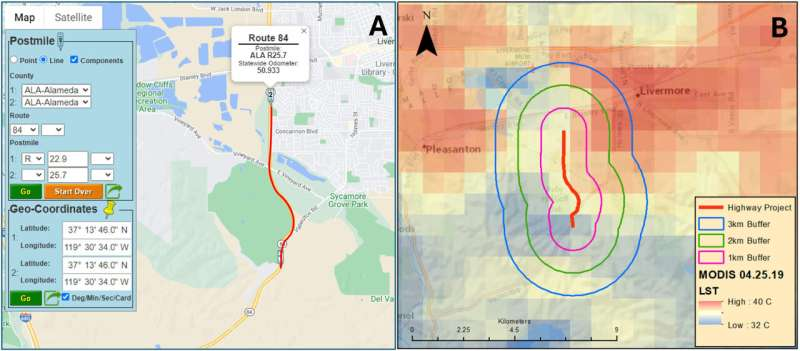
A) Highway expansion tools identifier for geographical location B). MODIS data collection for 1 km, 2 km, and 3 km buffers for highway expansion project site 0400020580 and 0400021248 in Alameda County. Credit: Cities (2026). DOI: 10.1016/j.cities.2025.106555
Highway construction nonetheless remains a leading form of infrastructure investment in the U.S. As of January 2026, there were nearly 115,000 new highway projects underway in the U.S., accounting for $257 billion in federal funds, according to the American Road and Transportation Builders Association.
This research focused on California for a specific reason: The state has experienced major highway expansion as the population has boomed over the last decade. Between 2018 and 2023 alone, the California Department of Transportation added 550 lane miles, enough to stretch from Mexico to Oregon, according to state data.
But the 11 projects Alexander and her team studied, which spanned 2013 to 2020, are not unique to California.
“It is very likely that in other areas, if you look at similar projects over time with a similar model, you would see that highways are intensifying the urban heat island effect,” Alexander said.
So, what can be done to mitigate the impact that highway construction is having on urban heat islands?
Bringing plant life back into urban areas and establishing green buffers along highways with grass, shrubs and shade-providing trees, is one solution, Alexander explained. But there are also ways to make highways themselves more heat resistant.
Cool pavements, which can be made using modified asphalt and concrete but also newer methods like special coatings, are capable of reflecting solar energy to keep roads cooler. An Environmental Protection Agency pilot study conducted in Arizona found that conventional asphalt can reach highs of 152 degrees Fahrenheit by mid-day. Cool pavements, however, made road surfaces between 10 and 16 degrees Fahrenheit cooler.
For Alexander and her team, the most important path forward goes beyond materials and greenery and cuts straight to the very policies informing highway construction in the first place.
There are federal and state policies in place that govern the environmental quality of highway projects, most notably the National Environmental Policy Act (NEPA), which established a national framework for environmental planning around infrastructure projects. But much of this legislation is decades old.
NEPA and its California equivalent, the California Environmental Quality Act, were both adopted in 1970 and are still the most significant legislative attempts to regulate where and how highways are built.
“These tools were prepared at a time when we were just guessing what the environmental impacts of these projects could be,” Alexander said.
“Now, we can actually go out and measure and look at the satellite data and see what happened. Now that we can do that, can we or should we go back and update our environmental review processes, both at the federal level and state level? That would be ideal.”
More information
Bo Yang et al, Quantifying highway expansion impact on urban heat island effect in San Francisco bay area, Cities (2026). DOI: 10.1016/j.cities.2025.106555
Leave a Reply