
April 6, 2026 by Cedars-Sinai Medical Center
Collected at: https://medicalxpress.com/news/2026-04-aed-algorithm-lifesaving-devices.html
Cedars-Sinai Health Sciences University investigators and colleagues created an algorithm designed to use data on sudden cardiac arrests to determine the best public locations for lifesaving devices called automated external defibrillators. Their findings were published in IJC Heart & Vasculature.
Known as AEDs, the portable devices deliver an electrical shock, with the aim of restarting the heart when it stops beating due to sudden cardiac arrest. Sudden cardiac arrest is common and usually fatal when it happens somewhere other than a hospital.
“Research shows that the sooner a bystander can locate and use an AED, the higher the likelihood that the person experiencing sudden cardiac arrest survives,” said Sumeet Chugh, MD, vice dean and chief AI Health Research Officer at Cedars-Sinai, and senior author of the paper.
The investigators reviewed data on incidents of sudden cardiac arrest in Ventura County, California, and Multnomah County, Oregon, that took place between 2012 and 2023. The algorithm they created identified clusters of three or more incidents that occurred within a 100-meter radius of each other, and proposed AED locations within 200 meters of where these clusters occurred.
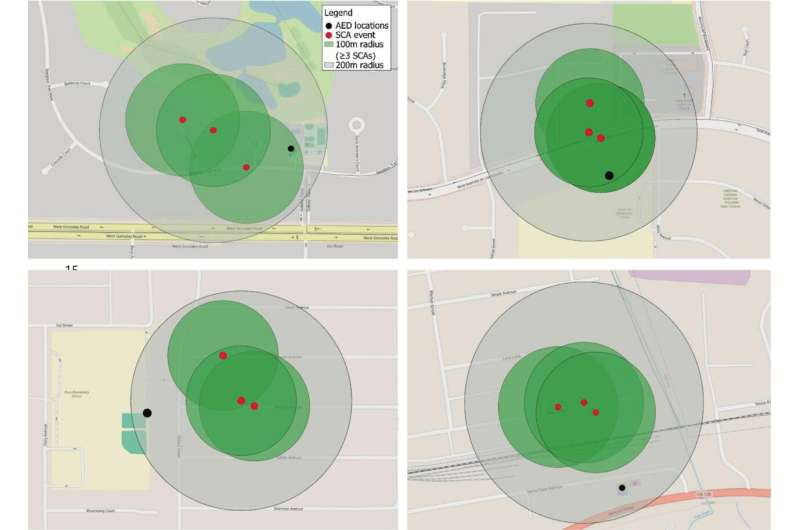
Examples of clusters of ≥ three SCA events within a 100-meter radius created on QGIS Desktop 3.23.3. Proposed AED locations were placed within 200 m of each SCA event. Credit: IJC Heart & Vasculature (2026). DOI: 10.1016/j.ijcha.2026.101889
Future studies will be needed to determine whether the algorithm is an improvement over current AED location strategies, the investigators said.
“These community-based studies are a huge team effort that involves ongoing collaborations with colleagues in emergency medical services and the fire department,” said Chugh, who is also director of the Center for Cardiac Arrest Prevention in the Smidt Heart Institute.
“We hope researchers use this algorithm to study how the placement of AEDs reduces deaths from sudden cardiac arrest.”
More information
Elizabeth Heckard et al, Strategic automated external defibrillator deployment based on geospatial analysis of historical cardiac arrest locations, IJC Heart & Vasculature (2026). DOI: 10.1016/j.ijcha.2026.101889
Leave a Reply