

March 31, 2026 by Sean Barton, University of Sheffield
Collected at: https://techxplore.com/news/2026-03-solar-energy-key-sustainable-aviation.html
A new way of making sustainable aviation fuel that could cut the reliance on used cooking oil as a feedstock has been developed by a team of engineers led by the University of Sheffield. The new technique captures CO2 from the air, combines it with hydrogen, and then heats it using concentrated solar energy to produce the fuel. For their study published in the journal Nature Communications, the researchers used comprehensive computer modeling and simulation to understand how and where this first-of-a-kind technology could function at an industrial scale.
Where the new fuel could scale
Their analysis suggests that five countries across different continents could be suitable for such large-scale SAF production plants due to their high levels of sunlight and low costs of hydrogen or land. These are: the U.S. (North America), Chile (South America), Spain (Europe), South Africa (Africa), and China (Asia).
The research follows recent statistics from the UK’s SAF mandate, which show the majority of SAF in the U.K. is made from used cooking oil.
Why new feedstocks are needed
Professor Meihong Wang, Professor of Energy Systems at the University of Sheffield, who led the research, said, “Decarbonizing the aviation industry is key to slowing global warming and achieving net zero. SAF has emerged as a promising solution to meet energy needs while reducing greenhouse gas emissions, as it works in existing engines, potentially allowing for sustainable air travel without major mechanical changes to airplanes. However, a major challenge in switching to SAF is ensuring that we have enough feedstock to produce the huge amount of fuel that the industry needs and also making the fuel in a way that doesn’t require fossil fuels.
“The process we have proposed has the potential to address key challenges in scaling up SAF. It’s a renewable energy-powered way of capturing CO2 from the air and making SAF that is cost-effective and can be scaled to industrial levels. It also reduces electricity consumption in the production process and can fit within a circular economy.”
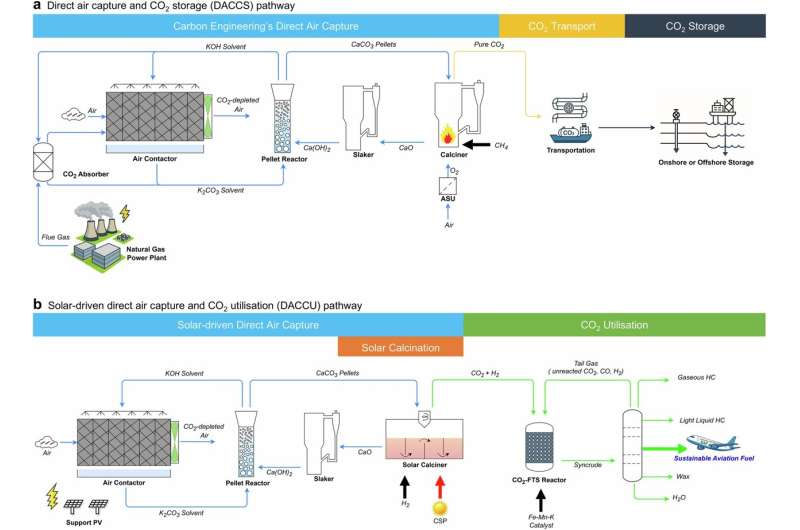
Schematic representation of DAC for CO2 storage or utilization pathways. Credit: Nature Communications (2026). DOI: 10.1038/s41467-025-67977-x
How the solar-driven process works
The solar-driven SAF technique was developed in collaboration with researchers from the East China University of Science and Technology. It improves on an existing proposed way of making SAF called Direct Air Capture and CO2 Utilization (DACCU), which is currently in the research and development phase.
This existing DACCU method captures CO2 from the air and combines it with hydrogen, similar to the proposal led by Sheffield; however, it heats the chemicals using a fossil fuel—natural gas—a process which the Sheffield-led team says would prevent SAF from being a truly sustainable fuel.
The researchers from Sheffield and China have shown in their study that replacing the fossil fuel with concentrated solar energy is capable of providing the intense heat needed to create the chemical reactions to produce SAF. It could also cost less than existing DACCU pathways—projections estimate US$4.62 per kg compared to US$ 5.6 per kg.
The reactor at the heart of it
Professor Wang added, “The innovation lies in a hydrogen-fluidized calciner. This is a specialized reactor that uses a field of mirrors to focus sunlight, eliminating the need for onsite fossil fuel combustion. By using hydrogen to circulate the carbon particles, the system also streamlines production as it serves as the medium to circulate the carbon particles while simultaneously providing the essential feedstock for fuel synthesis.
“This dual-purpose design allows us to bypass traditional, complex steps like syngas production and CO2 purification, resulting in a much more streamlined and cost-effective production cycle. By converting atmospheric carbon into SAF directly onsite, we transform CO2 from a waste product into a valuable resource, fostering a circular economy that eliminates the need for the expensive pipeline networks and geological reservoirs required by traditional carbon capture and storage.”
Publication details
Yide Han et al, Solar-driven direct air capture to produce sustainable aviation fuel, Nature Communications (2026). DOI: 10.1038/s41467-025-67977-x
Journal information: Nature Communications
Leave a Reply