
March 31, 2026 by Torsten Fischer, Helmholtz Association of German Research Centres
Collected at: https://techxplore.com/news/2026-03-hydrogen-coolant-gas-metal-hydride.html
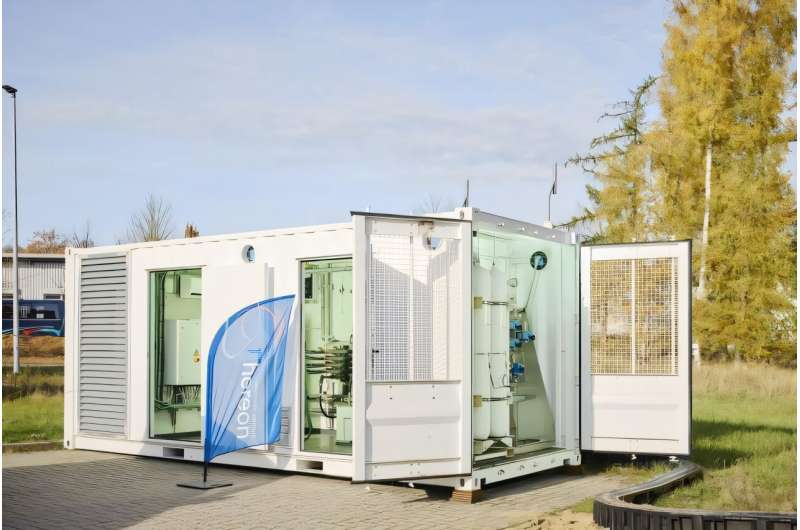
A joint research team from the Helmut Schmidt University/ University of the Bundeswehr in Hamburg and the Helmholtz Zentrum Hereon has developed and presented an innovative metal hydride compressor system. For the first time, hydrogen takes on a dual function: it serves not only as the medium to be compressed but also simultaneously as a heat transfer agent. The results were recently published in the journal Communications Engineering and have been patented in advance.
At the center of the work is a so-called metal hydride compressor. These systems are considered a promising alternative to mechanical compressors because they are operated primarily with heat rather than electrical energy. Until now, however, their performance has been limited by the slow heat transport within the metal hydride material.
The new concept overcomes this limitation by circulating hydrogen in a closed loop through the metal hydride, directly transferring heat in the process. A cold loop supports hydrogen absorption in the metal hydride, while a hot loop enables its release.
“We use hydrogen not only as the working medium but also simultaneously as an effective heat transfer agent. This allows us to bypass previously limiting heat conduction processes and avoid complex internal heat exchanger structures,” explains Lukas Fleming, first author of the study and researcher at the Hereon Institute of Hydrogen Technology as well as at the Helmut Schmidt University.
“In this way, productivity and efficiency increase. In addition, thermal and mechanical compression technologies are combined. This enables a sustainable hydrogen infrastructure,” adds Dr. Julián Puszkiel, who co-supervised the study.
Significant leap in performance
Simulation results show that significantly higher power densities can indeed be achieved in this way. In suitable operating ranges, productivity—as a measure of performance—can be substantially increased compared to conventional metal hydride compressors, while the additional electrical energy required for the blower remains comparatively low. Since most of the required energy is supplied in the form of heat, the system also achieves higher electrical efficiency than mechanical compressors.
Conventional mechanical compressors are currently the industry standard, but they involve high maintenance requirements, noise generation, and potential contamination of the hydrogen. Metal hydride compressors, by contrast, operate with minimal wear and are nearly silent.
Publication details
Lukas Fleming et al, A Metal Hydride Compressor Concept using Hydrogen as a Heat Transfer Fluid, Communications Engineering (2026). DOI: 10.1038/s44172-026-00615-6
Journal information: Communications Engineering
Leave a Reply