
March 29, 2026 by Ingrid Fadelli, Phys.org
Collected at: https://phys.org/news/2026-03-protocol-reconstructs-quantum-states-large.html
Quantum computers, systems that process information leveraging quantum mechanical effects, could outperform classical computers on some computationally demanding tasks. Despite their potential, as the size of quantum computers increases, reliably describing and measuring the states driving their functioning becomes increasingly difficult.
One mathematical approach to simplify the description of quantum systems entails the use of matrix-product operators (MPOs). These are mathematical representations that allow researchers to break down very large systems into a long chain of connected smaller pieces.
Researchers at Université Grenoble Alpes, Technical University of Munich, Max Planck Institute of Quantum Optics, University of Innsbruck and University of Bologna recently developed a new protocol that could be used to learn the MPO representations of quantum states in real, large-scale quantum experiments. Their protocol, presented in a paper published in Physical Review Letters, has so far been found to reliably reconstruct states in quantum systems including up to 96 qubits.
“Benoît Vermersch and I were initially working on a class of protocols to extract interesting physical properties from experimental quantum computers, called randomized measurements,” Matteo Votto, first author of the paper, told Phys.org. “While these methods simplify the experimental observation of entanglement and other intrinsically quantum phenomena, they require quite an expensive number of measurements, making them inapplicable to systems of more than 10–15 qubits, compared to the hundreds of qubits of state-of-the-art experiments.”
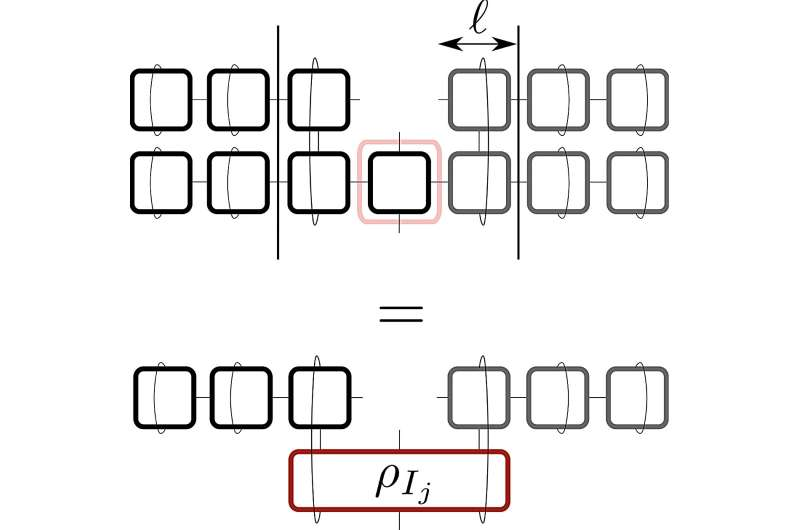
The team optimize each tensor MðjÞ by solving the linear system equation that is represented in this diagram. Credit: Votto et al. (PRL, 2026)
Most quantum computers developed to date are extremely noisy, which essentially means that the operations they perform are not perfect, as qubits are highly sensitive to variations in heat or other changes in the surrounding environment. Interestingly, noisy quantum systems are also easier to simulate, as entangled states become weaker and easier to approximate using classical computers.
“We felt like this implied that noisy systems contained ‘less information’; hence they should also have been easier to analyze,” said Votto. “After discussing this idea with Lorenzo Piroli and our other collaborators, we realized that the unique properties of tensor network states (a tool routinely used to simulate noisy quantum systems) could simplify the learning task. This led us to develop an efficient protocol to analyze global properties of very large experimental quantum devices.”
How the team’s protocol works
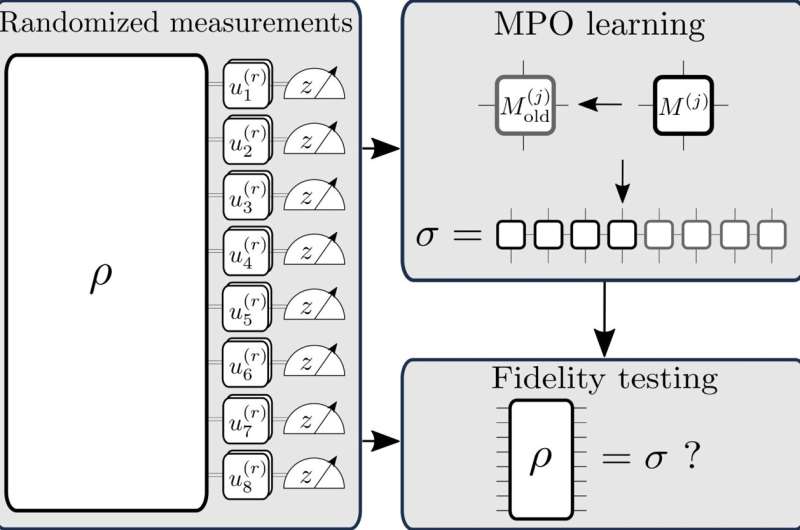
As part of their study, Votto and his colleagues prepared large-scale quantum states on the superconducting quantum processor Brisbane developed by IBM. They then performed several randomized measurements on individual qubits and extracted useful information from these measurements using a technique called classical shadows.
“As in any randomized measurement protocol, the starting step is in the experiment: after having prepared the quantum state of interest, we perform a random operation on each qubit and we measure them,” explained Votto. “By repeating this many times, we obtain a dataset made of random operations and strings of bits. Our protocol then learns a tensor network state compatible with such a dataset.”
Essentially, the team’s protocol works by creating a compressed representation of a full quantum state. A state is represented using an MPO, a mathematical representation that breaks down a large state into smaller tensors (i.e., mathematical objects used to store complex numerical data in multiple dimensions).
“One could view a tensor network as a collection of boxes, one per qubit, where each one of them contains information about the correlations with the other qubits,” said Votto. “The key discovery of our work is that the content of each one of these boxes can be learned by using the data coming from just a few qubits surrounding the target one; imagine we want to learn the box of the qubit number 10 out of hundreds: in some cases, we just need the data coming from the qubits from 8 to 12.”
Tensor network states, such as those that the team relied on, do not take up much memory, yet they can be used to derive any physical property of a system. Their protocol can learn these mathematical descriptions directly from experimental data. This could greatly simplify the analysis and simulation of quantum systems made up of hundreds of qubits.
“The kind of tensor networks we use also include extensive information about the noise and decoherence affecting the system, making our protocol very useful to benchmark prototypical quantum computers and correct noise from their data,” said Votto. “We demonstrate this explicitly in our work, where we applied our protocol to a real quantum computer, learning the entangled state of 96 qubits (compared to the previous state-of-the-art for quantum state tomography, limited to 35 qubits).”
A simpler approach to study large quantum systems
Over the past decade, quantum physicists and computer scientists have introduced various approaches to reconstruct tensor network states from experiments. The new protocol introduced by the researchers, however, offers two significant advantages that could make learning these states easier.
“Firstly, our method is compatible with randomized measurements,” explained Votto. “Not only do people already use these measurements routinely to analyze quantum experiments, making these datasets readily available, but they are also naturally robust to experimental errors. Our approach also considerably simplifies the numerical procedure for the reconstruction, drawing inspiration from well-known tensor network algorithms already implemented in software libraries, such as the density matrix renormalization group.”
So far, Votto and his colleagues have tested their protocol on quantum processors that include up to 96 qubits. In the future, however, it could be applied to even larger systems with hundreds of qubits, allowing researchers to reconstruct their underlying quantum states from measurements and verify that they are operating correctly.
“While analyzing quantum states is very interesting per se, everybody who is trying to build a quantum computer is interested in characterizing the operations it is performing,” added Votto.
“To do so, we are working on generalizing our protocol to learning quantum channels; this requires quite some methodological improvements, as the task is notoriously extremely hard. Another interesting perspective is to generalize our work beyond one-dimensional geometries, as most quantum computers nowadays have a two-dimensional connectivity. Tensor network states in two dimensions are a theoretically rich area of research, so I expect this research direction to be a lot of fun.”
Publication details
Matteo Votto et al, Learning Mixed Quantum States in Large-Scale Experiments, Physical Review Letters (2026). DOI: 10.1103/rbg2-f61m.
Journal information: Physical Review Letters
Leave a Reply