
March 27, 2026 by Ingrid Fadelli, Phys.org
Collected at: https://phys.org/news/2026-03-piezoelectric-materials-enable-approach-axions.html
Dark matter, a type of matter that does not emit, reflect or absorb light, is predicted to account for most of the matter in the universe. As it eludes common experimental techniques for studying ordinary matter, understanding the nature and composition of dark matter has so far proved very challenging. One hypothesis is that it is made up of hypothetical particles known as quantum chromodynamics (QCD) axions. These are theoretical elementary particles that would interact very weakly with ordinary matter and are predicted to be extremely light, highly stable and electrically neutral.
While several large-scale studies have searched for small signals or effects that would indicate the presence of these particles or their interaction with ordinary matter, their existence has not yet been confirmed experimentally. In a paper recently published in Physical Review Letters, researchers at Perimeter Institute, University of North Carolina, Kavli Institute and New York University have introduced a new approach to search for QCD axions using a class of materials that generate electric fields when deformed, called piezoelectric materials.
“The axion was proposed in the late 1970s by Weinberg and Wilczek, as a solution to the strong CP (Charge-Parity) problem, a long-standing puzzle in the theory of the strong nuclear force,” Amalia Madden, co-senior author of the paper, told Phys.org.
“The problem is that the mathematical description of the strong force allows for the violation of so-called CP symmetry, meaning it should distinguish between matter and its mirror-image antimatter counterpart. If this were the case, it would lead to a concrete experimental signature: the neutron should possess a measurable electric dipole moment (EDM). However, decades of increasingly precise experiments have found no evidence for such an EDM.”
The fact that physicists have not been able to observe the predicted EDM signature has proven difficult to reconcile with the current theoretical understanding of the so-called strong force. This hints at the existence of new physics that would explain why the predicted CP violation appears to be absent in the strong interaction.
“The axion is currently one of the best-motivated solutions to the strong CP problem,” explained Madden. “It also has the right properties to potentially serve as dark matter in our universe. Particles similar to the axion appear frequently in string theory, making them a fairly generic prediction of that framework. In our current work, however, we do not require the QCD axion to be the dark matter, nor do we require string theory to describe our universe. These ideas simply provide additional motivation for why axions might exist.”
The difficult quest of detecting the QCD axion
The recent study by Madden and her colleagues also builds on earlier research by Frank Wilczek and John Moody, published in the 1980s. These two physicists explored the possibility that hypothetical light particles such as the axion mediate entirely unknown forces of nature.
“If the mediating particle is very light, such forces could extend over macroscopic, laboratory-scale distances,” said Madden. “This opens the possibility of discovering particles like the axion indirectly by measuring the tiny forces they generate between objects. The difficulty, however, is that such forces would be incredibly small, making them extremely challenging to produce and measure experimentally.”
In 2014, two of the authors of the recent paper, Arvanitaki and Andrew Geraci, introduced the idea of a different type of experiment aimed at detecting tiny forces associated with the presence of axions. This experiment, dubbed the Axion Resonant InterAction Detection Experiment (ARIADNE), would try to pick up axion-mediated forces by measuring nuclear spins (i.e., the intrinsic angular momentum of atomic nuclei) with high precision.
“This type of experiment searches for the tiny interactions that axions can generate between matter,” said Madden. “Since the axions in this experiment would be produced in the laboratory, they do not need to constitute the dark matter in our universe, although they could still do so.”
The researchers’ recent study was informed by this previously proposed approach to search for axion-mediated forces. It also followed a more recent paper by Madden, Arvanitaki and their colleague Ken Van Tilburg, which tried to predict how a QCD axion that solves the strong CP problem would interact with piezoelectric materials.
“We found that when a piezoelectric material also contains aligned nuclear spins, the resulting medium breaks both of the C and P symmetries we mentioned earlier,” said Madden. “Axion interactions with matter also violate these same symmetries, and the result is that the strength of the interaction between axions and matter can be significantly enhanced inside these materials.”
Shortly after they published their previous paper, Madden and her colleagues realized that the same physics allowing QCD axions to interact strongly with piezoelectric materials implies that these materials could be used to source axions in a laboratory setting. This ultimately paved the way for their recent work and for the introduction of a new experimental approach to search for the elusive particles.
“We designed an experiment that could exploit this effect: producing QCD axions using a piezoelectric crystal and then detecting them through the tiny forces they mediate,” explained Madden. “Compared to earlier proposals such as ARIADNE, using a piezoelectric source could enhance the production of QCD axions in the laboratory by a factor of up to ten million. This could significantly strengthen our experimental sensitivity and open a new route to discovering the QCD axion using existing precision measurement techniques.”
A different type of experiment
The new experimental approach introduced by the researchers is closely related to nuclear magnetic resonance (NMR). This is a physics technique that entails studying how nuclear spins respond to magnetic fields.
“Axions have another important property: they can interact with nuclear spins in a way that is very similar to how an ordinary magnetic field interacts with them,” said Madden.
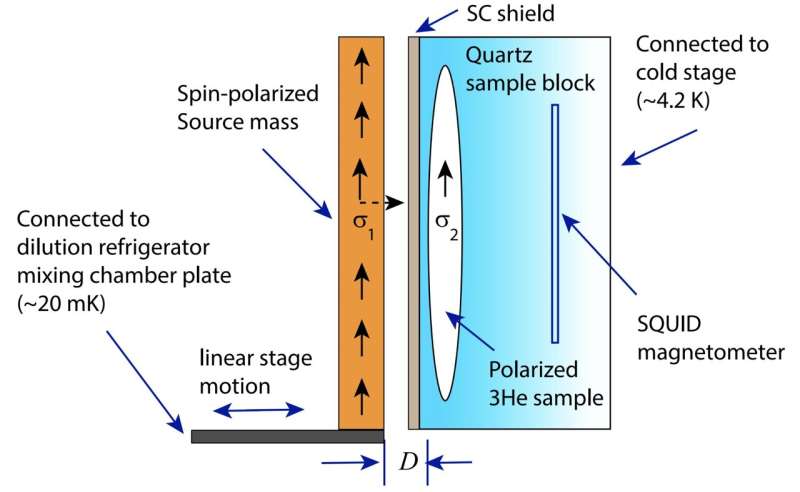
“If axions are present, the force they mediate would cause the nuclear spins in our detector to tilt slightly. When many spins tilt together, the tiny magnets associated with the nuclei begin to point in a slightly different direction. Together they produce a very small magnetic field that we can try to measure using one of the most sensitive magnetic-field detectors available: a SQUID (Superconducting Quantum Interference Device).”
To isolate the small magnetic field that would be produced by interactions between axions and nuclear spins from external magnetic fields that could mimic it, the team propose the generation of a strong magnetic shield around the experiment. Finally, their experimental method would leverage the resonance associated with the NMR technique.
Specifically, the team propose moving the piezoelectric crystal used in the experiment back and forth using a motor. The crystal would be moved at the exact same resonant frequency of the nuclear spins, as this would ultimately amplify the axion-induced magnetic field signal and facilitate its detection.
“The search for new fundamental laws of physics ultimately depends on experiment,” said Madden. “No matter how compelling a theoretical idea may be, it must eventually be tested in the laboratory. For many decades, particle physicists have relied primarily on high-energy colliders to search for new particle.
“Yet over the past two decades, there has been growing interest in a complementary strategy: using extremely sensitive precision experiments to look for very light, weakly interacting particles that would be invisible in collider experiments. The QCD axion is one of the best-motivated candidates for new physics, and if it exists, it likely belongs to this class of light, weakly coupled particles.”
New paths towards the detection of axion signals
The recent work by Madden and her colleagues introduces a promising new strategy to perform QCD axion searches. Their approach could help to detect this elusive particle within a parameter space that has so far been very difficult to access experimentally.
“Our proposal is also complementary to existing axion search strategies, such as haloscope experiments,” said Madden. “Unlike many current approaches, because this is a force experiment, it does not rely on the axion constituting dark matter (but it could still serve as such). Our approach is also a natural extension of the ARIADNE experiment.”
A further advantage of the team’s proposed experiment is that it could be realized using existing techniques and equipment, instead of relying on entirely new technologies. In fact, Geraci, one of the authors based at Northwestern University, is already planning to search for the force identified in this paper as part of a planned future experiment.
“Geraci leads the Axion Resonant InterAction DetectioN Experiment (ARIADNE), which searches for axion-mediated spin-dependent interactions between polarized nuclear spins in a helium-3 sample and an unpolarized tungsten source mass,” added Madden. “To search for the ferroaxionic force, a few modifications of the apparatus would be needed and the unpolarized source mass would be replaced with a spin-polarized piezoelectric crystal that is doped with nuclei having a Schiff moment or magnetic quadrupole moment.”
Publication details
Asimina Arvanitaki et al, Detecting the QCD Axion via the Ferroaxionic Force with Piezoelectric Materials, Physical Review Letters (2026). DOI: 10.1103/6xw1-1715
Journal information: Physical Review Letters
Leave a Reply