
March 26, 2026 by Li Zhengang and Zhao Weiwei, Hefei Institutes of Physical Science, Chinese Academy of Sciences
Collected at: https://techxplore.com/news/2026-03-ultra-sensitive-method-hydrogen-complex.html
As a promising clean energy source, hydrogen (H2) requires reliable safety monitoring. However, lacking a permanent dipole moment, it is “infrared-inactive” and cannot be effectively measured by conventional absorption-based techniques. Although Raman spectroscopy can provide molecular fingerprinting, its extremely weak signal limits sensitivity. Together, these factors hinder real-time hydrogen monitoring in complex industrial environments.
A research team led by Fang Yonghua from the Hefei Institutes of Physical Science of the Chinese Academy of Sciences, has developed a novel method called Differential Photoacoustic Stimulated Raman Spectroscopy (DPA-SRS), which enables high-sensitivity hydrogen detection at concentrations as low as 1 ppm under atmospheric pressure.
The study is published in Photoacoustics.
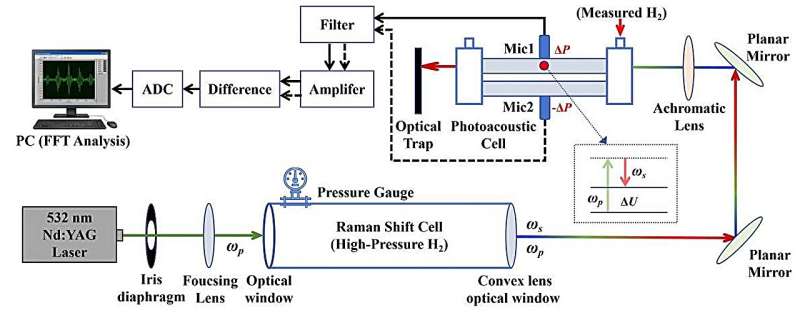
The DPA-SRS technique integrated stimulated Raman scattering (SRS) with photoacoustic detection to significantly enhance signal strength.
A 532 nm pump beam generated a high-intensity 683 nm Stokes beam, forming a dual-color excitation field that matched the vibrational energy levels of hydrogen. This process induced stimulated Raman transitions, followed by vibration-to-translation (V–T) relaxation, which converted molecular excitation into detectable acoustic signals.
By combining a custom-designed differential H-type resonant photoacoustic cell with advanced weak-signal processing algorithms, the proposed DPA-SRS system achieved a minimum detection limit of 0.65 ppm (3σ) for hydrogen.
This work provides a new strategy for the high-sensitivity detection of trace non-polar gases in complex environments, paving the way for improved hydrogen safety monitoring in future energy systems, according to the team.
More information
Xin Yu et al, Differential photoacoustic-stimulated Raman spectroscopy (DPA-SRS) for high-sensitivity hydrogen detection, Photoacoustics (2026). DOI: 10.1016/j.pacs.2026.100814
Leave a Reply