
March 26, 2026 by Örebro University
Collected at: https://techxplore.com/news/2026-03-factories-faster-greener-ai-digital.html
Researchers at Örebro University have developed a new production system that uses artificial intelligence (AI) to improve efficiency and sustainability across industries such as automotive manufacturing. The research is published in the journal IOP Conference Series: Materials Science and Engineering.
“Our results show that production can become both faster and more sustainable at the same time,” says Rajesh Patil, researcher in mechanical engineering.
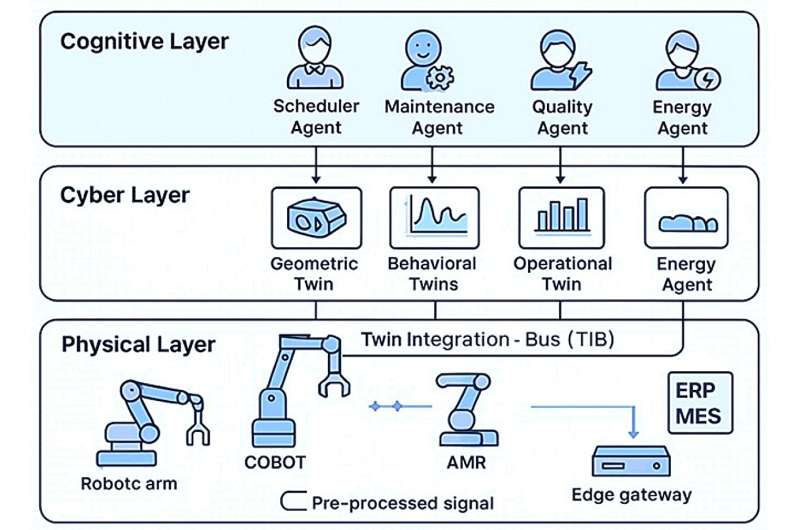
Together with Professor Magnus Löfstrand at Örebro University’s School of Science and Technology, Rajesh Patil has developed a system called Digitalized Operation of Sustainable Production Systems (DOSPS).
The system links physical machines and robots with digital counterparts—so-called digital twins. These digital models track machine behavior in real time and are used to test scenarios before implementing changes in the production process. At the same time, intelligent software manages scheduling, maintenance, quality control, and energy use.
Faster production—fewer defects
According to a new study to be published in a scientific journal, the researchers’ tests in robotic assembly cells show that DOSPS leads to clear improvements. Energy use was reduced by 28%, cycle time per task dropped by around 24%, and the number of defects decreased by more than 65%. Unplanned downtime was also reduced by more than half.
Analyses also show a clear correlation between energy use and sustainability: as energy consumption decreases, the overall sustainability of production improves.
“Energy efficiency is the single most important factor for sustainable industrial production. By optimizing energy use in real time, emissions and resource waste can be significantly reduced,” says Rajesh Patil.
Ready for large-scale implementation
The system is designed to operate in collaboration with humans. With the help of augmented reality, operators can monitor the production process, observe digital twins, and intervene as needed. The solution can be applied to both individual production cells and entire factories.
“Our goal is to contribute to the next generation of production systems—systems that are autonomous, robust, and environmentally responsible,” says Magnus Löfstrand.
The research group is now continuing its work by testing the system at a larger scale.
More information
Rajesh Patil et al, Robots and Intelligent Agents for Product Creation and Manufacturing in Sustainable Digitalized Manufacturing Systems, IOP Conference Series: Materials Science and Engineering (2026). DOI: 10.1088/1757-899x/1342/1/012043
Leave a Reply