
March 15, 2026 by Ingrid Fadelli, Phys.org
Collected at: https://phys.org/news/2026-03-ultra-high-energy-neutrino-linked.html
Neutrinos are extremely lightweight and electrically neutral particles that rarely interact with ordinary matter. Due to these rare interactions, neutrinos can travel across space almost entirely unaffected, carrying information about highly energetic cosmological events, such as exploding stars or supermassive black holes.
The KM3NeT neutrino telescope, an observatory located at the bottom of the Mediterranean Sea, recently detected the presence of a neutrino carrying extremely high energy, above 100 PeV (peta-electronvolts). This is one of the most energetic neutrinos observed to date.
Theoretical predictions suggested that another large-scale neutrino detector, namely the IceCube detector, would also observe similar high-energy neutrino events. However, this did not happen, which might potentially hint at some new physics, such as a new type of neutrinos or non-standard interactions, that are not included in the standard model of physics.
Researchers at Oklahoma State University set out to explore a possible explanation for the reported discrepancy between predictions and recent neutrino observations.
Their paper, published in Physical Review Letters, specifically considers the existence of sterile neutrinos—hypothetical neutrinos that do not interact via normal forces in the universe—as well as neutrino oscillations, a quantum effect that causes neutrinos to change type while they are moving in space.
“Our paper was motivated by the detection of an ultra-high-energy neutrino by the KM3NeT detector,” Vedran Brdar and Dibya S. Chattopadhyay, co-authors of the paper, told Phys.org.
“The detection of a 220 PeV neutrino by the KM3NeT detector was particularly surprising because the IceCube detector has not observed events of comparable energy, despite its longer data-taking period and larger effective area.”
The recent work by Brdar and Chattopadhyay also builds on an earlier paper published in Physics Letters B. This paper had tried to quantify, through statistical methods, how unlikely it would be for IceCube not to have detected any similar events.
“This earlier observation prompted us to investigate what kinds of beyond the Standard Model (BSM) scenarios might resolve the tension between the KM3NeT observation and the absence of similar events in IceCube,” said Brdar and Chattopadhyay.
“More broadly, we wanted to explore whether neutrino telescopes may already be beginning to probe new physics at extremely high energies, well beyond those accessible in terrestrial experiments.”
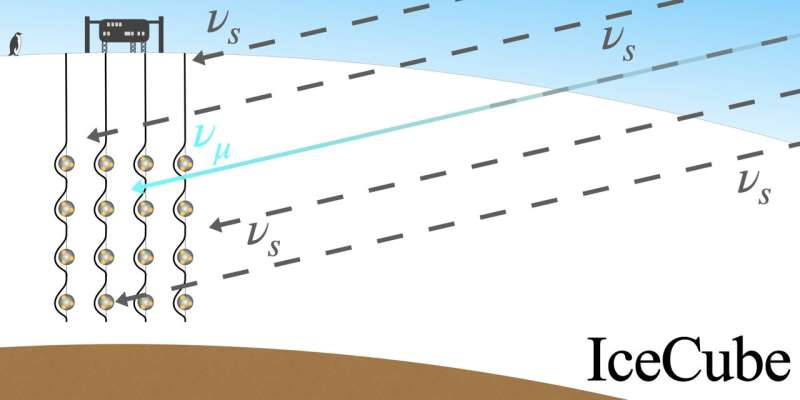
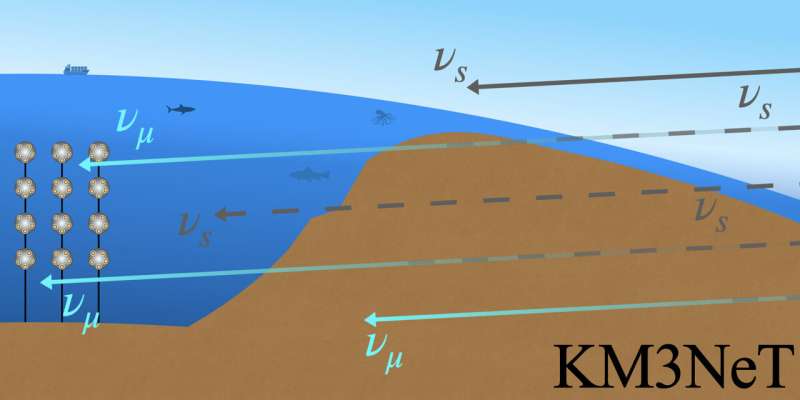
Schematic illustration of sterile-to-active neutrino conversion enhanced in the presence of matter effects. The longer path through Earth for neutrinos reaching KM3NeT can lead to a stronger conversion compared to IceCube. Credit: Vedran Brdar & Dibya S. Chattopadhyay.
Seeking the physics behind the record-breaking neutrino
The main goal of the team’s recent study was to investigate the possibility that the KM3NeT event could be convincingly explained by physics beyond the standard model.
In their paper, the researchers focused specifically on hypothetical scenarios outside of the standard model in which hints of new physics would only manifest at very high energies around or above 100 PeV.
“In the simplest term, the question we asked was: what is the most important difference between KM3NeT and IceCube for this event?” explained Brdar and Chattopadhyay.
“We found that, for a transient source, the neutrino signal reaching KM3NeT would pass through roughly 150 km of Earth (rock and seawater) before reaching the detector, whereas the corresponding path for IceCube would involve only about 14 km through Antarctic ice. This difference suggested that any viable new-physics explanation would involve a mechanism triggered by matter effects during neutrino propagation.”
After theoretically exploring various theoretical possibilities, Brdar and Chattopadhyay ended up focusing on specific scenarios that involve sterile neutrinos. In particular, they looked at cases in which the conversion of sterile neutrinos into active neutrinos, via neutrino oscillations, is enhanced in the presence of matter inside Earth.
“Active neutrinos are the neutrinos we are already familiar with, which occasionally interact with matter and can be detected, while sterile neutrinos are hypothetical neutrinos that can be primarily probed indirectly through their mixing with the active neutrinos,” said Brdar and Chattopadhyay.
“The idea we proposed is that a dominantly sterile neutrino flux may create a lot of active neutrinos at KM3NeT. Due to the significantly larger path through matter, this would increase the expected signal at KM3NeT compared to IceCube, solving the anomaly.”
The researchers considered two different theoretical models involving sterile neutrinos: the matter-induced resonance model and the off-diagonal non-standard interaction model. These two models could explain the detected ultra-high-energy neutrino event via different types of new physical interactions. Nonetheless, they would both support the enhancement predicted by the authors.
Deepening the understanding of ultra-high-energy neutrino observations
This recent study offers a plausible explanation for the KM3NeT ultra-high-energy neutrino event, which considers physics outside the standard model. The researchers believe that their paper makes two notable contributions.
“First, we highlight that the anomalous absence of comparable ultra-high-energy events in IceCube could already be hinting at new physics present at extremely high energies,” said Brdar and Chattopadhyay.
“Second, we show that any BSM mechanism capable of resolving this anomaly must rely on the difference in the amount of matter traversed by the neutrinos before detection, meaning that the effect must be tied to matter-induced effects.”
On a broader scale, the team’s efforts suggest that ultra-high-energy neutrino observations could probe fundamental particle physics at energy scales that are beyond those accessible using conventional experimental tools. As part of their next studies, Brdar and Chattopadhyay plan to continue investigating physical phenomena at energies around or above 100 PeV.
“We are currently following up with a more detailed analysis exploring the connections between sterile neutrinos and active neutrino flavors in these extreme-energy regimes,” added Brdar and Chattopadhyay.
“Another interesting direction will be to determine which next-generation experiments might be sensitive to signatures of such BSM scenarios, and what kinds of astrophysical sources could potentially produce high-energy sterile neutrino fluxes. As more ultra-high-energy neutrinos are detected by experiments such as KM3NeT and IceCube, we will be able to test these ideas better.”
Written for you by our author Ingrid Fadelli, edited by Sadie Harley, and fact-checked and reviewed by Robert Egan—this article is the result of careful human work. We rely on readers like you to keep independent science journalism alive. If this reporting matters to you, please consider a donation (especially monthly). You’ll get an ad-free account as a thank-you.
Publication details
Vedran Brdar et al, Does the 220 PeV Event at KM3NeT Point to New Physics?, Physical Review Letters (2026). DOI: 10.1103/xcnt-trs2.
Shirley Weishi Li et al, Clash of the titans: ultra-high energy KM3NeT event versus IceCube data, Physics Letters B (2026). DOI: 10.1016/j.physletb.2026.140293
Journal information: Physical Review Letters , Physics Letters B
Leave a Reply