
March 13, 2026 by Paul Arnold, Phys.org
Collected at: https://techxplore.com/news/2026-03-chip-robots-4d-tracking-distance.html
Current vision systems for robots and drones rely on 3D sensors that, although powerful, do not always keep up with the fast-paced, unpredictable movement of the real world. These systems often struggle to measure speed instantly or are too bulky and expensive for everyday use. Now, in a paper published in the journal Nature, scientists report how they have developed a 4D imaging sensor on a chip that creates 3D maps of an environment while simultaneously tracking the speed of moving objects.
Sensors on a chip
The researchers built a focal plane array (FPA), a physical grid of 61,952 stationary pixels etched onto a single silicon chip. Each one is a tiny sensor that emits laser light toward a scene and detects the reflected signal.
To “see” its surroundings, laser light from an external source is fed into the chip. This light is routed across the chip through a network of optical switches that sequentially direct it to groups of pixels. Each pixel then uses a technique called FMCW LiDAR to measure the returning signal, which is later processed to determine distance and speed. In many LiDAR systems, one set of pixels sends the light, and another receives it, but here, all pixels both send and receive, making the system much more compact.
Additionally, the chip uses a continuous laser beam rather than short pulses of light, which is how traditional sensors operate. The advantage of this is that it allows the sensor to detect tiny shifts in the frequency of the light waves. This lets the chip calculate an object’s distance and speed at the same time.
Measuring distance and speed at once
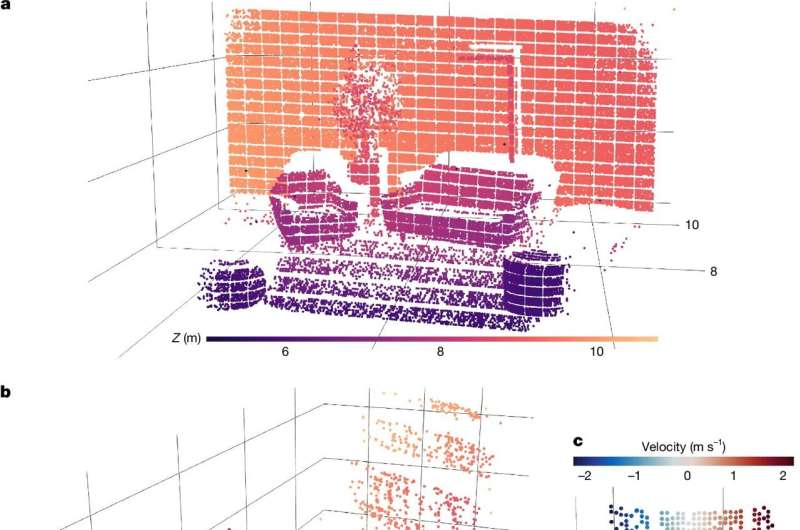
The team tested their sensor on a chip in several environments to see how it could handle different distances and movement. It scanned scenes and then reconstructed them into 3D digital maps made of thousands of data points. The system successfully mapped indoor rooms at a distance of 6 to 11 meters.
To test its range, the scientists pointed the chip at a building 65 meters away, and it was powerful enough to capture details such as windows and balconies. They also tested their innovation on a spinning disk, and it measured its speed instantly.
“This is the first demonstration of a large-scale coherent FPA with all of the associated electronics integrated on-chip, leading to the cost structure necessary for widespread adoption,” wrote corresponding author Remus Nicolaescu.
The team still has work to do on the chip, such as increasing the resolution and extending its range. Once it moves out of the lab, it could do more than just help robots and drones. The technology could also improve digital cameras, including those in our phones.
Publication details
Francesca Fabiana Settembrini et al, A large-scale coherent 4D imaging sensor, Nature (2026). DOI: 10.1038/s41586-026-10183-6
Journal information: Nature
Leave a Reply