
March 11, 2026 by Sungkyunkwan University
Collected at: https://techxplore.com/news/2026-03-unraveling-stochasticity-key-generation.html
A joint research team has reported for the first time that the resistive switching behavior of ion-motion-mediated volatile memristors, which are emerging as promising next-generation semiconductor devices, originates from a combined mechanism comprising multiple conductive filaments coupled with electrothermal effects.
The work is published in the journal Advanced Functional Materials.
The study, led by Professor Jung Ho Yoon from the School of Advanced Materials Science and Engineering at Sungkyunkwan University, in collaboration with Professor Kyeongtae Kim from the Department of Mechanical Engineering at Incheon National University and Dr. Sunghoon Hur of the Korea Institute of Science and Technology (KIST), reveals the fundamental origin of the inherent stochasticity that has long been observed in memristor devices but remained poorly understood.
The findings are expected to provide a critical advancement for the development of future computational systems, including true random number generation for information security and probabilistic computing architectures.
Ion-motion-mediated volatile memristors exhibit electrical property that conductive filaments composed of metallic ions randomly form within the device when a voltage bias is applied and voluntarily dissolve when the voltage bias is removed.
This inherently stochastic behavior makes such devices highly attractive for applications requiring randomness, such as true random number generators (TRNGs) that can produce unpredictable encryption keys and probabilistic computing systems capable of efficiently solving complex combinatorial optimization problems.
However, because these internal resistive switching dynamics are extremely difficult to observe directly in real time, the optimal design of devices that maximize stochastic behavior has remained challenging.
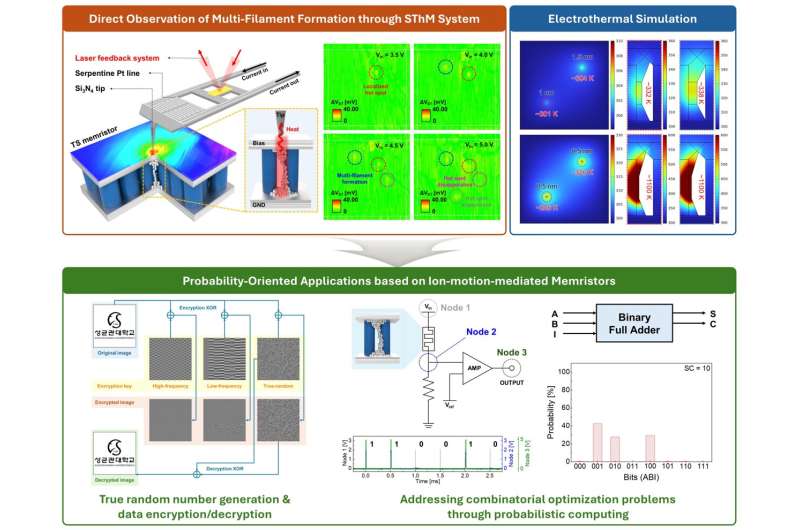
To overcome this limitation, the joint research team introduced scanning thermal microscopy (SThM), a nanoscale thermal characterization technique capable of detecting heat signals precisely.
Using this method, the researchers successfully measured Joule heating generated during resistive switching events directly from the top surface of the memristor device.
Their measurements revealed the repeated appearance and disappearance of multiple localized hot spots, providing decisive evidence that multiple conductive filaments simultaneously compete for current conduction while ions continuously redistribute inside the device.
In addition, the research team implemented a bimodal true random number generator capable of producing both digital and analog random numbers.
Furthermore, they successfully demonstrated data encryption and decryption sequence using generated random numbers as encryption keys. Moreover, the researchers demonstrated the potential of probabilistic computing by performing the inverse operation of a binary full-adder circuit, illustrating the feasibility of extending this technology toward next-generation computing applications.
Professor Jung Ho Yoon of Sungkyunkwan University commented, “This study moves beyond the conventional simplistic interpretation of resistive switching behavior of memristor as a single-filament formation and rupture process. Instead, it reveals the complex interplay between multi-filamentary dynamics and electrothermal effects.
“Going forward, we aim to achieve global technological leadership in stochastic and probability-oriented intelligent semiconductor systems by developing practical applications based on these devices.”
Publication details
Keunho Soh et al, Unraveling Origin of Stochasticity in Multi‐Filamentary Memristor, Advanced Functional Materials (2026). DOI: 10.1002/adfm.202527482
Journal information: Advanced Functional Materials
Leave a Reply