
March 10, 2026 by Nanyang Technological University
Collected at: https://phys.org/news/2026-03-scientists-free-electric-currents.html
By controlling magnetic fields using light, a team of researchers led by NTU scientists has solved a long-standing challenge to precisely direct electric currents produced by quantum materials. Their findings unlock new avenues for controlling the flow of electricity through such materials and could herald the age of energy-efficient quantum computing devices. The research is published in Nature in January.
A cool way to produce electric currents
Like water moving through lakes and rivers, electrons in electric currents encounter resistance when flowing through electronic devices. This resistance generates large amounts of heat, which poses a problem for large computing facilities such as data centers and quantum computers, incurring major costs for cooling.
With artificial intelligence driving the demand for more computing applications, there is a need to produce electricity that flows without resistance to avoid generating excessive amounts of heat. These “free-flowing” electric currents could pave the way for novel low-power electronics and new quantum computing technologies.
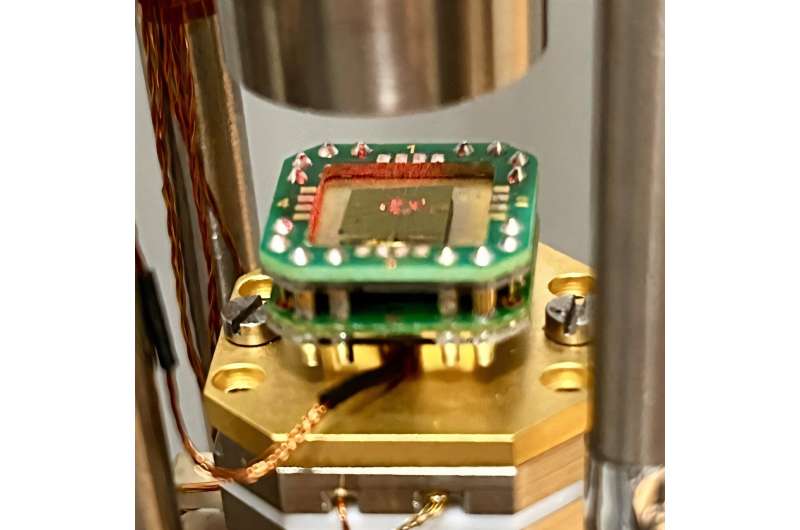
One of the most promising sources of such electric currents are ultrathin materials that are only several atoms thick. Stacking these layers together, with a slight mismatch, creates a magnetic quantum material known as a moiré Chern ferromagnet. Although the center of the material is insulating, electrons move freely along the edges of this material, like cars traveling along a smooth racetrack without friction.
Using light to steer electricity
However, it is challenging to precisely control the flow of these electrons to direct them to where they are needed.
The direction of electron movement depends on the orientation of the magnetic field of the ferromagnet. The scientists found that by using circularly polarized light, which rotates like a corkscrew, to switch the orientation of the magnetic field of the moiré Chern ferromagnet, they were able to steer the flow of electrons. When the beam of light—dimmer than a portable light torch—flips the orientation of the magnetic field from “up” to “down,” the movement of electrons moving along the edges reverses direction instantly, from clockwise to anti-clockwise.
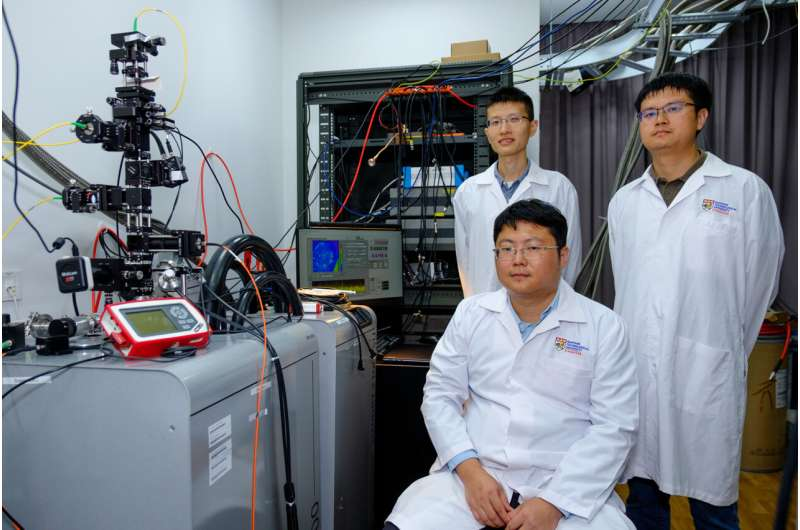
From left: Dr Cai Xiangbin, Prof Gao Weibo and Dr Pan Haiyang from NTU’s School of Electrical and Electronic Engineering. Credit: NTU Singapore
“Such optical control of electric currents is attractive because it enables electricity to be directed without the need for physical wires. The method is also precise and fast, without requiring bulky external equipment,” says Prof Gao Weibo of NTU’s School of Electrical and Electronic Engineering (EEE), who was the corresponding author of the paper.
“By enabling the design of programmable electrical circuits that are energy efficient, our breakthrough also opens the door to electronic devices with greatly reduced power consumption,” says Dr. Cai Xiangbin, Presidential Postdoctoral Fellow at NTU’s EEE, who was the first author of the study.
“Our work paves the way for exploring other phenomena associated with moiré Chern ferromagnets that are crucial for quantum information processing, such as superconductivity,” added Dr. Pan Haiyang, research fellow at NTU’s EEE.
In the next step, the researchers are investigating the robustness of processing quantum information using this innovation.
Publication details
Xiangbin Cai et al, Optical switching of a moiré Chern ferromagnet, Nature (2026). DOI: 10.1038/s41586-025-10048-4. On arXiv: DOI: 10.48550/arxiv.2508.19602
Leave a Reply