
March 7, 2026 by Ingrid Fadelli, Phys.org
Collected at: https://phys.org/news/2026-03-superconducting-dome-hints-high-temperature.html
Superconductivity is a quantum state of matter characterized by an electrical resistance of zero and the expulsion of magnetic fields at low temperatures below a critical point. Superconductors, materials in which this state occurs, have proved to be highly advantageous for the development of various technologies, including medical imaging devices, particle accelerators and quantum computers.
While superconductivity typically only occurs at extremely low temperatures, recent studies showed that in some materials it can arise at higher temperatures. These unconventional superconducting materials are referred to as high-temperature (high-Tc) superconductors.
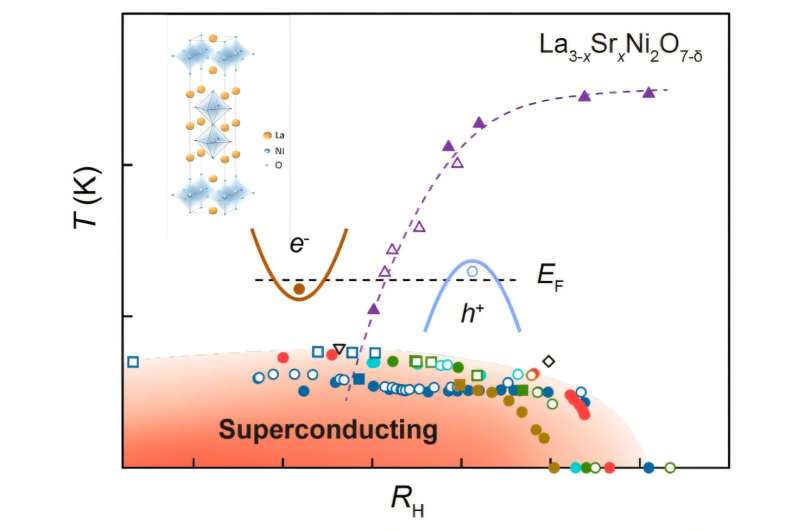
Researchers at the National Laboratory of Solid-State Microstructures and Nanjing University recently gathered hints of high-Tc superconductivity in a thin film nickelate, a material that contains nickel and oxygen arranged in a thin layered crystal structure. Their paper, published in Physical Review Letters, maps the evolution of physical states in these materials under different conditions, unveiling a so-called “superconducting dome” in this phase diagram, which is associated with high-Tc superconductivity.
“Our work was inspired by recent pioneering breakthroughs in the nickelate community, particularly the discovery of high-pressure superconductivity in bulk and strained thin films of La3Ni2O7,” Yuefeng Nie, senior author of the paper, told Phys.org. “Yet, amid this excitement, a key piece of the puzzle was still missing: the phase diagram. We wanted to see if this bilayer system has a ‘superconducting dome’—the classic hallmark of unconventional high-Tc superconductors.”
Synthesizing and studying Nickelate thin films
Many past studies have mapped the phase diagram of cuprates, ceramic materials with a layered structure containing copper and oxygen, and found that they host a rich variety of competing phases of matter. Nie and his colleagues wanted to determine whether similar complex phases also exist in nickelates.
“Synthesizing nickelate films is really challenging and requires strict atomic-scale precision,” said Nie. “I have to give huge credit to my talented students—Maosen Wang, Bo Hao, Wenjie Sun, and the rest of the team—who worked incredibly hard to master this complex material system.”
The researchers grew thin films of the nickelate La₃Ni₂O₇ on substrates that compressed its crystal structure. To do this, they used a technique that they perfected as part of their earlier work, known as reactive molecular beam epitaxy (MBE).
“My experience with MBE actually goes back 15 years to my postdoc days with Darrell Schlom and Kyle Shen at Cornell,” explained Nie. “You can think of MBE as playing with ‘atomic LEGOs,’ letting us stack materials layer by layer to create novel structures. To map the dome, we used two parallel ‘tuning knobs’: Strontium (Sr) doping and in-situ vacuum annealing to control oxygen vacancies. Both methods serve as effective ways to tune the carrier concentration and modulate superconductivity, much like in cuprates.”
Essentially, Nie and his colleagues progressively replaced some lanthanum atoms in their La₃Ni₂O₇ samples with Sr. This allowed them to tune the number of electrical charge carriers in the material.
To further control the material’s electronic behavior, the researchers also adjusted the amount of oxygen in the films. They then collected various measurements under different conditions and used them to construct a phase diagram of La₃Ni₂O₇.
“Since finding the exact doping density is tricky in these multiband systems, we tracked the Hall coefficient (RH) as our key metric to map the full phase diagram,” said Nie.
Informing physics theories and experiments
Interestingly, the researchers found that a superconducting dome emerges in the phase diagram of the nickelate they examined. The materials’ superconductivity was found to peak when the so-called Hall coefficient undergoes a sign transition, suggesting that the predominant charge carriers have changed from holes to electrons.
“This brings us right back to our initial motivation: the comparison with cuprates,” said Nie. “These features look very similar to what we see in electron-doped copper-based superconductors. It implies that superconductivity here may be closely related to a Fermi surface reconstruction and electronic symmetry, just like in the cuprates.”
This recent study and the phase diagram derived by the researchers could help to improve theories relating to nickelates and describing their underlying physics. In the future, it could help to design advantageous nickelate materials that exhibit superconductivity at ambient pressures and at higher temperatures than conventional superconductors.
“Now that we’ve mapped out this fascinating macroscopic phase diagram, we really want to look under the hood,” added Nie. “The next step for us will be to go in with advanced ARPES to directly visualize what’s happening to the electronic structure and Fermi surface during that carrier crossover. Honestly, we’re just scratching the surface of this ‘Nickel Age,’ and trying to figure out what’s behind their superconductivity—that’s going to be a very exciting challenge.”
Publication details
Maosen Wang et al, Superconducting dome in La3−𝑥Sr𝑥Ni2O7−𝛿 thin films. , Physical Review Letters (2026). DOI: 10.1103/qrkk-l2ng. On arXiv: DOI: 10.48550/arxiv.2508.15284
Journal information: Physical Review Letters , arXiv
Leave a Reply