
March 6, 2026 by Ingrid Fadelli, Phys.org
Collected at: https://techxplore.com/news/2026-03-liquid-metal-pupil-artificial-eye.html
Computer vision technologies are artificial intelligence (AI)-powered systems that can capture, analyze, and interpret visual data captured from real-world environments. While these systems are now widely used, many of them perform poorly under some lighting conditions and when the light in captured scenes changes abruptly.
Researchers at University of North Carolina at Chapel Hill, Westlake University and other institutes have developed a new artificial eye that draws inspiration from the eyes of humans, cats and other animals. This artificial eye, introduced in a paper published in Science Robotics, could be used to advance the sensing capabilities of robots, advanced security systems and autonomous vehicles.
“Our project grew from a simple problem: traditional machine vision systems (like the cameras deployed in self-driving cars or robots) struggle with extreme light changes, such as changes from pitch black to bright sunlight,” Dr. Kun Liang, first author of the paper, told Tech Xplore.
“These systems use complicated hardware and algorithms to fix overexposure/blurriness, which makes them slow, power-hungry, and less reliable. Nature solved this problem over millions of years ago, as animal eyes have adaptive pupils and neural systems that adjust to light instantly, with no extra computation.”
An adaptive vision system inspired by animals
The recent work by Dr. Kun Liang, Dr. Bowen Zhu, Dr. Wubin Bai and their colleagues draws inspiration from the pupils of most animals, in particular the fact that they have adapted to automatically adjust pupils in response to changes in lighting. The researchers tried to artificially replicate this adaptation process, which is known as the closed-loop pupillary light reflex (PLR) or adaptive pupil reflex (APR).
“Our core objectives were to integrate a hemispherical artificial retina with liquid-metal (LM) shapeshifters for artificial neurons and adaptive pupils, mimic biological PLR via LM deformation, solve high-light overexposure issues in machine vision, and achieve programmable replication of multiple animal pupil shapes to boost environmental adaptability and image recognition accuracy,” said Dr. Zhu.
The nature-inspired vision system developed by this research group has three primary components. The first is a hemispherical bio-mimetic retina, which is essentially a grid of light-sensitive components that collectively process and transmit visual information.
Finally, the team developed an adaptive pupil made of liquid metal that changes its shape and size depending on the intensity of light.
“The hemispherical retina adopts an In₂O₃/Y6 heterojunction‑based photodetector array with 64 pixels,” explained Dr. Liang.
“The liquid‑metal neurons, using eutectic gallium‑indium (EGaIn), achieve electrochemical actuation and switching behavior to emulate neural spiking transmission. As the key innovation, the adaptive pupil is realized by encapsulating liquid metal within PDMS microchannels, whose controllable deformation is driven electrochemically via the synergy of surface tension gradients and electrostatic forces.”
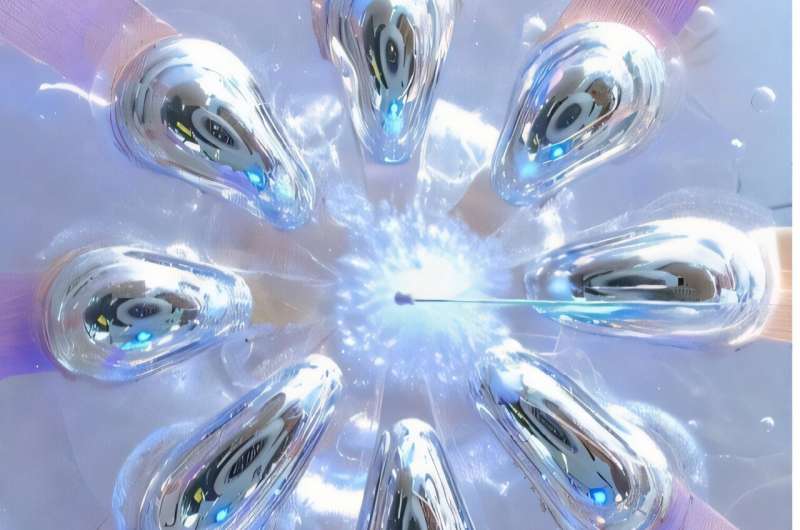
The artificial pupil developed by the researchers relies on eight liquid-metal actuators that can be controlled independently. These actuators adjust the aperture of the pupil, controlling how much light passes through it. In addition, these actuators can produce different pupil shapes, mimicking the shape of human pupils or those of cats, sheep, squids, frogs and various other animals.
“This bio-inspired vision system perfectly replicates the closed-loop pupillary reflex of biological organisms,” said Dr. Bai.
“After the biomimetic retina captures strong light signals, they are encoded into pulse currents by liquid metal neurons, which drive the liquid metal pupil to contract, reducing light intake to prevent overexposure of the photosensitive units. When the light intensity decreases, the pupil automatically dilates again to ensure sufficient light intake.”
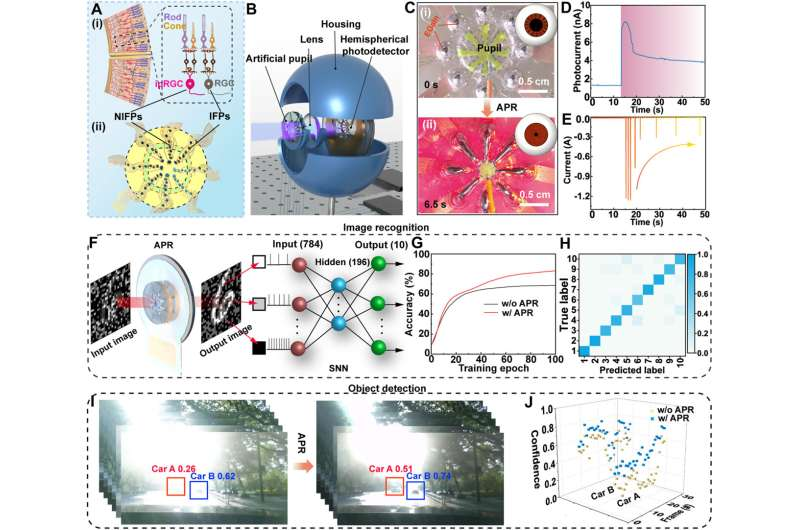
APR visual system in machine vision. Credit: Science Robotics (2026). DOI: 10.1126/scirobotics.adx0715
Towards more adaptive machine vision systems
In initial tests, the system developed by the team was found to perform remarkably well, emulating the processes via which human and animal eyes adapt to light. Notably, the team’s artificial eye adapts to light autonomously, without requiring human intervention.
“We introduced a programmable LM pupil system that replicates diverse animal pupil shapes (not just circular dilation),” said Dr. Zhu. “The high-performance In₂O₃/Y6 hemispherical retina we demonstrated has broadband response (365 nm-780 nm) and flexible stability, matching commercial photodetector performance.
“Ours is a hardware-centric solution to high-light overexposure that could boost machine vision recognition without complex algorithms.”
The newly introduced artificial eye could soon be deployed in various technologies, including robots with different body structures, autonomous vehicles, medical imaging tools, drones and neuromorphic computing systems.
This could make these technologies more adaptive, improving their ability to capture and analyze images in real-world dynamic settings and under changing lighting conditions.
“In our future work, we plan to scale down LM actuators/photodetectors to reduce response time (meeting real-time autonomous driving needs), optimize electrolyte/electrode materials to enhance LM stability and energy efficiency, and improve the retina’s photoresponsivity,” said Dr. Bai.
“We also wish to add more LM control channels to explore rare animal pupil shapes for extreme environments, integrate color/multispectral imaging into the retina, and combine APR with tactile/motion sensing for multi-modal bioinspired perception.”
As part of their next studies, Dr. Liang, Dr. Zhu and Bai plan to devise more effective strategies to fabricate the artificial eye, while also trying to reduce it in size.
Concurrently, they hope to soon integrate their vision system with other components or add it to existing devices, robots or vehicles, to assess its potential for various real-world applications.
“We will develop monolithic integrated APR systems via microfabrication for miniaturization, integrate low-power microelectronics/wireless modules for portable use, and conduct real-world testing (autonomous robots/ADAS vehicles),” added the researchers.
“Moreover, we wish to explore new 2D/perovskite materials for the retina and LM-polymer composites for actuators, and design SNN algorithms tailored to the system’s spike signals to further boost recognition capabilities.”
Publication details
Kun Liang et al, Bioinspired adaptive pupil reflex based on liquid-metal shape-shifters for machine vision, Science Robotics (2026). DOI: 10.1126/scirobotics.adx0715.
Journal information: Science Robotics
Leave a Reply