
March 5, 2026 by Scott Gibson, Oak Ridge National Laboratory
Collected at: https://phys.org/news/2026-03-electric-field-tunes-vibrations-ease.html
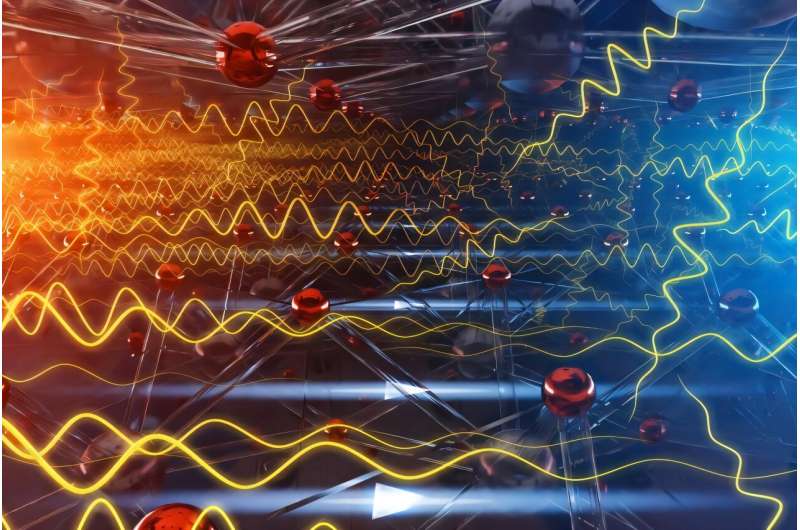
New research from the Department of Energy’s Oak Ridge National Laboratory, in collaboration with The Ohio State University and Amphenol Corporation, challenges conventional understanding about controlling heat flow in solid materials. The study, published in PRX Energy, shows that applying an electric field to a ceramic material changes how phonons (tiny vibrations that carry heat) behave.
Phonons with atoms moving along the field direction (poling direction) last longer than those with atoms moving perpendicular to the field. As a result, the material conducts heat almost three times more efficiently along the field direction than in perpendicular directions. This promising approach could lead to new solid-state devices that control heat flow in everyday technologies.
“Being able to control both how fast and in what manner heat flows could lead to devices that manage thermal energy far more efficiently,” said Puspa Upreti, an ORNL postdoctoral research associate.
Why better heat control matters
Controlling heat flow is important for high-performance systems such as modern electronic coolers with no moving parts, energy converters that change heat into power, chip-based circuits used in everyday technology, and cogeneration systems, which capture and repurpose industrial heat. Regulating heat in these systems creates the right conditions for peak efficiency and performance.
The link between efficiency and heat flow is shown by the Carnot cycle, an idealized model of a heat engine that sets the highest possible efficiency by precisely controlling the transfer of heat between hot and cold reservoirs. In this study, applying an electric field removes barriers to phonon transport. This lets the vibrations travel farther, much like reducing traffic on a busy road, and improves heat conduction along the electric field direction, which leads to better efficiency.
Probing atomic vibrations with neutrons
Experiments took place at the Spallation Neutron Source, a DOE Office of Science user facility operated by ORNL. The researchers used advanced inelastic neutron scattering techniques to capture both the static arrangement of atoms (structure) and their movements (dynamics). Neutrons help scientists see exactly where the atoms are in the material and how they move, a concept recognized in the Nobel Prize-winning work by Clifford Shull and Bertram Brockhouse.
The detailed dataset from the Spallation Neutron Source offers a clear understanding of how adjusting the electric field not only speeds up the phonons but also extends their lifetimes, which is key for developing future ways to manage heat.
Special ceramics behind the advance
The study focused on a special type of ceramic called relaxor-based ferroelectrics. When these ceramics are exposed to an electric field, tiny electrical charges inside them align. This alignment reduces scattering of the heat-carrying vibrations, allowing energy to flow more efficiently. The crystals used in this study were carefully grown and then subjected to the electric field (poled) by Raffi Sahul at Amphenol Corporation. The work produced solids that enable precise control of energy flow.
ORNL senior researcher Michael Manley designed and led the inelastic neutron scattering experiments along with ORNL senior R&D staff member Raphaël Hermann.
Unexpectedly large gains in conductivity
“Earlier work on bulk ferroelectric materials achieved modest improvements in thermal conductivity of five percent to ten percent, while the new measurements reveal an enhancement close to 300 percent—mainly because the phonons are able to travel much longer before they stop,” Manley said.
By integrating their thermal conductivity measurements with neutron scattering data, the researchers directly connected changes in heat flow to the behavior of atomic vibrations within the crystal. The late Professor Joseph Heremans of Ohio State designed the thermal conductivity experiments and guided doctoral candidate Delaram Rashadfar through the data interpretation.
“While earlier work led us to expect only a modest effect, observing a threefold difference turned out to be a significant result,” said Rashadfar. “Professor Heremans always stressed the importance of trusting the data first and letting the theory follow.”
Publication details
Puspa Upreti et al, Electric Field Control of Phonon Lifetimes and Thermal Conductivity in Relaxor-Based Ferroelectric, PRX Energy (2026). DOI: 10.1103/5d1z-wg4p
Journal information: PRX Energy
Leave a Reply