
March 4, 2026 by Sungkyunkwan University
Collected at: https://techxplore.com/news/2026-03-silicon-indium-selenide-roadmap-ultra.html
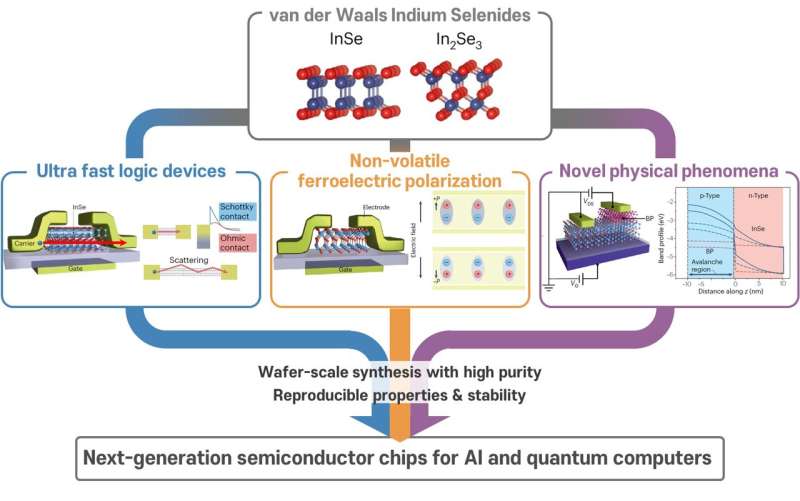
A research team led by Prof. Seunguk Song from the Department of Energy Science at Sungkyunkwan University (SKKU), in collaboration with the Institute for Basic Science (IBS), the University of Pennsylvania, and the U.S. Air Force Research Laboratory, has developed a comprehensive technical roadmap for two-dimensional (2D) indium selenides (InSe)—a key material for next-generation low-power and quantum computing.
The study, titled “Indium selenides for next-generation electronics and optoelectronics,” was published in Nature Reviews Electrical Engineering. This research provides a deep dive into the physical properties and device applications of 2D quantum semiconductors, which are viewed as a definitive alternative to silicon as it reaches its physical scaling limits.
As current silicon-based semiconductors shrink to the sub-nanometer scale, they face critical hurdles such as surging power consumption, overheating, and leakage current. To address these challenges, Professor Song’s team focused on InSe, an atomically thin material.
InSe is characterized by exceptional ballistic transport properties, allowing electrons to move at high speeds with minimal resistance. Its extremely small effective electron mass enables high-speed operation with significantly less energy. Furthermore, depending on its atomic arrangement, InSe exhibits ferroelectric properties, meaning it can remember its electrical state—a perfect combination for multifunctional semiconductor devices.
A key highlight of the paper is the ability of InSe to perform both computation (logic) and storage (memory) within a single material. This suggests a move away from the traditional Von Neumann architecture, where data constantly moves between the CPU and memory, leading to energy inefficiency.
By enabling in-memory computing, InSe can drastically reduce data travel paths and power loss. The roadmap provides a specific technological path for scaling InSe from ultra-fine quantum transistors to non-volatile memory systems.
The research also addresses the practical challenges required for industrial adoption, such as large-area synthesis and oxidation stability. Once these hurdles are cleared, InSe-based devices are expected to play a pivotal role in quantum computer peripherals and ultra-low-power AI semiconductors.
“This research is significant because indium selenide is not just a new material; it represents a shift in the computing paradigm,” said Professor Seunguk Song. “We expect it to evolve into a core platform that bridges quantum information technology with low-power semiconductor engineering.”
This achievement is the result of close international cooperation, including the IBS Center for 2D Quantum Heterostructures, Air Force Research Lab, and University of Pennsylvania.
Publication details
Seunguk Song et al, Indium selenides for next-generation low-power computing devices, Nature Reviews Electrical Engineering (2026). DOI: 10.1038/s44287-025-00251-w
Journal information: Nature Reviews Electrical Engineering
Leave a Reply