
March 3, 2026 by Sam Jarman, Phys.org
Collected at: https://phys.org/news/2026-03-hidden-atomic-dichotomy-superconductivity-ultra.html
Physicists in China have unveiled new clues to the origins of high-temperature superconductivity in an iron-based material just a single unit-cell thick. Led by Qi-Kun Xue and Lili Wang at Tsinghua University, the team’s experiments show that the effect emerges through a striking dichotomy between two atomic “sublattices” in the material—offering deeper insight into how superconductivity arises. Their results are published in Physical Review Letters.
Iron-based superconductors
When cooled below its critical temperature, a superconductor allows electrical currents to flow with virtually zero resistance. While most superconductors discovered so far have critical temperatures close to absolute zero, recent decades have seen the discovery of increasingly advanced materials that host the effect at ever higher temperatures, making them far easier to implement for practical applications.
In 2012, superconductivity was discovered in a single-unit-cell-thick layer of iron selenide (FeSe), consisting of a Se–Fe–Se trilayer only 0.55 nm thick. However, it remained unclear how such a strong superconducting effect could emerge in such an ultrathin system.
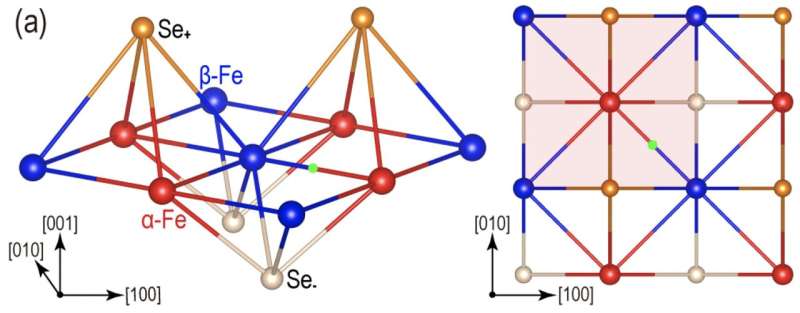
Within a single unit cell of the material’s atomic lattice, iron atoms form a repeating pattern that can be described as two interwoven “sublattices.” This is a consequence of the lattice symmetry and the absence of a simple inversion center at the Fe sites.
Then in 2013, Jiangping Hu at the Chinese Academy of Sciences—one of this study’s corresponding authors—proposed a new theoretical framework, suggesting that the superconducting order parameter in trilayer FeSe could emerge from the material’s unusual atomic lattice structure.
Investigating distinct sublattices
According to Hu’s theories, this two-sublattice structure introduces a new “degree of freedom” for electrons traveling through the material—meaning they could behave differently depending on which of the two sublattices they occupy. If so, superconductivity could emerge from the interplay between electrons associated with each sublattice.
“Compared with other high-temperature superconductors, this nonsymmorphic lattice symmetry is a distinctive feature of iron-based superconductors,” explains Jiang at the Institute of Physics . “How this sublattice degree of freedom participates in superconductivity remains an open and fundamental question.”
To investigate, Wang’s team harnessed the latest capabilities of two powerful analytical techniques that exploit quantum tunneling: scanning tunneling microscopy (STM), which images surfaces at atomic resolution, combined with scanning tunneling spectroscopy (STS), which reveals how the electronic density of states varies with energy at specific atomic sites.
With this approach, the researchers were able to measure the superconducting properties on each sublattice separately. “The high structural homogeneity of the FeSe-(1×1) phase enabled atomic-resolution spectroscopy measurements that resolve the two Fe sublattices within a single unit cell,” Ding describes. “This level of spatial resolution allowed us to directly compare the electronic spectra of the two sublattices.”
Sublattice dichotomy
When analyzed in this way, a striking contrast emerged between the two sublattices. In a superconductor, electrons near the Fermi level—the highest occupied energy in a material—form bound states known as Cooper pairs. These pairs open an energy gap around the Fermi level: to break a pair, a minimum energy is required.
In tunneling measurements, dual-gap appears as a zero-conductance plateau around zero energy, flanked by two pairs of sharp “coherence peaks” that mark the energies needed to excite quasiparticles above and below the Fermi level, and the dual-gap are denoted the inner gap and outer gap. States below the Fermi level are often described as “hole-like,” while those above are “electron-like.”
For Wang’s team, both sets of states showed up clearly in the coherence peaks of their tunneling spectra.
“We observed clearly distinct tunneling spectra on different sublattices: on one sublattice, the hole-like peak is more pronounced than the electron-like peak, whereas on the other sublattice the situation is reversed, with the differences being comparable in magnitude. Moreover, the intensity contrast between the dual-gap coherence peaks was reversed,” Ding says.
“We termed this phenomenon ‘sublattice dichotomy.'” Above the material’s critical temperature, this dichotomy disappears.
Origins of superconductivity
Theoretical modeling shows that the observed sublattice dichotomy can be naturally explained by the coexistence of two pairing channels: an intraband pairing, where electrons form Cooper pairs within the same electronic band, and an interband pairing component, where they from different bands pair together. The interband singlet pairing—tied to the two-sublattice structure—emerges due to inversion symmetry breaking at the FeSe/SrTiO3 interface.
Their finding suggests that the enhancement of the superconducting transition temperature is associated with the activation of an additional interband pairing channel, proposed by Jiangping Hu over a decade ago as an extension of Chen-Ning Yang’s -pairing concept in the Hubbard model. The substantial -pairing component is beyond the scope of a conventional intraband Fermi surface instability alone.
“These findings provide new insight into the pairing mechanism of monolayer FeSe and highlight the rich and nontrivial role played by sublattice degrees of freedom in unconventional superconductivity,” Hu says.
Publication details
Cui Ding et al, Parity Breaking and Sublattice Dichotomy in Monolayer FeSe Superconductor, Physical Review Letters (2026). DOI: 10.1103/f3w1-rn6p
Journal information: Physical Review Letters
Leave a Reply