
March 3, 2026 by Sean Barton, University of Sheffield
Collected at: https://techxplore.com/news/2026-03-green-hydrogen-backfire-chain-overhaul.html
Green hydrogen—the cornerstone of net zero strategies around the world—could fail in becoming a truly sustainable fuel unless countries rapidly decarbonize their energy grids, according to research led by the University of Sheffield. In a study published in the journal Communications Sustainability, researchers have highlighted the decisive role that national energy mixes will play in determining the level of emissions involved in producing the fuel and its impact on the environment.
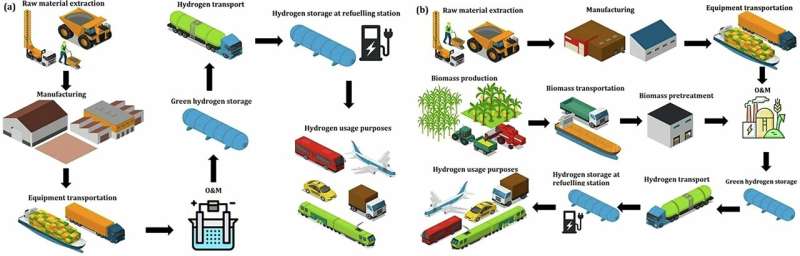
The researchers, led by Professor Lenny Koh, an expert in supply chains at the University’s Management School, evaluated 20 possible scenarios for producing and transporting green hydrogen across 14 countries from 2023 through to 2050. The countries included were the U.K., Japan, China, France, Norway, Canada, Germany, South Korea, the U.S., Austria, Ireland, Poland, Italy, and the Netherlands—all of which were chosen because they are currently world leaders in hydrogen development.
The research focused on five different ways of making hydrogen fuel—three of which used electrolysis and two of which used biomass systems—the current main production methods globally.
How production methods shape impact
Results show that in 2023, electrolysis technologies had the highest global warming impacts, mainly due to their energy-intensive operation, maintenance and manufacturing stages, as well as how the electricity used in these systems largely came from grids that were powered by oil, gas or coal.
However, the research suggests that making hydrogen via proton exchange membrane—a type of electrolysis—could be the most sustainable option by 2050, if the grids supplying the electricity have moved away from fossil fuels.
Many of the study’s scenarios project substantial reductions in greenhouse gas emissions by 2050, as long as electricity grids become cleaner and countries shift towards renewable energy. In some cases, hydrogen supply chains could reduce key environmental impacts by more than 90% compared with current hydrogen production.
UK–US supply chain potential
One of the most environmentally friendly supply chains could involve both the U.K. and U.S., should they meet their clean energy ambitions, according to the research. This scenario is based on manufacturing hydrogen in the United Kingdom using proton exchange membrane, with significant exports to the United States, which could support the U.S. and U.K.’s ambition to transition to a more resilient energy system by 2050.
Warnings from the research team
Professor Lenny Koh, Professor of Operations Management at the University of Sheffield, said, “Green hydrogen is seen as the answer to the world’s energy crisis in terms of reducing our reliance on imported fossil fuels; however, at present, approximately 96% of hydrogen is made using fossil fuels. We cannot be successful in using hydrogen to reach net zero, if fossil fuels are still playing such a huge role in the hydrogen supply chain.
“Our research suggests that hydrogen could still live up to its promise and play a vital role in the clean energy transition, but only if the electricity used to produce it comes from genuinely low-carbon sources and the full supply chain is designed with sustainability in mind.
“Aligning green hydrogen technology selection with regional decarbonization trajectories is crucial for achieving sustainable and resilient international supply chains by 2050.”
Dr. Moein Shamoushaki, Research Associate at the University of Sheffield’s Management School, and co-author on the study, said, “Our research is clear that the sustainability of green hydrogen very much depends on energy mix and supply chains. Any delays in policy implementation or disruptions to renewable energy deployment could substantially alter the relative sustainability of green hydrogen supply chains.
“Our findings offer valuable insights for governments and policymakers on shaping green hydrogen production, supply chains, and policies that align with global and national net-zero and sustainability goals.”
More information
Moein Shamoushaki et al, Sustainability of green hydrogen technologies depends on energy mix and supply chain, Communications Sustainability (2026). DOI: 10.1038/s44458-025-00033-3
Leave a Reply