
February 26, 2026 by David Appell, Phys.org
Collected at: https://phys.org/news/2026-02-absorption-limit-ultra-thin.html
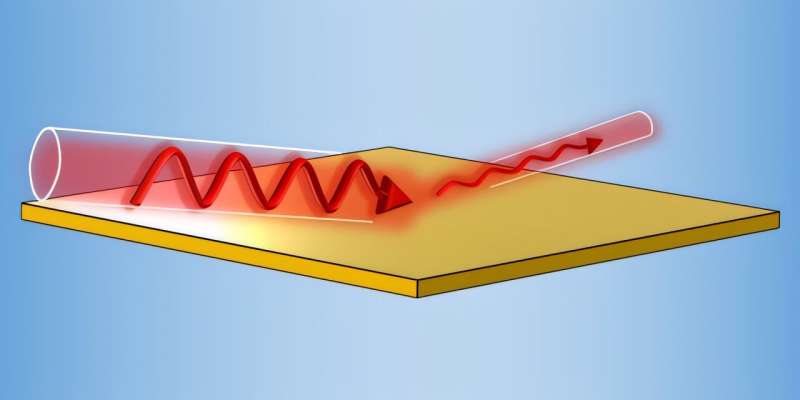
Ultrathin, conductive films such as those made of graphene have many applications, but it’s been thought their efficacy is limited to absorbing only half of the incidental light at best. A research group in China has now shown that absorption can be as high as 82.8% at light grazing angles nearly parallel to the film. This could not only significantly improve design efficiencies but sheds light on light-matter interactions at sizes much lower than the light’s wavelength. Their work has been published in Physical Review Letters.
Graphene ultrathin films, as thin as one carbon atom (about 0.34 nanometers, 300,000 times thinner than a sheet of paper) have many applications: flexible and transparent electronics, energy storage and batteries, solar cells and photovoltaics, sensors and high-speed electronics and more, where they absorb light.
While such films allow for miniaturizing devices and reducing their weight, their extreme thinness has led to the characterization that they are limited to absorbing only half of the incoming light.
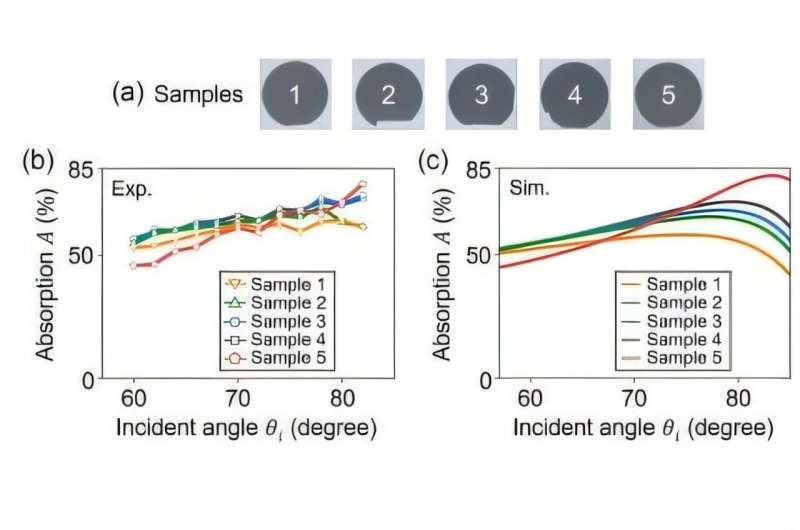
Top: Photographs of five doped silicon wafers with a thickness of about 75 microns and varying conductivities. Bottom left: measured absorption A as a function of a varying incidental angle for TM waves at 0.2 terahertz. Bottom right: simulated absorption for the same wafers and light. Credit: Physical Review Letters (2026). DOI: 10.1103/71vr-lb26
Why scientists thought there was a 50% cap
This 50% limit arises from the electric fields that arise in such a scattering. As the light wave hits the film, the wave is partly reflected and partly refracted. Electric fields are established just above and just below the film. Assuming the film is homogeneous and symmetrical, the electric field parallel to and directly above the field must be equal to its pair below the film, assuming the film is uniform and homogeneous.
In turn, it was thought that this symmetry meant the amount of energy absorbed must be 50%, regardless of the light wave’s frequency, polarization, and angle of incidence. Moreover, it seemed absorption would be zero for a grazing wave that is nearly parallel with the film, perpendicular to the plane of the film.
Theoretical challenge to conventional wisdom
The researchers, Jie Luo at Soochow University in China and colleagues, first tackled the problem theoretically. Their calculations, centered around Maxwell’s equations and fundamental electromagnetic properties of the film material, revealed that for grazing light, the strict reflection-transmission relation does not hold.
This meant for such light absorption could theoretically be higher than 50%. In fact, solving their complicated equation for the absorption gives a notable prediction: it could be as high as 2√2-2, which is 82.8%, when the film thickness is arbitrarily small compared to the light’s wavelength and the incident light’s direction is grazing. At the same time, the minimum reflection is 1–82.8%, which is 17.2%.
“The enhanced absorption of grazing TM waves presents a seeming contradiction,” they write. (TM stands for transverse-magnetic polarization, so the magnetic component of the wave is wholly perpendicular to the wave’s direction of travel, while its electric field components can have a component along the propagation direction.)
“Traditional theory predicts near total reflection and negligible absorption at grazing incidence…. Surprisingly, in our Letter, we unexpectedly report strong broadband absorption enhancement. This contradiction is resolved when considering the extremely high conductivity [at grazing angles]…. [This] compensates for the diminished [parallel electric fields] to maintain a substantial tangential current…thereby enabling efficient energy dissipation.”
In other words, there is no fixed reflection-transmission relationship, so absorption can go past 50%.
Putting the theoretical limit to the test
To test their prediction, the researchers used a 10-micro-thick conductive silicone film hanging in free space, on which they directed TM light with a terahertz frequency. (Such light has a wavelength of about 300 microns.)
They found that the absorption does indeed approach their theoretical limit of 82.8%, though incident angles greater than 80 degrees were difficult to obtain. (Again, this is the angle relative to the plane’s normal direction.) This is because keeping the light beam and the hanging film very close to parallel is difficult in practice—this is a limitation other optoelectronics researchers have found.
So their experimental absorption numbers aren’t trustworthy for incident angles beyond about 80 degrees, but below that they certainly trend to the predicted limit.
They went beyond these results and looked at incident microwaves at 10 GHz, and also for infrared light—for all, absorption peaked at 82.8% at incident grazing angles, a result they called “striking.”
They found the same maximal absorption for conducting materials such as the noble metals such as silver and gold, and an emerging 2-dimensional material called Mxenes. Their findings will enable, they write, “applications in terahertz modulators and wide-angle photodetectors. Their discovery holds significant potential for even more high-performance devices at extreme angles.
Publication details
Yuxuan Liu et al, Breaking the Intrinsic Absorption Limit for Arbitrarily Thin Conductive Films at Grazing Incidence, Physical Review Letters (2026). DOI: 10.1103/71vr-lb26
Journal information: Physical Review Letters
Leave a Reply