
February 27, 2026 by Ingrid Fadelli, Phys.org
Collected at: https://phys.org/news/2026-02-metasurface-based-slm-ar-vr.html
Many cutting-edge technologies, ranging from augmented reality (AR) and virtual reality (VR) to LiDAR (light detection and ranging) systems, rely on components that enable the precise control of light. These components include so-called spatial light modulators (SLMs), systems that dynamically adjust the position of a light wave within its cycle (i.e., phase), as well as its amplitude or direction across several pixels.
Conventional SLMs rely on liquid crystals, materials in a state of matter at the intersection between solid and liquid. While these components are widely used, they typically struggle to reach the speed and pixel density required to create high-quality three-dimensional (3D) images known as holographs.
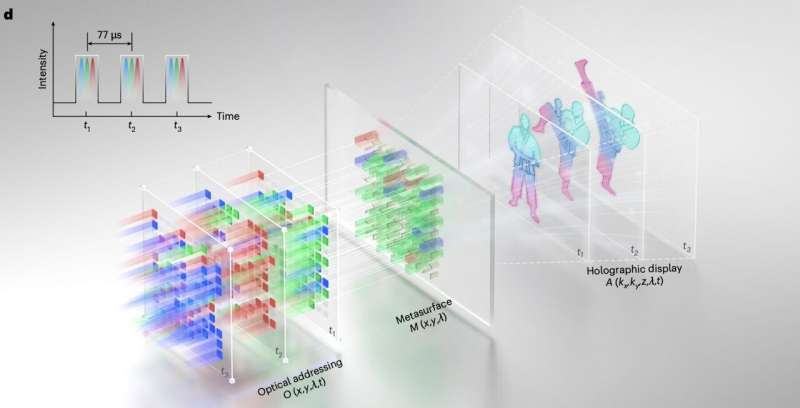
Researchers at Huazhong University of Science and Technology and other institutes recently developed a new metasurface, an ultrathin and nano-engineered surface, that could be used to produce dynamic and high-quality holographic images in real time, with a remarkable definition. The new metasurface, introduced in a paper published in Nature Nanotechnology, was used to create a SLM that could be used to enhance the performance of AR, VR, and LiDAR technology.
“Emerging demands for dynamic wavefront modulation in holographic displays, augmented/virtual reality, and light detection and ranging require spatial light modulators (SLMs) with high pixel density and fast refresh rates,” wrote Xuhao Fan, Wei Xiong, and their colleagues in their paper.
“However, key parameters of existing liquid-crystal and metasurface-based SLMs, such as spatiotemporal product density, field of view and refresh rate, remain far below application requirements. We report an optically addressed metasurface SLM composed of independently tunable meta-atom supercells with a 756 nm pitch.”
A new spatial light modulator
The metasurface developed by Fan, Xiong, and their colleagues is comprised of small structures that can control light. These structures are grouped into supercells that can be controlled using light, as opposed to electrical signals.
“This device reduces SLM pixel size to the submicrometer scale while achieving a spatiotemporal product density of 2.3 × 1012 pixels s−1 cm−2, thereby meeting the critical threshold for true holography,” wrote Fan, Xiong, and their colleagues. “It enables real-time complex-amplitude holography, three-dimensional focusing and beam steering over a ±20.6° field of view in the visible spectrum.”
To evaluate the potential of their metasurface, the researchers used it to develop a SLM, which they then used to generate holographic images. In initial tests, the team’s device was found to significantly outperform conventional SLMs, producing sharper and more realistic 3D images, despite being smaller than existing devices.
An initial demonstration and future applications
In the future, the metasurface-based SLM developed by Fan, Xiong, and their colleagues could be integrated with other components to create specific optical and sensing technologies. For instance, it could enable the development of new displays for VR or AR headsets that allow users to experience digital content even more immersively.
Concurrently, the team’s device could be used to advance LiDAR technologies, remote sensing systems that rely on rapid laser pulses to measure distances between objects and create detailed 3D maps or object representations. The remarkable results achieved by the new SLM could soon also inspire other nanoengineers to design and realize similar metasurfaces that can adjust properties of light faster and with greater precision.
Publication details
Xuhao Fan et al, Spatial light modulator via optically addressed metasurface, Nature Nanotechnology (2026). DOI: 10.1038/s41565-026-02128-x.
Journal information: Nature Nanotechnology
Leave a Reply