
February 27, 2026 by Thomas Jefferson National Accelerator Facility
Collected at: https://phys.org/news/2026-02-asymmetry-proton.html
Getting an up-close view of life at the cellular level can be as simple as placing onion skin under a microscope and adjusting the knobs. Peering deeper, into the heart of the atoms within, isn’t as easy. It requires peeling through layers of particle accelerator data to shed light on protons, neutrons and the subatomic processes at play.
This type of zoom doesn’t use a lens. Clarity is achieved by blending ultrafine physics measurements and theoretical predictions. Now, the first results from the KaonLT experiment at the U.S. Department of Energy’s Thomas Jefferson National Accelerator Facility are adding a new level of detail in the quest to map out how the components of atomic nuclei are put together.
The study, published in the journal Physics Letters B, focuses on producing short-lived particles called mesons, which can provide important information about the particles and forces that form the proton.
The results suggest that the conditions for interpreting meson production in a key framework expected to be valid at high energies, called generalized parton distributions (GPDs), are not yet met. This provides valuable guidance for future efforts to image the proton’s inner workings.
“We’re looking at an energy region where we can extract really exciting observables for information about the 3D structure of the proton,” said Alicia Postuma, a doctoral student at Canada’s University of Regina and the corresponding author on the paper. “It’s expected that the picture will be refined even further as we get more results.”
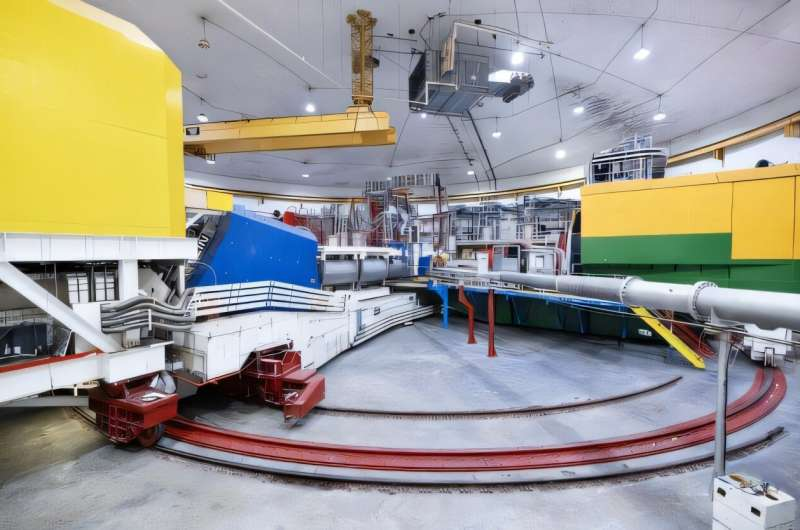
The High Momentum Spectrometer (HMS), left, and the Super High Momentum Spectrometer (SHMS), right, are shown inside Experimental Hall C at Jefferson Lab. HMS and SHMS are movable, magnetic focusing spectrometers that allow researchers to precisely control the particle kinematics they study. Credit: Thomas Jefferson National Accelerator Facility, Aileen Devlin
KaonLT experiment
The KaonLT experiment relies on one of the world’s most powerful microscopes for studying the atom’s nucleus, the Continuous Electron Beam Accelerator Facility (CEBAF) at Jefferson Lab. CEBAF is a DOE Office of Science user facility that enables the research of more than 1,700 nuclear physicists worldwide. And it’s a far cry from the microscopes you may remember from biology class.
“With a classic microscope, you can just put something on the slide and switch on the light,” said Tanja Horn, a physics professor at Catholic University of America in Washington, D.C., and a spokesperson for KaonLT.
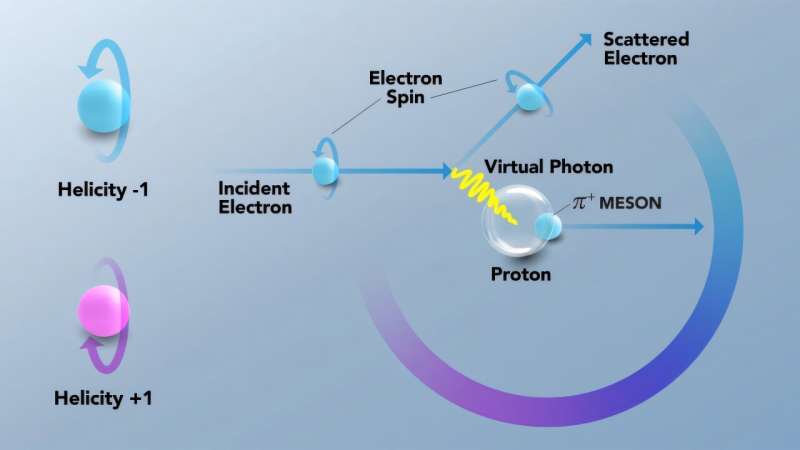
“You can’t do that with a proton. You need an electron to interact with it. They exchange a photon, and the motion of that photon can then be used to probe the proton.”
KaonLT is named after a specific class of mesons, called kaons. All mesons are composed of a quark and an antiquark bound together by a strong nuclear force. These particles can be produced by CEBAF during scattering, when fast-moving electrons interact with protons inside a fixed target. The experiment’s setup also produces pions, another meson variety.
“Mesons are simple systems to study because they have two quarks in their fundamental structure instead of the proton’s three,” Horn said. “If you don’t understand the pion and the kaon, circumstances for understanding the proton appear unpromising. That’s why these particles are so interesting.”
“LT” refers to the spin orientation of virtual photons that are exchanged between an electron and a proton. Virtual photons are fluctuations in the electromagnetic field created when charged particles interact. They can be aligned either longitudinally (L) or transversely (T) relative to the photon’s trajectory or direction.
The experiment detects mesons using a pair of movable, magnetic focusing spectrometers that allow researchers to precisely control the particle kinematics they study. Kinematics describe the dynamics of particles’ motion, such as energy, position, speed and acceleration.
The KaonLT results discussed here take advantage of Jefferson Lab’s expertise in beam-spin asymmetry, where a polarized electron beam (most electrons spinning the same direction) interacts with an unpolarized target (in this case, liquid hydrogen).
Beam-spin asymmetry amplifies small effects that would be hard to detect in unpolarized measurements, helping scientists understand the probability of mesons being produced in this scattering process.
“CEBAF has made a name for itself using longitudinally polarized electrons and flipping the polarization direction back and forth,” said Pete Markowitz, a professor at Florida International University and longtime collaborator at Jefferson Lab.
“This is building off experiments that Jefferson Lab pioneered, and it’s been 20 to 25 years of intense work that’s allowing us to get out these really clean observables.”
First results
The team analyzed pion production data to see whether a pair of subprocesses, called hard (close-range interactions) and soft (long-range interactions), can be factorized, or told apart, at certain energy levels.
“Factorization is when you can clearly separate the hard, which we already know, from the soft, which we want to know,” Postuma said. “Essentially, we’re testing the predictions of different classes of models that say we’re in the factorization regime.”
Knowing the onset of hard/soft factorization is crucial for extracting information from generalized parton distributions (GPDs), which are mathematical objects that represent the quark structure of the proton.
The experiment probes hard/soft factorization using the momentum transfer of the virtual photon. The virtual photon’s momentum transfer is denoted as Q², and the higher the Q², the finer the structural details that can be probed via beam-spin asymmetry.
To determine whether the conditions for factorization are reached, the KaonLT team applied its data to theoretical models to see which best fit at varying levels of Q². Those frameworks included Regge models, which interpret reactions in terms of composite particles rather than the individual quarks described by GPDs.
“Think of the physics described by Regge models as astrophysics before the Hubble Space Telescope, where you could only see macroscopic objects,” Horn said.
“Then, you launch Hubble, and suddenly you can see tiny features. That would be the analog to the physics described by GPDs, where you see the individual quarks. So basically, if our data agrees with the Regge model only, it suggests that we don’t yet have our Hubble.”
A Regge model best fits the KaonLT data, suggesting that hard/soft factorization for this reaction is not met in the studied energy region.
“It’s better to know that you’re not in the factorization regime than to think you are and not be,” said Garth Huber, a University of Regina professor who is also a longtime collaborator at Jefferson Lab. “The value of this result is telling researchers to be cautious trying to get this information in these kinematics, because we’re not there yet.”
Looking to the future
KaonLT’s early success is due in large part to the contributions of graduate students and postdoctoral fellows, who are involved in everything from data analysis to detectors and device calibration.
“This experiment is exciting because it provides many Ph.D. opportunities and research projects for students and early-career scientists,” Horn said, “and we have many of them on KaonLT.”
Postuma, who’s been with the collaboration for three years and is supported by the prestigious Vanier Canada Graduate Scholarships, said she joined at just the right time.
“This paper is my first physics analysis project with this group,” Postuma said. “It builds on work that was done by quite a number of people before I joined, but I came in at a nice time to show up and do some physics.”
To further test its hypothesis, the KaonLT team plans to perform more direct tests of the onset of hard/soft factorization by taking a different look at the data using precision LT-separated cross sections.
Separating the L and T will allow the team to check specific factorization predictions without needing to use theoretical models. This would allow the data to speak for themselves without introducing any uncertainty from theory.
Further KaonLT results will support research at future facilities such as the Electron-Ion Collider, a next-generation particle accelerator being built at Brookhaven National Laboratory in partnership with Jefferson Lab.
“This type of physics is being used as a motivation for wherever the field goes,” Markowitz said. “Right now, these types of studies can only be done at Jefferson Lab.”
Publication details
A.C. Postuma et al, Probing hard/soft factorization via beam-spin asymmetry in exclusive pion electroproduction from the proton, Physics Letters B (2026). DOI: 10.1016/j.physletb.2025.140094
Journal information: Physics Letters B
Leave a Reply