
February 26, 2026 by Santa Fe Institute
Collected at: https://phys.org/news/2026-02-framework-hidden-natural-dynamic.html
Some computers are easy to spot. Artificial, human-built computers like those found in smartphones and laptops are abstract dynamic systems with observable computational elements like input, output, energy cost, and logical processes. Other computers aren’t so readily recognized.
Scientists have argued that many natural dynamic systems—from cells to brains to turbulence in fluids—carry out computations, too. However, it’s not always been clear what these dynamic systems are computing, or how they might be harnessed to solve tasks, says SFI Professor David Wolpert.
Defining computation in natural systems
“The issue is how to define, formally, a set of criteria for identifying what computation(s) a given, arbitrary dynamical system does, in order to give us insights into these computational systems found in nature,” says Wolpert.
Such criteria, he says, would be powerful tools for investigating what it means to compute, in the broadest sense of the word. They would also reveal connections between what he calls “constructed” computers, which would include those found in phones and laptops, and those that are “non-constructed,” these natural systems that can carry out computations but remain poorly understood.
A paper in the Journal of Physics: Complexity offers a way forward.
A new mapping between systems
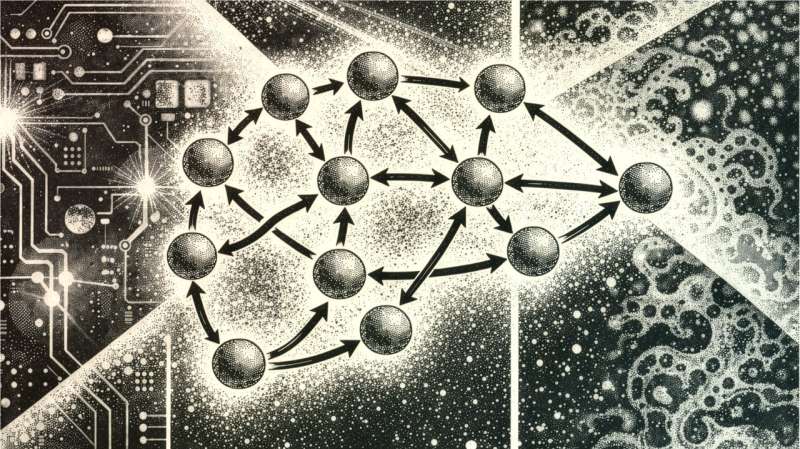
In the article, Wolpert and Jan Korbel, a postdoctoral researcher at the Complexity Science Hub in Vienna, Austria, describe a novel approach to identifying and studying the computations encoded in a dynamic system. Their framework shows how to map, or connect, computations carried out by a non-constructed system to those carried out by a constructed computer.
For example, a network of chemical reactions can be seen as a kind of non-constructed computer. The input to this system is the initial concentration of chemical reactants.
The output is the concentration of the chemicals after the reaction stops. Looking at a reaction this way, says Wolpert, reveals that chemical reactions “encode” a broad set of computational tasks that align neatly with computing operations that are already well known.
A mapping that connects physical systems to computer counterparts, says Korbel, will allow researchers to probe the computational behavior of any dynamic system. It also provides a way to define computation specifically.
“We can say that some systems can compute and what a particular instance of their dynamics does in fact compute, because now there’s an explicit mapping between an abstract computational device and a real dynamic system,” says Korbel.
A growing collaboration around computation
Wolpert and Korbel have been collaborating on projects related to computing and complexity for years. For instance, in 2022, the two co-organized an SFI meeting focused on the thermodynamics of computing systems, and in the summer of 2025, Korbel attended an SFI working group on stochastic thermodynamics and computer science.
Their collaboration crosses borders, too: both attended an October 2023 meeting on the nature of computing, hosted by the Complexity Science Hub. It brought together researchers from a range of fields to share recent insights and results from investigations into how various systems can be seen to compute.
Those fields included fluid dynamics, neuroscience, and cellular automata—mathematical models that evolve according to simple rules. “They were very different things,” says Korbel. During the meeting, the researchers looked for definitions and rules that could describe computational commonalities.
The paper is part of a special issue of Journal of Physics: Complexity, which features the work by Wolpert and Korbel, and is devoted entirely to the broad question, “What does it mean for a system to compute?” The other papers included in this special issue also highlight work by researchers at the fall meeting in Austria, focused on unmasking computation in its many guises.
More information
David H Wolpert et al, What does it mean for a system to compute?, Journal of Physics: Complexity (2026). DOI: 10.1088/2632-072x/ae3af8
Leave a Reply