
February 23, 2026 by The University of Hong Kong
Collected at: https://techxplore.com/news/2026-02-physics-principle-absorption-barriers-ventilated.html
In everyday life, designing spaces that both let air flow and absorb sound can be a tricky balancing act. Usually, materials that allow air to pass through—like vents—also let sound escape, making it hard to reduce noise effectively. Conversely, sound-absorbing materials like foam often block airflow, limiting their use in ventilated areas.
A research team led by Professor Nicholas X. Fang from the Department of Mechanical Engineering from the Faculty of Engineering at The University of Hong Kong (HKU) has solved this puzzle using new scientific methods and found an exciting breakthrough.
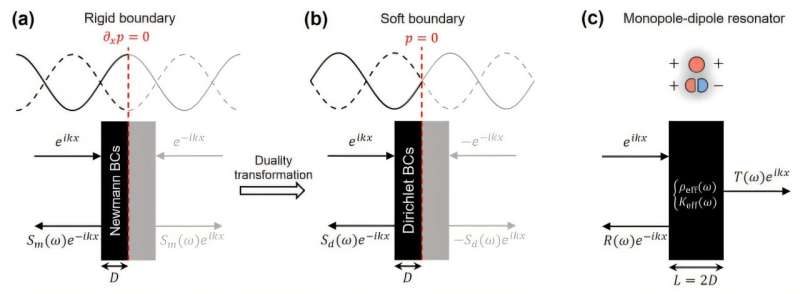
They identified a fundamental physical principle called duality symmetry that sets new limits and opens new possibilities for designing ventilated sound-absorbing materials.
The research, carried out in partnership with Professor I. David Abrahams from the University of Cambridge and industrial partner Acoustic Metamaterials Group Ltd., was published in Nature Communications.
“The most exciting moment for me was realizing that duality symmetry—a concept from field theory—governs the absorption bandwidth of a ventilated system,” said Dr. Sichao Qu, lead author and Research Assistant Professor at HKU’s Department of Mechanical Engineering. “Symmetry and absorption bandwidth were previously unrelated ideas. Our derivation reveals a deep mathematical coupling between them.”
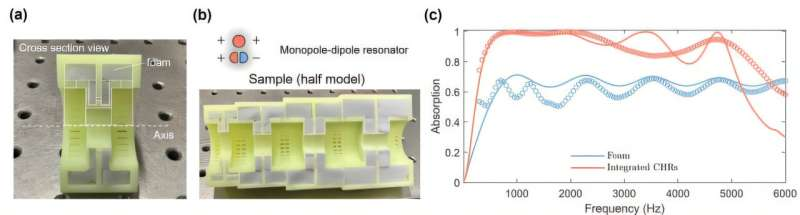
Sample photographs of a high-performance ventilation silencer. (a) Single resonant unit. (b) Integrated resonant unit. (c) Measured absorption spectrum (compared to a conventional sponge). Credit: Nature Communications (2025). DOI: 10.1038/s41467-025-65786-w
The team designed a new type of ventilated structure made of two connected acoustic chambers. This setup allows air to flow freely while trapping and dissipating sound energy through a process called destructive interference, significantly improving noise reduction.
Experiments showed that this innovative material could absorb over 86% of sound across a wide range of frequencies—from low (300 Hz) to high (6,000 Hz)—outperforming traditional foam panels of the same thickness. The researchers also introduced a new performance measure called the figure of merit (FOM), which evaluates how well the system works across bandwidth, thickness, and airflow all at once.
Traditionally, the well-established physics principle, “causality constraint,” defines a theoretical limit between material thickness and bandwidth. This new study not only challenges those limits for ventilated systems but also provides a new design approach based on duality symmetry.
Such advances could lead to quieter buildings, better noise control in aircraft engines, and more effective damping solutions in various engineering fields. With the help of artificial intelligence (AI) and advanced simulation techniques, this breakthrough holds strong potential for real-world applications, making our environments quieter and more comfortable without sacrificing ventilation.
Publication details
Sichao Qu et al, Generalized causality constraint based on duality symmetry reveals untapped potential of sound absorption, Nature Communications (2025). DOI: 10.1038/s41467-025-65786-w
Journal information: Nature Communications
Leave a Reply