
February 17, 2026 by Krystal Kasal, Phys.org
Collected at: https://phys.org/news/2026-02-ai-tonggeometry-generates-olympiad-geometry.html
The International Mathematical Olympiad (IMO) is a prestigious competition featuring talented high school students from around the world, in which competitors solve complicated mathematical problems. Geometry problems from these kinds of competitions—in particular, the formal logic and spatial reasoning involved—has been noted as a critical benchmark in artificial intelligence (AI) research.
Now, a team in China has developed an AI system capable of both solving and generating these olympiad-level geometry problems. The new AI system, TongGeometry, performs as well as top human olympiads in a domain requiring deep creativity and reasoning. Its achievements are detailed in the research team’s new study, published in Nature Machine Intelligence.
Automated reasoning in geometry
Some AI systems are currently capable of solving olympiad-level geometry problems, but proposing them requires mathematical mastery, as well as aesthetic sensibility, which is difficult to achieve in AI systems. Previous systems, like AlphaGeometry, focused on solving only, and still required significant computational resources.
The study authors write, “The most admired problems exhibit deceptive simplicity: accessible through fundamental knowledge yet demanding profound creativity for complete solutions. Mathematical elegance, particularly symmetry in various forms, serves as a critical quality criterion in prestigious competitions.”
The visual and constructive nature of geometry presents hurdles for AI. Fundamental limitations arise in computational approaches to olympiad geometry problems from the “combinatorial explosion of reasoning paths and scarcity of exemplar problems for heuristic development,” according to the study authors.
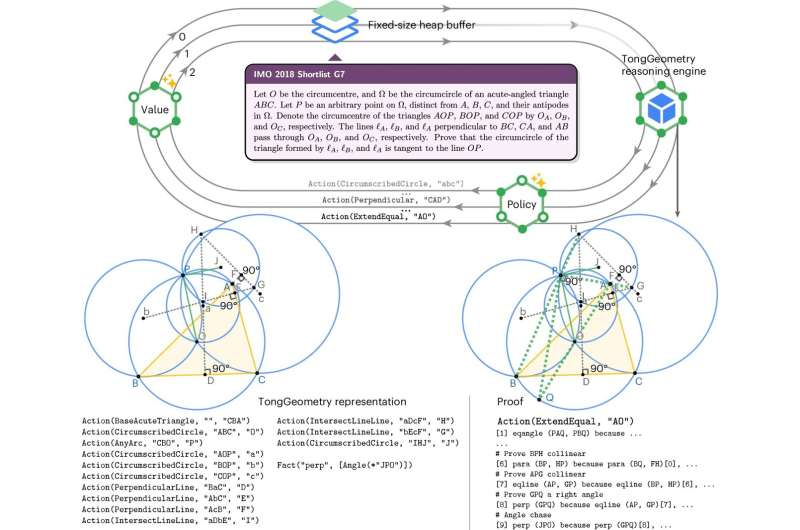
TongGeometry’s actor–critic-style neural architecture for geometric problem solving. Credit: Nature Machine Intelligence (2026). DOI: 10.1038/s42256-025-01164-x
TongGeometry: Olympiad-level problem proposer and solver
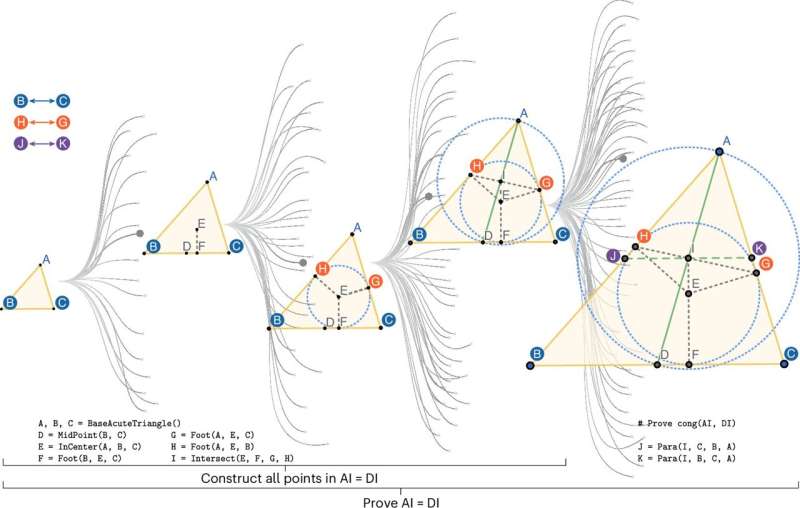
TongGeometry, a neuro-symbolic system that uses a guided tree search with a Markovian framework to model geometric reasoning, seems to largely overcome the hurdles presented by these geometry problems. The team developed the system by fine-tuning two large language models—one that suggests search directions, and another that estimates reasoning steps.
Using 196 olympiad problems from previous competitions as guiding statistics, the system generated a repository of 6.7 billion geometry problems, of which 4.1 billion exhibited mathematical symmetry. Three of these problems were selected for major math olympiads in China and the USA.
The researchers also tested out TongGeometry’s solving abilities with a dataset curated for AlphaGeometry (IMO-AG-30) and a new dataset (MO-TG-225), both serving as benchmarks. IMO-AG-30 included 30 problems from 23 years of IMO competitions, and MO-TG-225 contained 225 known theorems, such as the Euler line theorem. TongGeometry solved all 30 problems in the IMO-AG-30 benchmark, outperforming average IMO gold medalists on this particular dataset. Even more impressively, it did so within 38 minutes, using consumer-grade computing resources.
“TongGeometry’s DD backend demonstrated an improved problem-solving capability over AlphaGeometry’s DD+AR, reaching performance levels close to AlphaGeometry overall. We noted that AlphaGeometry’s success largely stemmed from its backend engine, with 72.5% of total solves achieved by DD+AR.
“By contrast, TongGeometry not only solved a greater proportion of problems (81.3% versus 45.3%) but also more effectively leveraged its neural models to address auxiliary construction challenges, with only 55.2% of the problems solved by DD alone,” the study authors explain.
Educational and research potential
Although TongGeometry did not cover all possible geometry problems, like those requiring algebraic or combinatorial reasoning, it could be extended to other areas of mathematics. It has already demonstrated practical deployment in educational settings, in which experienced IMO coaches review and adjust the problems, and then use them with students.
“This curated collection is then presented to students, serving a dual purpose: it provides a rich source of training material that helps students master complex topics and competition-specific techniques, simultaneously acting as a powerful creative aid for coaches and helping them to brainstorm interesting and challenging problems for their teams,” the authors write.
The authors also note the potential for TongGeometry to be used in research and for advancing computational geometry and mathematics education.
Publication details
Chi Zhang et al, Proposing and solving olympiad geometry with guided tree search, Nature Machine Intelligence (2026). DOI: 10.1038/s42256-025-01164-x
Journal information: Nature Machine Intelligence
Leave a Reply