
February 20, 2026 by Sam Jarman, Phys.org
Collected at: https://phys.org/news/2026-02-tissues-propelled-topological-defects-biophysicists.html
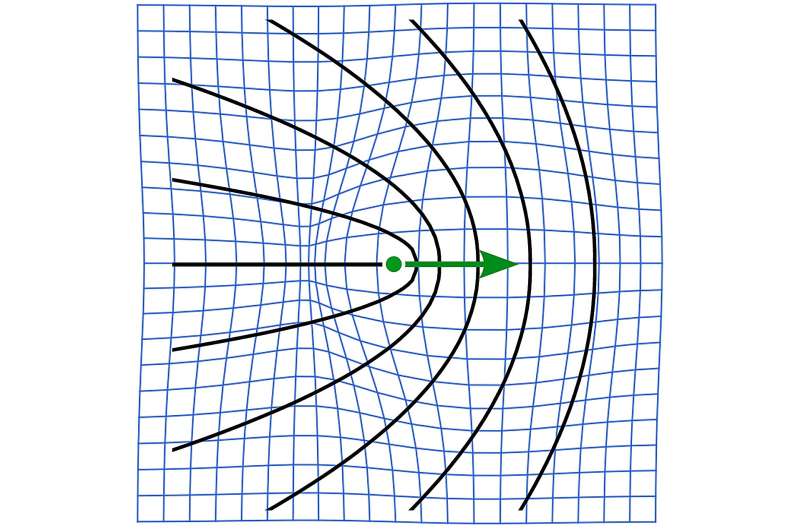
With a new mathematical model, a team of biophysicists has revealed fresh insights into how biological tissues are shaped by the active motion of structural imperfections known as “topological defects.” Published in Physical Review Letters, the results build on our latest understanding of tissue formation and could even help resolve long-standing experimental mysteries surrounding our own organs.
Topological defects are structural imperfections that emerge in systems hosting multiple, incompatible configurations of particles. They can be found in many different kinds of systems—both natural and manmade—but are especially important for describing “active fluids,” which are composed of particles that constantly harvest energy from their surroundings and convert it into motion, generating their own propulsion.
This behavior also underpins the physics of liquid crystal displays, where topological defects emerge in 2D systems of rod-shaped molecules and help determine how light is modulated to produce the images and colors we see every day on our phones, laptops, and TV screens.
Self-propelling defects
Beyond these immediate technological applications, motions of topological defects in active fluids can trigger a diverse array of more exotic effects.
“Such active systems are driven by internal forces, generated by molecular motors,” explains Fridtjof Brauns at the University of California Santa Barbara, who led the research. “This internal activity leads to many exciting phenomena such as active turbulent flows and self-propelled topological defects that focus mechanical stress.”
These behaviors are especially useful for describing biological systems such as colonies of bacteria, which use energy from their surroundings to propel themselves towards new sources of nutrients.
Defects in living systems
But they aren’t exclusive to fluid systems. As Brauns explains, the same ideas can also be applied to living tissues like muscle, which are made up of bundles of long, thread-like cells. “These tissues often act like solids—they resist forces so the material can’t move freely,” he says. “Instead, forces generate internal strains and stresses that can feed back on orientational order.”
In such a system, topological defects can emerge when the orientations of different clusters of muscle fibers become misaligned. In their study, Brauns’ team set out to understand these mechanics more deeply. To do this, they developed a relatively simple mathematical model capturing the mechanical forces muscles experience as they contract and relax.
“We show that topological defects in active solids behave fundamentally differently from those in active fluids,” Brauns describes. “In particular, we find a new mechanism for self-propulsion of the defects, which move relative to the solid material.”
Origins of tissue shapes
The team’s discoveries could have especially important implications for our understanding of “morphogenesis”—the process by which organisms acquire their shape and structure. Previously, biophysicists have recognized the importance of topological defects in the ability of the aquatic organism Hydra vulgaris to regenerate its body parts.
By offering a deeper description of how mechanical forces can move and position these imperfections, the team’s results could help explain more generally how different organisms acquire their body shapes.
“In addition, our theory may explain puzzling observations from in-vitro experiments on kidney tissue where topological defects have been found to move in the opposite direction than predicted by active fluid models.” Brauns adds. “In the active solid case, direction can be reversed compared to an active fluid, thus possibly resolving the puzzle.”
Publication details
Fridtjof Brauns et al, Active Solids: Topological Defect Self-Propulsion Without Flow, Physical Review Letters (2026). DOI: 10.1103/xv94-xpz2. On arXiv: DOI: 10.48550/arxiv.2502.11296
Journal information: Physical Review Letters , arXiv
Leave a Reply