
February 20, 2026 by SPIE
Collected at: https://phys.org/news/2026-02-phonon-lasers-ultrabroadband-acoustic-frequency.html
Acoustic frequency combs organize sound or mechanical vibrations into a series of evenly spaced frequencies, much like the teeth on a comb. They are the acoustic counterparts of optical frequency combs, which consist of equally spaced spectral lines and act as extraordinarily precise rulers for measuring light.
While optical frequency combs have revolutionized fields such as precision metrology, spectroscopy, and astronomy, acoustic frequency combs utilize sound waves, which interact with materials in fundamentally different ways and are well-suited for various sensing and imaging applications.
However, existing acoustic frequency combs operate only at very high, inaudible frequencies above 100 kHz and typically produce no more than a few hundred comb teeth, limiting their applicability.
Record-setting acoustic comb performance
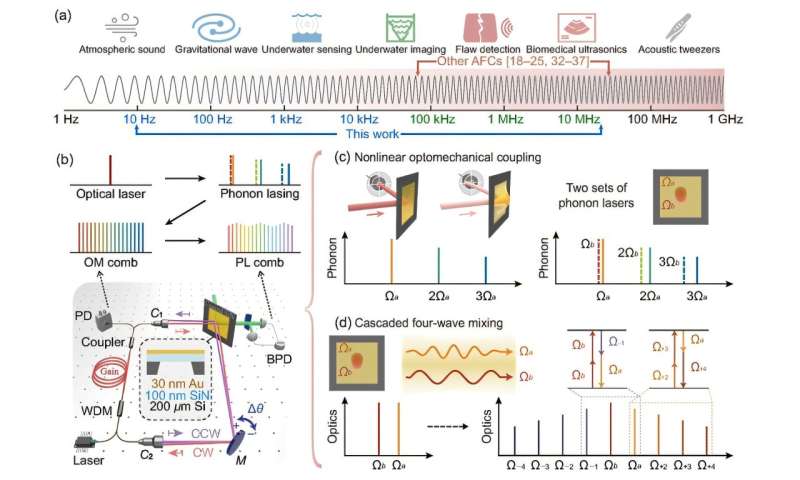
Now, in a study published in Advanced Photonics, researchers report an acoustic frequency comb containing up to 6,000 teeth, with spacing tunable across a wide range from about 10 Hz to 100 kHz.
Conducted in collaboration with researchers from China, Japan, India, Singapore, the U.S., and the United Arab Emirates, the work demonstrates the highest tooth count and the broadest tunable bandwidth achieved in an acoustic frequency comb to date.
How the phonon-laser comb works
The breakthrough is enabled by a new way of generating the mechanical vibrations that form the comb, using phonon lasers. In this approach, an ultra-thin silicon nitride membrane, only about 100 nanometers thick, acts as a tiny mechanical drum. The membrane is placed inside an optical cavity, where laser light circulates many times, and the entire system is kept in a low-pressure vacuum to minimize interference from air.
As the laser power increases, the circulating light exerts a stronger radiation pressure on the membrane, tightly coupling the intracavity light to the membrane’s motion.
Once the laser power exceeds a critical level, the membrane starts vibrating at specific, well-defined frequencies, along with their harmonics. This marks the onset of phonon lasing, a state where mechanical vibrations become as orderly and intense as optical laser light, but in the form of sound.
These coherent vibrations modulate the laser light inside the cavity, producing an intermediate optomechanical frequency comb. As the interaction strengthens further, nonlinear wave mixing between different vibrational modes causes the system to develop into a fully developed phonon-laser frequency comb, made up of thousands of evenly spaced acoustic frequencies.
Uniquely, the comb exists simultaneously in both mechanical and optical domains, providing acoustic and optical output channels at the same time, a capability not previously demonstrated in acoustic frequency comb systems.
Potential applications and next steps
This work sets new performance records for acoustic frequency combs and opens the door to applications in underwater sensing, structural flaw detection, and biomedical ultrasonics.
“Compared to previous acoustic frequency combs, our phonon-laser comb features phonon lasing, a record-high number of teeth, tunable spacing, and a broad bandwidth spanning the low-frequency audible region,” comments Prof. Franco Nori.
Currently, the phonon-laser frequency comb operates at pressures up to 1 kPa. The next step is to adapt the system for operation at normal atmospheric pressure, a critical requirement for many real-world applications.
“This could be achieved using advanced nanofabrication techniques such as dissipation dilution and metasurface engineering, which would improve the mechanical quality of the membrane and reduce air damping, thereby expanding the technology’s practical impact,” concludes Nori.
Publication details
Guangzong Xiao et al, Ultrabroadband phonon laser frequency comb, Advanced Photonics (2026). DOI: 10.1117/1.ap.8.2.026004
Journal information: Advanced Photonics
Leave a Reply