

By University of Warwick February 11, 2026
Collected at: https://scitechdaily.com/physicists-unlock-a-new-way-to-detect-tiny-fluctuations-in-spacetime/
A new theoretical framework shows how subtle fluctuations in spacetime could be detected using existing interferometers.
Researchers led by the University of Warwick have created a single, practical roadmap for hunting “spacetime fluctuations,” the tiny random ripples that many quantum gravity ideas suggest could be woven into spacetime itself.
The possibility that spacetime is not perfectly smooth was raised decades ago by physicist John Wheeler. Since then, multiple leading approaches to quantum gravity have pointed to some form of underlying jitter. The problem is that these theories do not agree on the details. Different models imply different patterns of randomness, so experiments have not had a clear, shared target for what a real signal should look like.
In a new Nature Communications study, the team tackles that mismatch by organizing the possibilities into three broad classes based on how structured the fluctuations are across space and time. Instead of asking experimentalists to chase one specific theory, the framework starts from the mathematical description of a hypothesized fluctuation and works forward to what an instrument should measure.
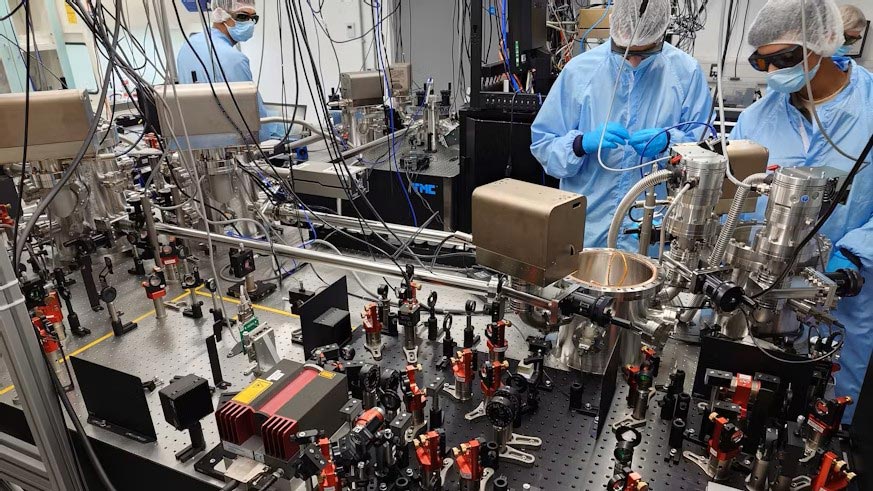
Interferometers do not measure spacetime directly. They compare the travel time of laser light along different paths, making them extraordinarily sensitive to minute changes in length. The researchers show how each category of fluctuation would imprint a distinct signature in interferometer data, from the 4km long LIGO detector to smaller laboratory instruments such as QUEST and GQuEST being developed in the UK (Cardiff University) and USA (Caltech) respectively.
Turning Theory Into Measurable Signals
Dr. Sharmila Balamurugan, Assistant Professor, University of Warwick and first author said: “Different models of gravity predict very different underlying trends in the random spacetime fluctuations, and that has left experimentalists without a clear target. Our work provides the first unified guide that translates these abstract, theoretical predictions into concrete, measurable signals.”
She continues, “It means we can now test a whole class of quantum-gravity predictions using existing interferometers, rather than waiting for entirely new technologies. This is an important step towards bringing some of the most fundamental questions in physics firmly into the realm of experiment.”
What the Study Reveals About Interferometers
The study found that:
- Tabletop interferometers beat LIGO in bandwidth
- Although they are much smaller than LIGO, QUEST and GQuEST may be able to reveal more detailed information about the character of spacetime fluctuations. Their broad frequency coverage enables them to capture all of the predicted signatures.
- LIGO is an excellent “yes/no” detector.
- Because of its long arm cavities, LIGO is extremely sensitive to whether spacetime fluctuations are present at all, even though the relevant frequencies are higher than those currently available in public datasets.
- A long-running debate is resolved.
- The study resolves ongoing disagreement over the role of arm cavities in detection. The results show that arm cavities can increase an interferometer’s sensitivity to spacetime fluctuations, depending on the specific type of fluctuation being examined.
Dr. Sander Vermeulen, Caltech, co-author of the study said: “Interferometers can measure spacetime with extraordinary precision. However, to measure spacetime fluctuations with an interferometer, we need to know where, i.e., at what frequency, to look, and what the signal will look like. With our framework, we can now predict this for a wide range of theories. Our results show that interferometers are powerful and versatile tools in the quest for quantum gravity.”
Broader Implications Beyond Quantum Gravity
Crucially, the new framework developed here is agnostic of the underlying mechanism for the fluctuations: it requires only the mathematical description of the hypothesized fluctuations and the geometry of the instrument. This makes it a powerful tool not only for quantum-gravity tests but also for searches for stochastic gravitational waves, dark-matter signatures, and certain forms of instrumental noise.
Prof Animesh Datta, Professor of Theoretical Physics at Warwick, concluded: “With this methodology, we can now treat any proposed model of spacetime fluctuations in a consistent, comparable way. In the coming years, we can use this to design smarter tabletop interferometers to confirm or refute possible theories of quantum or semiclassical gravity and even test new ideas about dark matter and stochastic gravitational waves.”
Reference: “Signatures of correlation of spacetime fluctuations in laser interferometers” by B. Sharmila, Sander M. Vermeulen and Animesh Datta, 23 December 2025, Nature Communications.
DOI: 10.1038/s41467-025-67313-3
This work was funded by the UK STFC “Quantum Technologies for Fundamental Physics” program (Grant Numbers ST/T006404/1, ST/W006308/1 and ST/Y004493/1) and the Leverhulme Trust under research grant ECF-2024-124 and RPG-2019-022.
Leave a Reply