
February 15, 2026 by Ingrid Fadelli, Phys.org
Collected at: https://phys.org/news/2026-02-strong-superconductivity-supermoir-lattice.html
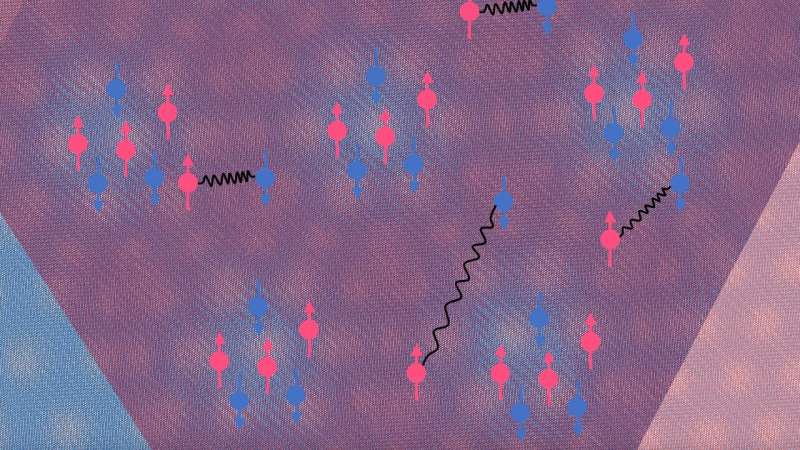
Two or more graphene layers that are stacked with a small twist angle in relation to each other form a so-called moiré lattice. This characteristic pattern influences the movement of electrons inside materials, which can give rise to strongly correlated states, such as superconductivity.
Researchers at Ecole Polytechnique Fédérale de Lausanne, Freie Universität Berlin and other institutes recently uncovered a strong superconductivity in a supermoiré lattice, a twisted trilayer graphene structure with broken symmetry in which several moiré patterns overlap. Their paper, published in Nature Physics, could open new possibilities for the design of quantum materials for various applications.
“Fabricating a twisted trilayer graphene device with two distinct twist angles was not our original intention,” Mitali Banerjee, senior author of the paper, told Phys.org. “Instead, we aimed to make a device in which the two twist angles are identical in magnitude (magic-angle twisted trilayer). During our measurements, however, my student Zekang Zhou found that the phase diagram of this device differs fundamentally from that of magic-angle twisted trilayer graphene.”
The signals recorded by Zhou exhibited an asymmetry with respect to the electric displacement field. This essentially means that when the researchers applied an electric field in one direction and the opposite direction, the magic-angle twisted trilayer system they developed behaved differently.
They found that this effect prompted the emergence of a resistive state in many distinct regions of the material. The team found that it exhibited various interesting states and transitions, which they set out to explore further.
“The rich phase diagram inspired us to pursue this system,” said Banerjee. “The project developed in a direction we had not originally anticipated. It ultimately revealed that the supermoiré degree of freedom provides a powerful new way to engineer and explore novel quantum phases in graphene-based systems.”
Probing the superconductivity of twisted trilayer graphene
The main objective of the recent study by Banerjee, Zhou and their colleagues ultimately became to determine whether strong superconductivity could emerge in a twisted trilayer graphene system with broken mirror symmetry. To do this, the researchers collected a series of low-temperature electrical transport measurements in the device that they had originally developed.
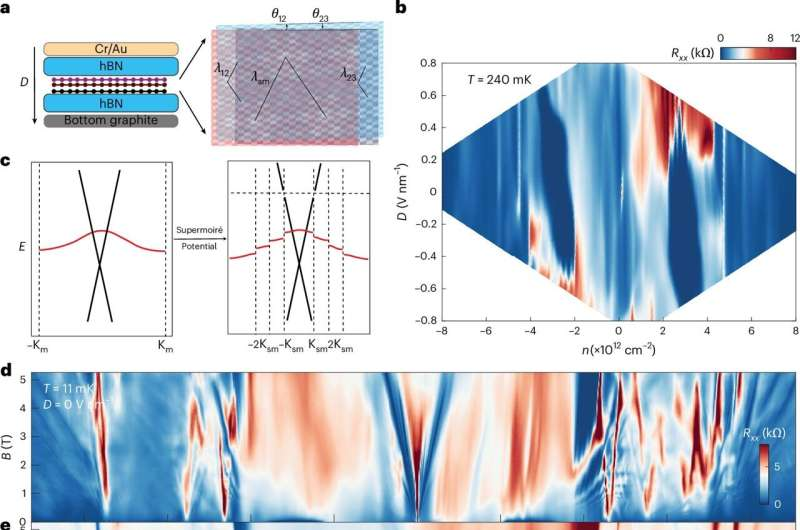
Mirror-symmetry-broken TTG. Credit: Nature Physics (2026). DOI: 10.1038/s41567-025-03131-0
“First, we measured its electrical resistance while carefully tuning two key parameters: the carrier density (by applying a gate voltage) and the displacement field (by applying an electric field across the layers, by tuning both top and back gates),” explained Banerjee. “This allowed us to map out the full phase diagram of the system.”
A transition to superconductivity is characterized by a dramatic drop in electrical resistance, down to a resistance of almost zero. When they collected their measurements, the researchers observed this near-zero resistance in their device, which hinted at the emergence of superconducting states.
“To verify that this zero-resistance state corresponds to superconductivity, we performed standard characterization measurements,” said Banerjee.
“Temperature-dependent measurements revealed that the superconducting (zero-resistance) state is gradually suppressed as temperature increases. Furthermore, we observed strong nonlinear transport behavior: the system transitions from the superconducting state to the normal state above a critical DC current, whose value is also suppressed by the out-of-plane magnetic field.”
Strong superconductivity with symmetry-broken phases
The researchers’ measurements ultimately showed that the superconducting states in their device were suppressed by magnetic fields in a unique way. Their device does not preserve mirror symmetry, as the two twist angles between its different layers are different, yet it exhibited a strong superconductivity.
“We performed further experimental characterizations to elucidate the system’s behavior and identified the presence of a supermoiré lattice through the Brown-Zak oscillations,” said Banerjee. “Brown-Zak oscillations are repeating patterns in electrical resistance that appear when electrons move through a material under a magnetic field and become synchronized with a repeating lattice pattern. When this synchronization happens, the resistance oscillates in a regular way.”
The oscillations observed by Banerjee and her colleagues suggest that the electrons in their systems are influenced by a larger periodic structure. This ultimately confirmed that the graphene layers formed a so-called supermoiré lattice.
“Despite this symmetry breaking, we still observed robust superconducting regions with clear critical temperatures and critical magnetic fields,” said Banerjee. “This demonstrated that strong superconductivity survived and can even be modulated, in twisted trilayer graphene without mirror symmetry. The credit for this work goes to the first author of this paper, Zekang Zhou, who very carefully characterized the device and noticed all the distinct features.”
Informing the design of quantum materials
Over the past decade or so, twisted graphene systems and twisted systems based on materials have emerged as promising platforms for the study and realization of quantum phases. This recent study shows that supermoiré lattices, specifically a twisted graphene system with a further layer of patterning, could exhibit an even more intricate range of quantum phases.
“Numerous quantum phases, including superconductivity, the (fractional) quantum anomalous Hall effect, and others have been observed in twisted systems,” said Banerjee.
“Our findings demonstrate that, in twisted multilayer systems, the interference between distinct moiré lattices constitutes a new degree of freedom. This degree of freedom not only facilitates a deeper understanding of the quantum phases inherent to the original moiré lattices but also enables the design and realization of novel quantum states by leveraging the existing quantum phases of moiré lattices.”
This recent study could soon inform the design of materials and devices with entirely new electronic properties. These systems could prove promising for the development of quantum devices and other cutting-edge technologies.
Banerjee and her colleagues are now planning further studies focusing on systems in which moiré quasicrystals arise alongside supermoiré lattices. Specifically, they will try to uncover the precise conditions required to stabilize a supermoiré lattice within this multidimensional parameter space.
“Our next studies will also investigate the microscopic origin of superconductivity in the system we devised,” added Banerjee. “The system exhibits behavior analogous to twisted bilayer graphene (TBG) combined with a monolayer graphene modulated by a supermoiré potential; however, the TBG component in this structure is far from the magic angle. A key open question is thus why robust superconductivity is still observed under these conditions.”
Publication details
Zekang Zhou et al, Strong correlations and superconductivity in the supermoiré lattice, Nature Physics (2026). DOI: 10.1038/s41567-025-03131-0. On arXiv: DOI: 10.48550/arxiv.2509.24670
Journal information: Nature Physics , arXiv
Leave a Reply