
February 10, 2026 by Tejasri Gururaj, Phys.org
Collected at: https://phys.org/news/2026-02-machine-reveals-hidden-landscape-robust.html
In a new study published in Physical Review Letters, researchers used machine learning to discover multiple new classes of two-dimensional memories, systems that can reliably store information despite constant environmental noise. The findings indicate that robust information storage is considerably richer than previously understood.
For decades, scientists believed there was essentially one way to achieve robust memory in such systems—a mechanism discovered in the 1980s known as Toom’s rule. All previously known two-dimensional memories with local order parameters were variations on this single scheme.
The challenge lies in the sheer scale of possibilities. The number of potential local update rules for a simple two-dimensional cellular automaton is astronomically large, far greater than the estimated number of atoms in the observable universe. Traditional methods of discovery through exhaustive search or hand-design are therefore impractical at this scale.
The research addresses a fundamental problem at the intersection of nonequilibrium physics, complex systems, fault-tolerant computation, and biological information processing. It asks how a system made of many simple, locally interacting parts can collectively protect information against degradation.
Phys.org spoke to Aditya Bhardwaj, a graduate student at Caltech’s Institute for Quantum Information and Matter, and Nathaniel Selub, a physics graduate student at UC Berkeley, co-authors of the study.
“A big inspiration for us was how natural systems store information robustly, even in noisy or disruptive environments, using only simple local interactions,” explained Bhardwaj.
“We originally asked whether similar mechanisms could be useful for quantum computing, where the central challenge is protecting extremely fragile quantum information from constant noise and errors.”
Understanding how these memories work requires first understanding what makes storing information in noisy, locally interacting systems so difficult.
The challenge of many-body memories
Many-body memories arise when local nonequilibrium dynamics of a many-particle system retain information about its initial state for very long times, even under noise. Here, that information is a single bit stored in the overall magnetization. A familiar example is a magnet, where one bit is encoded in whether most microscopic spins are aligned in one direction or the other.
“What makes this so challenging in nonequilibrium settings is that the environment is constantly injecting errors into the system,” said Selub. “Moreover, because the dynamics are local, there’s no central supervisor that can ‘look at the whole state’ and fix it; correction has to emerge from nearby interactions alone.”
In the models considered in this study, information is stored in the sign of the magnetization of a two-dimensional lattice of spins. Each site interacts only with its neighbors and updates according to a fixed local rule, while noise continually flips spins and can favor one orientation over the other.
The system must detect and correct errors autonomously through its local dynamics, even when perturbations are biased or structured rather than purely random.
Beyond Toom’s rule
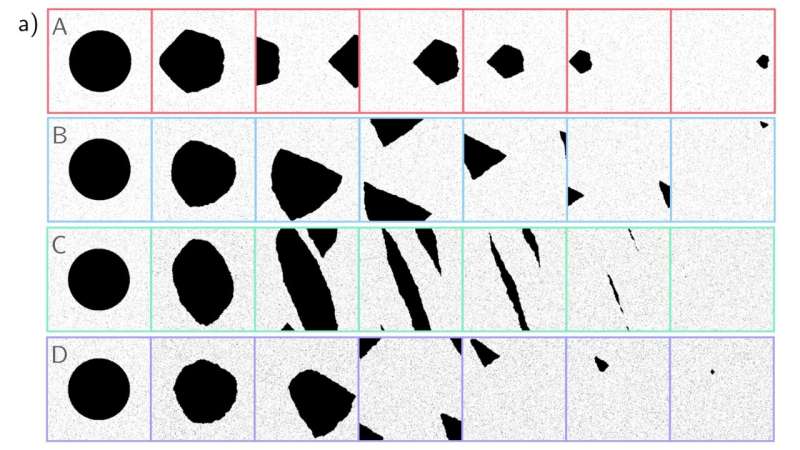
Toom’s rule works by having each cell repeatedly update to the majority vote of specific neighbors arranged in a triangular pattern. Small error domains are pushed in a preferred direction and are gradually eroded until they disappear.
As a first step, the researchers proved mathematically that Toom’s triangular geometry is not unique. They showed that many asymmetric majority-vote rules, in which each cell takes a majority over a chosen nonsymmetric subset of neighbors, also function as robust memories under synchronous updates.
Changing the shape of the voting region changes how error domains are eroded. Different asymmetric arrangements carve away minority domains along different directions, leading to distinct geometric patterns of error correction.
The more surprising discoveries came from using machine learning.
Neural cellular automata reveal hidden mechanisms
“Instead of hand-designing cellular automata, we used neural cellular automata as a differentiable, trainable representation of local update rules,” Bhardwaj explained.
“We represented the cellular automata rule as a small neural network that takes a cell’s neighborhood as input and outputs its next state. This turns the search for memory-preserving rules into a machine-learning problem rather than a combinatorial one.”
The neural networks were trained using gradient descent with a loss function that directly rewards memory retention under noise. The system starts in one of two states encoding a bit, evolves under the learned rule, and is penalized if it forgets which state it started in.
In 1,000 training runs with different random initializations, 37 cellular automata converged to robust memories. Remarkably, none implemented majority votes or were symmetric, and all corrected errors through qualitatively different mechanisms than Toom’s rule.
“Some don’t rely on majority voting at all, some work without the symmetries Toom’s rule depends on, and others are actually stabilized by noise rather than destroyed by it,” said Selub. “Machine learning revealed new memory mechanisms that we likely would not have found through traditional analytical reasoning.”
Fluctuations as a feature
Perhaps the most counterintuitive finding was a class of memories that actually require noise to function properly. In these cases, the zero-noise dynamics have exponentially many long-lived configurations: the system can become trapped in “frozen” local error patterns that the update rule cannot reliably eliminate.
With moderate noise, occasional random flips dislodge the system from these frozen patterns, allowing the local rule to steer it back toward one of the two intended memory states.
“Physically, ‘requiring noise’ means the system doesn’t behave like a standard memory where reducing noise always improves performance,” Bhardwaj explained. “In our case, in the zero-noise limit, the dynamics can become trapped in many long-lived, frozen configurations—local error patterns that the update rule cannot reliably eliminate.”
The authors also found that standard mean-field theory, which neglects fluctuations by assuming all sites see only an average environment, completely fails to predict the ordered phases of several of the learned rules. Mean-field calculations suggest these memories should be unstable; however, the full dynamics remain ordered and preserve information.
This points to a new type of fluctuation-stabilized order, distinct from conventional “order by disorder,” where noise and local fluctuations are an essential part of how the memory works rather than just a source of errors.
Implications and future directions
The findings have direct implications for quantum error correction, which is essential for building practical quantum computers. “Toom’s rule is already used as a local subroutine in some quantum error-correcting schemes, and our results show that there are many alternative memory mechanisms with similar or improved robustness,” said Selub.
The team is now extending their machine-learning approach to quantum systems. In ongoing work, they use reinforcement learning to design local dynamics that protect fragile quantum information, adapting the classical strategy to settings with additional quantum constraints.
Beyond quantum computing, the results point to broader principles for how robust, complex behavior can emerge in locally interacting systems. The authors view these many-body memories as simple examples of “homeostasis,” where a system continually counters noise to maintain stored information, and they suggest that identifying when such robust emergent behavior first appears remains an open challenge for theory.
Publication details
Ehsan Pajouheshgar et al, Exploring the Landscape of Nonequilibrium Memories with Neural Cellular Automata, Physical Review Letters (2026). DOI: 10.1103/2f97-49t1. On arXiv: DOI: 10.48550/arxiv.2508.15726
Journal information: Physical Review Letters , arXiv
Leave a Reply