
February 3, 2026 by National Institute for Materials Science
Collected at: https://phys.org/news/2026-02-cryogenic-cooling-material-solely-abundant.html
In collaboration with the National Institute of Technology (KOSEN), Oshima College, the National Institute for Materials Science (NIMS) succeeded in developing a new regenerator material composed solely of abundant elements, such as copper, iron, and aluminum, that can achieve cryogenic temperatures (approx. 4K = −269°C or below) without using any rare-earth metals or liquid helium.
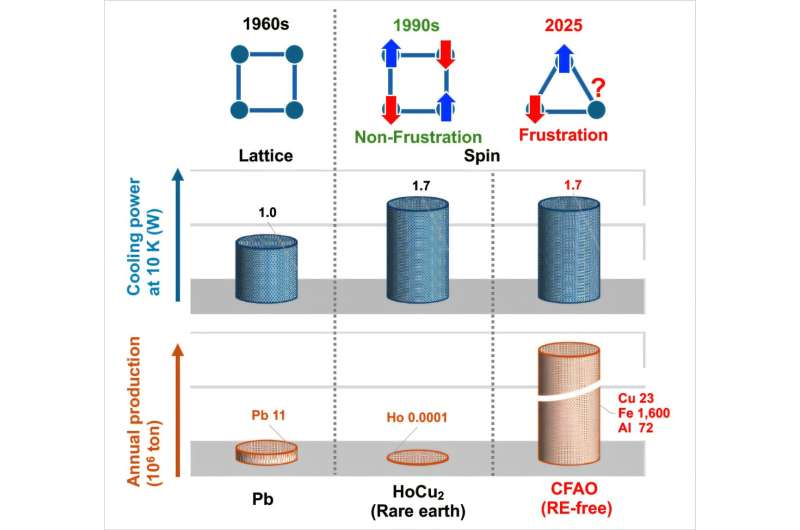
By utilizing a special property called “frustration” found in some magnetic materials, where the spins cannot simultaneously satisfy each other’s orientations in a triangular lattice, the team demonstrated a novel method that replaces the conventional rare-earth-dependent cryogenic cooling technology.
The developed material holds promise for responding to the lack of liquid helium as well as for stable cooling in medical magnetic resonance imaging (MRI) and quantum computers, which are expected to see further growth in demand. The results are published in Scientific Reports.
Cryogenic cooling technology that has primarily been used in medical MRI is strongly dependent on liquid helium and rare-earth elements that are subject to supply instability and resource depletion concerns. For example, holmium, which is currently used in regenerator materials, has an annual production of only 100 tons and its reserves are unevenly distributed. Therefore, with the demand for cryogenic cooling expected to significantly increase in the future, there is a strong need to develop new cooling technology that does not depend on such scarce resources.
In this study, a joint research team from NIMS and the National Institute of Technology (KOSEN), Oshima College, succeeded in developing a regenerator material for mechanical coolers (Gifford-McMahon [GM] coolers) capable of cooling to cryogenic temperatures without using liquid helium, which contains no rare-earth metal elements and uses a material composed of abundant elements.
The team demonstrated that the material exhibits high specific heat at cryogenic temperatures despite being a transition metal, by utilizing an effect known as “frustration,” specifically found in magnetic materials that have a special crystal structure called a triangular lattice, where the spin orientations become difficult to align until they reach cryogenic temperatures. The material achieved performance comparable to that of conventional cooling materials containing rare earths (holmium compounds). This was the first time that a magnetic regenerator material for coolers that does not use rare-earth elements showed practical-level performance.
Publication details
Noriki Terada et al, Innovative cryogenic cooling material using spin frustration from abundant elements, Scientific Reports (2025). DOI: 10.1038/s41598-025-29709-5
Journal information: Scientific Reports
Leave a Reply