
Tanya Weaver Wed 4 Feb 2026
Collected at: https://eandt.theiet.org/2026/02/03/wood-based-material-stores-heat-cut-building-energy-demand
A wood-based material that can store and release heat could help keep building temperatures comfortable without using electricity, according to a new study.
Researchers from the University of Texas at Dallas have developed a type of phase-change material that acts as a thermal battery, absorbing and releasing heat.
In 2020, about 10% of all energy used in the US went towards keeping buildings comfortable to live and work in. Integrated into building structures, such as drywall, flooring or roofing, the stored energy in phase-change materials could help reduce electricity demands for air conditioning and heating and improve overall energy efficiency.
Shuang (Cynthia) Cui, assistant professor of mechanical engineering and corresponding author of the study, said: “During the summer, for example, the phase-change material will absorb and store heat from the exterior, which would reduce the rise of room temperature.
“If the building has enough phase-change material incorporated, the air conditioning may not need to be turned on.”
Equally, the thermal energy storage solution could store daytime heat to provide warmth during colder periods.

University of Texas at Dallas
Phase-change materials collect heat as they melt and release it as they solidify. However, one problem is that these materials can leak when transitioning to liquids. One solution is to enclose them within a host material to prevent leakage, but this may impact effectiveness as the host material does not store heat.
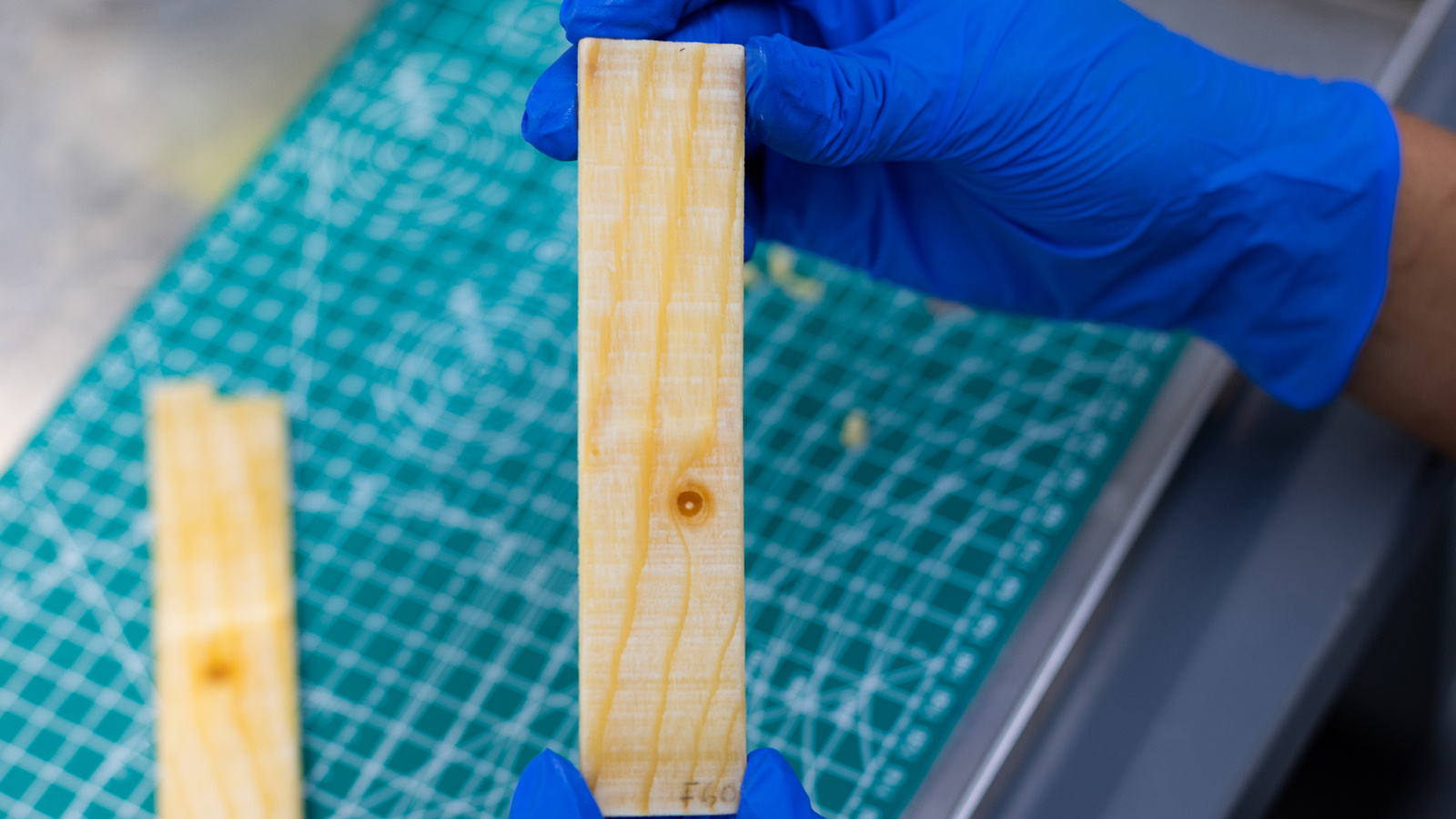
To address this issue, the researchers removed lignin, a substance in plant cells that provides structure and stiffness, from wood to create a spongelike structure with tiny pores. They filled the structure with a phase-change material mixed with an ingredient that forms into soft plastic. The soft plastic holds the phase-change material in place, even when it melts, and strengthens the wood.
According to the team, the resulting material did not leak or degrade over 1,000 phase-change cycles.
Hongbing Lu, professor of mechanical engineering and study co-author, said: “Unlike many energy storage materials that sacrifice strengths, these wood-templated phase-change composites maintain mechanical integrity under repeated heating and cooling cycles, making them both energy efficient and mechanically durable, which are critical for long-term use in buildings.”
The researchers say they plan to continue to improve and commercialise the technology.
The study – ‘Wood template-supported phase change material composites for durable and form-stable thermal energy storage in buildings’ – has been published in the journal Materials Today Energy.
Leave a Reply