
February 4, 2026 by National Research Council of Science and Technology
Collected at: https://techxplore.com/news/2026-02-trash-takeoff-kg-sustainable-aviation.html
The aviation industry accounts for a significant share of global carbon emissions. In response, the international community is expanding mandatory use of Sustainable Aviation Fuel (SAF), which is produced from organic waste or biomass and is expected to significantly reduce greenhouse gas emissions compared to conventional fossil-based jet fuel. However, high production costs remain a major challenge, leading some airlines in Europe and Japan to pass SAF-related costs on to consumers.
Against this backdrop, a research team led by Dr. Yun-Jo Lee at the Korea Research Institute of Chemical Technology (KRICT), in collaboration with EN2CORE Technology Co., Ltd., has successfully demonstrated an integrated process that converts landfill gas generated from organic waste—such as food waste—into aviation fuel.
The development of two catalysts enabling selective production of liquid fuels was published in ACS Catalysis and in Fuel.
Currently, the refining industry mainly produces SAF from used cooking oil. However, used cooking oil is limited in supply and is also used for other applications such as biodiesel, making it relatively expensive and difficult to secure in large quantities.
In contrast, landfill gas generated from food waste and livestock manure is abundant and inexpensive. This study represents the first domestic demonstration of aviation fuel production using landfill gas as the primary feedstock.
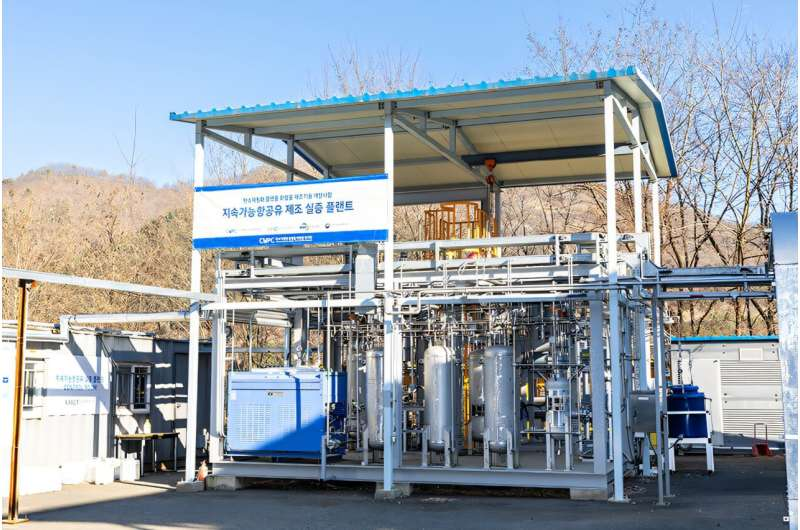
Unlike conventional systems, the use of miniaturized and modular microchannel reactors enables facility deployment at a small scale. Credit: Korea Research Institute of Chemical Technology (KRICT)
Turning landfill gas into jet fuel
Producing aviation fuel from landfill gas requires overcoming two major challenges: purifying the gas to obtain suitable intermediates and improving the efficiency of converting gaseous intermediates into liquid fuels. The research team addressed these challenges by developing an integrated process encompassing landfill gas pretreatment, syngas production, and catalytic conversion of syngas into liquid fuels.
EN2CORE Technology was responsible for the upstream processes. Landfill gas collected from waste disposal sites is desulfurized and treated using membrane-based separation to reduce excess carbon dioxide.
The purified gas is then converted into synthesis gas—containing carbon monoxide and hydrogen—using a proprietary plasma reforming reactor, and subsequently supplied to KRICT.
KRICT applied the Fischer–Tropsch process to convert the gaseous syngas into liquid fuels. In this process, hydrogen and carbon react on a catalyst surface to form hydrocarbon chains. Hydrocarbons of appropriate chain length become liquid fuels, while longer chains form solid byproducts such as wax. By employing zeolite- and cobalt-based catalysts, KRICT significantly improved selectivity toward liquid fuels rather than solid byproducts.
Microreactor innovation and pilot plant
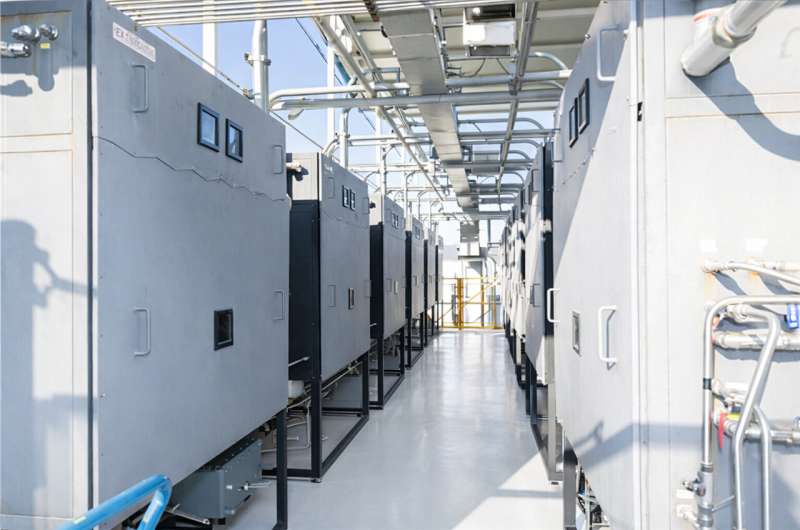
A key innovation of this work is the application of a microchannel reactor. Excessive heat generation during aviation fuel synthesis can damage catalysts and reduce process stability. The microchannel reactor developed by the team features alternating layers of catalyst and coolant channels, enabling rapid heat removal and suppression of thermal runaway.
Through integrated and modular design, the reactor volume was reduced by up to one-tenth compared to conventional systems. Production capacity can be expanded simply by adding modules.
For demonstration purposes, the team constructed an integrated pilot facility on a landfill site in Dalseong-gun, Daegu. The facility, approximately 100 square meters in size and comparable to a two-story detached house, successfully produced 100 kg of sustainable aviation fuel per day, achieving a liquid fuel selectivity exceeding 75%. The team is currently optimizing long-term operation conditions and further enhancing catalyst and reactor performance.
This achievement demonstrates the potential to convert everyday waste-derived gases from food waste and sewage sludge into high-value aviation fuel. Moreover, it shows that aviation fuel production—previously limited to large-scale centralized plants—can be realized at local landfills or small waste treatment facilities.
The technology is therefore expected to contribute to the establishment of decentralized SAF production systems and strengthen the competitiveness of Korea’s SAF industry.
The research team note that the work is significant in securing an integrated process technology that converts organic waste into high-value fuels. KRICT President Young-Kuk Lee stated that the technology has strong potential to become a representative solution capable of achieving both carbon neutrality and a circular economy.
More information: Jae Jun Lim et al, Tailoring Zeolite-Supported Bifunctional Cobalt Catalysts for Direct Conversion of Syngas to Liquid Fuels, ACS Catalysis (2025). DOI: 10.1021/acscatal.5c03696
SeongWoo Jeong et al, Comprehensive study of cobalt-based hybrid catalysts for selective liquid fuel production via Fischer–Tropsch synthesis, Fuel (2026). DOI: 10.1016/j.fuel.2025.136159
Journal information: ACS Catalysis
Leave a Reply