
By Amit Malewar Published: February 3, 2026
Collected at: https://www.techexplorist.com/gravitational-wave-detection-tests-einsteins-theory-gravity/102038/
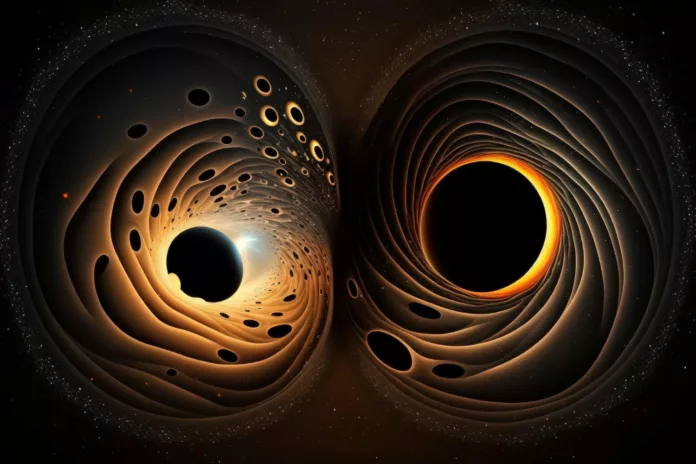
On January 14, 2025, the LIGO detectors recorded the loudest gravitational-wave (GW) signal to date, GW250114_082203, nicknamed GW250114, the most powerful gravitational-wave signal ever recorded. With a signal-to-noise ratio of 76, this cosmic tremor is not just another entry in the catalog of black hole collisions; it is a rare opportunity to test the very foundations of Einstein’s general relativity.
When two black holes collide, the universe rings like a bell. The resulting “tones” carry two key numbers: frequency and damping time. From just one tone, physicists can deduce the mass and spin of the newborn black hole. But GW250114 was so clear that scientists could measure two tones, and even constrain a third.
Cornell physicist Keefe Mitman explained:
“If you measure two or more tones in the data, which a clear signal such as GW250114 allows, each is effectively giving you a different mass and spin measurement, according to general relativity.”
“If those two measurements agree with one another, you are effectively verifying general relativity. But if you measure two tones that don’t match up with the same mass and spin combination, you can start to probe how much you’ve deviated away from general relativity’s predictions.”
In this case, the tones harmonized perfectly with Einstein’s predictions.
The team examined the remnant black hole’s “Kerr nature”, the mathematical description of a rotating black hole in general relativity. By analyzing the dominant quadrupolar mode and its overtone, they found agreement with numerical simulations to within tens of percent.
Their tests spanned the entire life cycle of the collision: inspiral, merger, and ringdown. Remarkably, the constraints were sometimes two to three times more stringent than those achieved by combining dozens of previous events.
The clarity of GW250114 gave physicists a rare chance to push Einstein’s theory to its limits. But what if the tones had disagreed?
Mitman reflected, “Then we would have had a lot of work to do as physicists to try to explain what’s going on and what the true theory of gravity would be in our universe.”
Physicists already suspect that general relativity is incomplete. It cannot explain dark matter or dark energy, and it clashes with quantum mechanics. Somewhere, they believe, cracks must appear.
“There has to be some way to resolve this paradox to make our theory of gravity consistent with our theory of quantum mechanics,” Mitman said. “Along those lines, we expect there to be some deviation from Einstein’s classical prediction, where you might see signatures of quantum gravity imprinting themselves on these gravitational wave signals.”
For now, GW250114 stands as a triumph for Einstein. But the hope is that future signals may reveal deviations, tiny fingerprints of quantum gravity.
“The hope is that we’ll see these deviations one day and that will help guide us along what the true theory of quantum gravity might be,” Mitman said.
Journal Reference:
- A. G. Abac, I. Abouelfettouh, F. Acernese et al. Black Hole Spectroscopy and Tests of General Relativity with GW250114. Physical Review Letters. DOI: 10.1103/6c61-fm1n
Leave a Reply