
February 3, 2026 by Tokyo University of Science
Collected at: https://techxplore.com/news/2026-02-mosi8322-transverse-thermoelectric-effect-electricity.html
Thermoelectric conversion devices offer a promising route for sustainable heat-to-energy conversion. They are particularly attractive for recovering energy from waste heat, such as that produced by conventional fossil fuel-based engines, improving their overall energy efficiency.
Around 20–50% of the input energy is lost as waste heat in industries. This could be used as a source by thermoelectric conversion devices. These devices also have the potential to enable portable power generation, for example, to run small sensors in remote locations.
Limitations of conventional thermoelectric designs
Currently, most thermoelectric devices rely on the longitudinal thermoelectric effect in which electricity is generated in the same direction as heat flow. Such devices generally consist of alternating layers of p- and n-type semiconductors connected in series; p- and n-type semiconductors generate electricity in opposite directions.
When a temperature difference is applied across the device, the charge carriers in these materials move from the hot side to the cold side, generating a voltage. However, stacking many layers increases the electrical contact resistance at their interfaces, which leads to energy losses and limits overall efficiency.
Promise and rarity of transverse devices
Transverse thermoelectric (TTE) devices that generate voltage perpendicular to the direction of heat flow are a promising alternative. Importantly, TTE devices can be made from a single material, eliminating the need for multiple interfaces, significantly reducing contact resistance and improving overall efficiency. This also makes manufacturing simpler. However, materials that exhibit a strong TTE effect are rare.
In a study published in the journal Communications Materials, a research team led by Associate Professor Ryuji Okazaki from the Department of Physics and Astronomy at Tokyo University of Science (TUS), Japan, demonstrated TTE behavior in the mixed-dimensional semimetal molybdenum disilicide (MoSi2).
The team also included Ms. Hikari Manako, Mr. Shoya Ohsumi, and Assistant Professor Shogo Yoshida from TUS, as well as Assistant Professor Yoshiki J. Sato from Saitama University, Japan.
“We wanted to explore new transverse thermoelectric materials. Recently, the presence of axis-dependent conduction polarity (ADCP) in a material has been recognized as an indicator for TTE generation ability,” explains Dr. Okazaki.
“Mixed-metal conductors like MoSi2 are potential ADCP candidates, but their thermopower generation ability has not been thoroughly investigated.”
Probing MoSi₂ transport and polarity
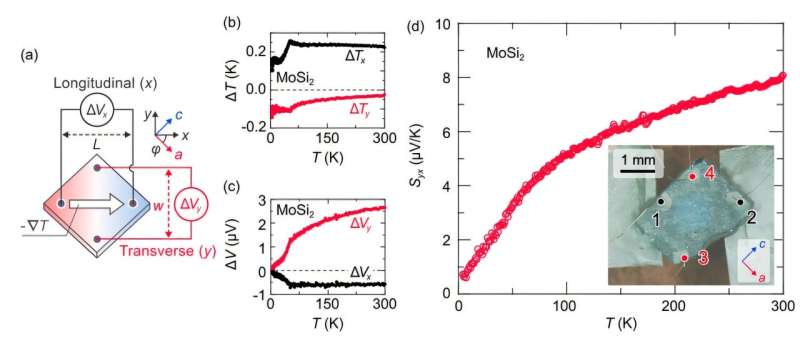
The researchers measured the transport properties of MoSi2 using both experiments and first-principles calculations. Specifically, they examined temperature dependence of resistivity and thermal conductivity, as well as longitudinal thermopower, along the material’s two crystallographic axes. Thermopower measurements demonstrated clear ADCP, which was further confirmed through Hall resistivity measurements.
To probe the origin of ADCP, the researchers examined the electronic structure of MoSi2 using first-principles calculations. They found that ADCP originates from a mixed-dimensional Fermi surface structure, consisting of two Fermi surfaces with opposite polarities.
The Fermi surface is essentially a boundary that separates filled and empty electronic states of a solid material. The shape of this surface, therefore, strongly determines the electronic and transport properties of the material.
Transverse performance and material comparisons
Next, the researchers directly measured transverse thermopower of MoSi2 by applying a temperature difference at a 45-degree angle to one of its crystallographic axes. The results showed clear and substantial transverse thermopower signal.
Notably, the magnitude of this signal was larger than that observed for tungsten disilicide (WSi2), another ADCP material examined previously by the team, mainly due to differences in how its electrons are distributed. Moreover, the transverse thermopower of MoSi2 was comparable to that of anomalous Nernst materials, which are magnetic materials well known for their strong TTE effects.
“These findings establish MoSi2 as an ideal material for TTE applications, particularly in the low-temperature range, thereby expanding the list of viable candidates,” remarks Dr. Okazaki.
“Moreover, both MoSi2 and WSi2 show that mixed-dimensional Fermi surfaces are important for the emergence of ADCP and therefore transverse thermopower.”
By utilizing thin film of MoSi2 as an ideal material for TTE applications, a large heat source area could be covered to produce voltage. Overall, this study represents a new direction for finding TTE materials, paving the way for efficient waste heat recovery systems for a greener future.
More information: Hikari Manako et al, Axis-dependent conduction polarity and transverse thermoelectric conversion in the mixed-dimensional semimetal MoSi2, Communications Materials (2025). DOI: 10.1038/s43246-025-01050-4
Journal information: Communications Materials
Leave a Reply