
February 2, 2026 by Krystal Kasal, Phys.org
Collected at: https://phys.org/news/2026-02-qubit-processor-accurately-simulates-body.html
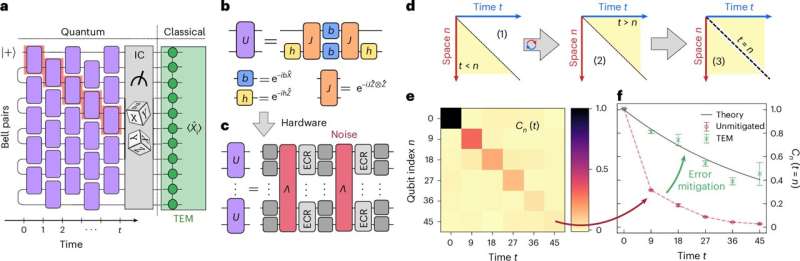
Quantum chaos describes chaotic classical dynamical systems in terms of quantum theory, but simulations of these systems are limited by computational resources. However, one team seems to have found a way by leveraging error mitigation and specialized circuits on a 91-qubit superconducting quantum processor. Their results are published in Nature Physics.
Error mitigation instead of error correction
While useful quantum simulations require an ability to eliminate errors, full quantum error correction requires large overheads in qubits and control. Previous work has gotten around this problem by simulating limited quantum many-body systems mostly at smaller scales or with integrable—or less chaotic—models.
The research team involved in the new study opted for a different method. Instead, they used error mitigation, which accepts noise and then corrects errors later, saving computational resources in the process.
“Our results are enabled by our ability to accurately characterize the noise on a large quantum processor, in conjunction with the recently introduced tensor-network error mitigation (TEM) method. TEM mitigates errors entirely in postprocessing via a tensor-network implementation of the inverted noisy channel, trading classical runtime and bias from tensor-network approximations for potentially reduced sampling overhead on the quantum device compared with traditional error mitigation techniques,” the study authors explain.
Dual-unitary circuits
The team successfully simulated many-body quantum chaos on a 91-qubit superconducting quantum processor using dual-unitary (DU) circuits. The DU circuits contain gates that exhibit unitarity in both the temporal and spatial dimensions—enabling the exact computation of certain system properties that would normally be too difficult to evaluate. However, DU circuits mix information extremely fast, while still allowing for exact predictions of a few specific measurements.
DU circuits were used to simulate a kicked Ising model, which is a periodically driven quantum many-body system, preparing specific initial quantum states. Error-mitigated results closely matched exact analytical predictions for autocorrelation decay in DU circuits across several different system sizes.
Benchmarking results
The team also benchmarked the simulation results against both analytical solutions and tensor-network classical simulations in both the Heisenberg and Schrödinger pictures. For analytically solvable DU circuits, they found that when moving away from exactly solvable points, quantum results agreed with advanced classical tensor-network simulations, even at scales where brute-force classical simulation is impossible. But, they emphasize that, at a scale beyond brute-force classical simulation without exact analytical solutions, these computations can only be compared with approximate classical methods.
On the comparisons between the error-mitigated results to tensor-network simulations, the team writes, “Across the different parameters, the experimental data show strong agreement with the Heisenberg-picture simulations with some deviations arising at larger circuit volumes, but large disagreements with the Schrödinger-picture simulations.
“Simulations in the Heisenberg picture display a higher convergence rate than those in the Schrödinger picture. While dynamics in the Heisenberg picture seem to be converging on classical computers, simulations in the Schrödinger picture with the same convergence rate become unaffordable at the scale of our experiments.”
Ultimately, this work has provided a pathway for using near-term quantum computers to study quantum chaos, transport, and localization in materials. This also helps advance trust in quantum computing as a scientific tool, even before error correction is fully developed. The study authors say this approach could enable quantum simulations of many-body dynamics that surpass classical methods before full fault tolerance is achieved as quantum hardware advances.
Written for you by our author Krystal Kasal, edited by Gaby Clark, and fact-checked and reviewed by Robert Egan—this article is the result of careful human work. We rely on readers like you to keep independent science journalism alive. If this reporting matters to you, please consider a donation (especially monthly). You’ll get an ad-free account as a thank-you.
Publication details
Laurin E. Fischer et al, Dynamical simulations of many-body quantum chaos on a quantum computer, Nature Physics (2026). DOI: 10.1038/s41567-025-03144-9. On arXiv: DOI: 10.48550/arxiv.2411.00765
Journal information: Nature Physics , arXiv
Leave a Reply