
January 30, 2026 by Ingrid Fadelli, Phys.org
Collected at: https://phys.org/news/2026-01-lab-longer-fracture-ice-sheets.html
When waves are moving across ice-covered seas, they can cause sheets of ice to bend and ultimately break. Understanding the processes underlying these wave-induced ice fractures and predicting when they will occur could help to better forecast how climate change will impact the environment and marine ecosystems on Earth.
Researchers at PMMH Lab, ESPCI, CNRS, PSL University, Sorbonne Université and Université Paris Cité recently performed a new laboratory experiment aimed at shedding new light on this phenomenon. The results of this experiment, published in Physical Review Letters, suggest that the stress at which ice sheets break depends on the length of the underlying waves.
“Since 2021, we wanted to study the propagation of ocean waves in floating ice, with laboratory-scale experiments, and in particular the fracture of a thin sheet by a surface wave,” said Stéphane Perrard, senior author of the paper, told Phys.org. “We were later inspired by the work of E. Dumas Lefevbre and D. Dumont, who monitored the fracture of a real sea ice layer by the wake of an icebreaker. To study a small-scale analog of their experiment, we used the concept of scale invariance: the same physical phenomenon can occur at very different scales, as long as the key ingredients are conserved across scales.”
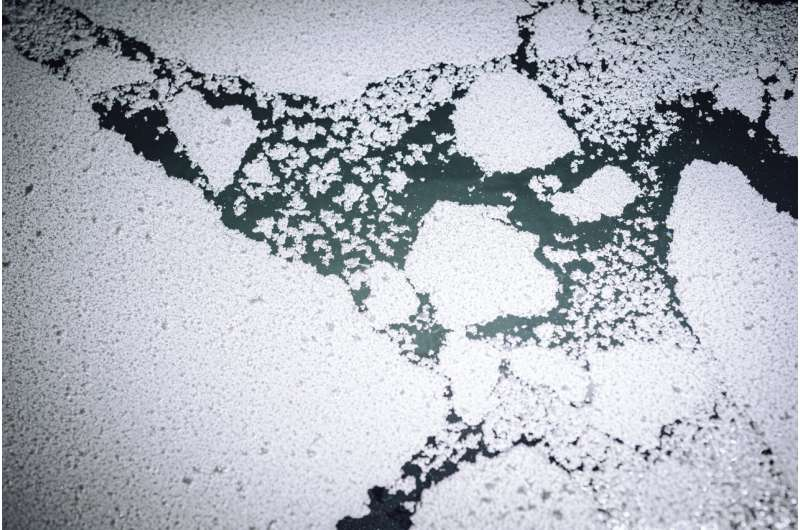
Top-view photograph of fragments of the varnish crust floating on the water surface after being fractured by centimetric waves. The field of view is about 15 cm wide. Credit: © Cyril FRESILLON / PMMH / CNRS Images
Reproducing ice fractures in the lab
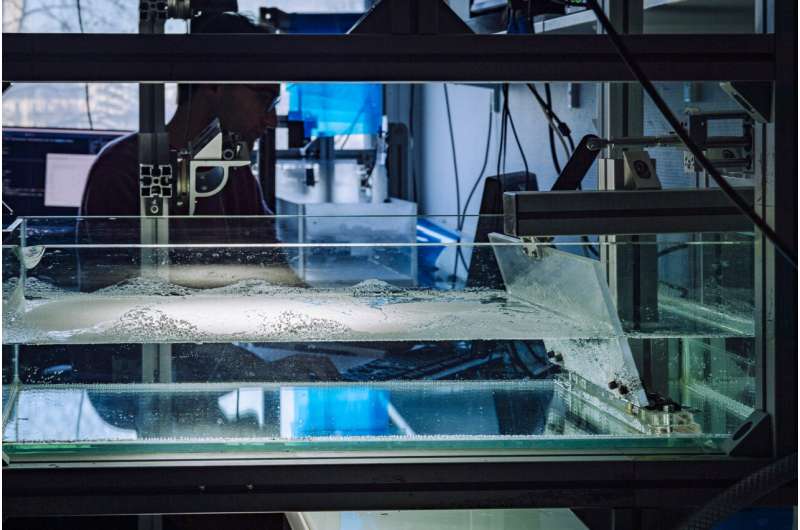
Perrard and his colleagues wanted to reproduce the surface wave-induced fracture of thin ice sheets at a laboratory scale. To do this, they used thin sheets of a brittle material that was floating in a water tank.
“We first looked for a material that was softer than ice and brittle enough to fracture with surface waves of centimetric size,” explained Perrard.
“We identified a varnish that can break in the blink of an eye. However, this material had been poorly characterized. We then used optical methods, in particular Digital Image Correlation (DIC) and profilometry, to detect low amplitude wave propagation in the varnish, from which we extracted the mechanical properties of the varnish (i.e., elasticity and thickness) using a non-invasive method.”
Once they identified and characterized the varnish they would use, the team placed it in a water tank and performed several experiments. In these experiments, they generated surface waves with varying lengths and amplitudes, then recorded the thresholds at which the material broke.
The researchers then analyzed all the data they collected to determine whether the material breaking depended on the characteristics of surface waves. Surprisingly, they found that the length of waves appeared to greatly contribute to fractures.
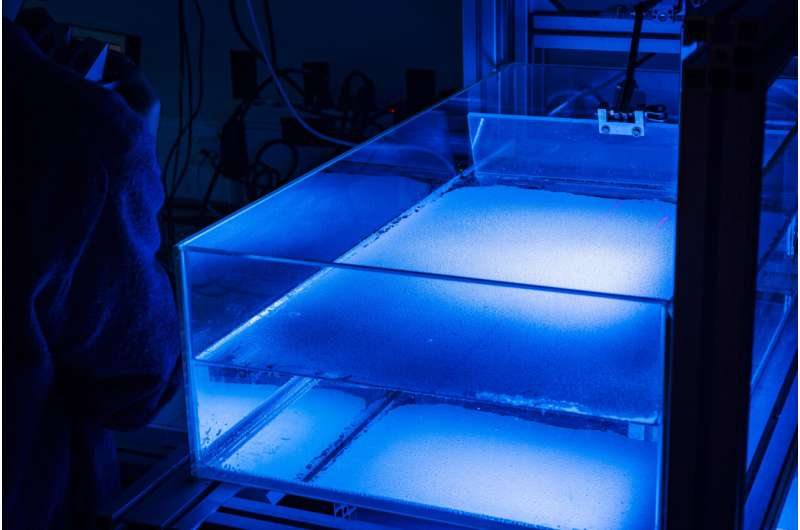
Photograph of the experimental tank filled with water and covered by the varnish crust. Blue illumination is used to enhance the contrast between the crust and the red laser line, which is employed for wave property measurements. Credit: © Cyril FRESILLON / PMMH / CNRS Images
Long waves break the surface more easily
Previous theoretical models predicted that wave-induced ice fractures occur when the stress (i.e., internal force per unit area inside ice sheets) exceeds a critical value. The results of this study appear to contradict this assumption, as the team found that longer waves broke the varnish sheets more easily.
“Surprised by such variations of the critical stress with the properties of the incoming wave, we were long puzzled by the implications of this result,” said Perrard.
“Today, we believe that the varnish behavior originates from its heterogeneous nature. As the varnish presents a broad range of defects, the fracture initiation is easier with long wave forcing. While we have no proof yet, we believe that the fracture of sea ice by waves may need to be revisited, to see if a similar trend could also be observed.”
The initial findings gathered by Perrard and his colleagues could soon inspire further research in this area, potentially leading to new interesting observations. If their hypothesis is confirmed, it could lead to new physical models explaining ice fractures, which could be used to better predict the evolution of real phenomena in icy marine environments.
“In parallel with this work, we started to perform field work on sea ice and its interaction with waves, in an attempt to bridge the gap between the real system and what we have learned from the laboratory analog,” added Perrard.
“Since 2023, we have performed a field campaign in the Saint Lawrence Estuary, in collaboration with the team of D. Dumont at UQAR (Université du Québec à Rimouski). Among the scientific objectives of this multi-year campaign, we are interested in the fracture threshold of sea ice by ocean waves. We are thrilled to measure and understand, in a near future, how real ice fractures.”
Publication details
B. Auvity et al, Wave-Induced Fracture of a Sea-Ice Analog, Physical Review Letters (2026). DOI: 10.1103/911x-1hyh. On arXiv: DOI: 10.48550/arxiv.2501.04824
Journal information: Physical Review Letters , arXiv
Leave a Reply