
January 30, 2026 by University of Stuttgart
Collected at: https://phys.org/news/2026-01-photons-telecom-wavelengths-demand.html
A team of researchers from the University of Stuttgart and the Julius-Maximilians-Universität Würzburg led by Prof. Stefanie Barz (University of Stuttgart) has demonstrated a source of single photons that combines on-demand operation with record-high photon quality in the telecommunications C-band—a key step toward scalable photonic quantum computation and quantum communication. “The lack of a high-quality on-demand C-band photon source has been a major problem in quantum optics laboratories for over a decade—our new technology now removes this obstacle,” says Prof. Stefanie Barz.
The key: Identical photons on demand
In everyday life, distinguishing features may often be desirable. Few want to be exactly like everyone else. When it comes to quantum technologies, however, complete indistinguishability is the name of the game. Quantum particles such as photons that are identical in all their properties can interfere with each other—much as in noise-canceling headphones, where sound waves that are precisely inverted copies of the incoming noise cancel out the background.
When identical photons are made to act in synchrony, then the probability that certain measurement outcomes occur can be either boosted or decreased. Such quantum effects give rise to powerful new phenomena that lie at the heart of emerging technologies such as quantum computing and quantum networking. For these technologies to become feasible, high-quality interference between photons is essential.
Now Nico Hauser, scientist at the University of Stuttgart and first author of the publication, and his colleagues report a source of highly indistinguishable photons that is uniquely suitable for practical applications: it produces the photons on demand, and it operates at a wavelength compatible with existing telecommunications infrastructure.
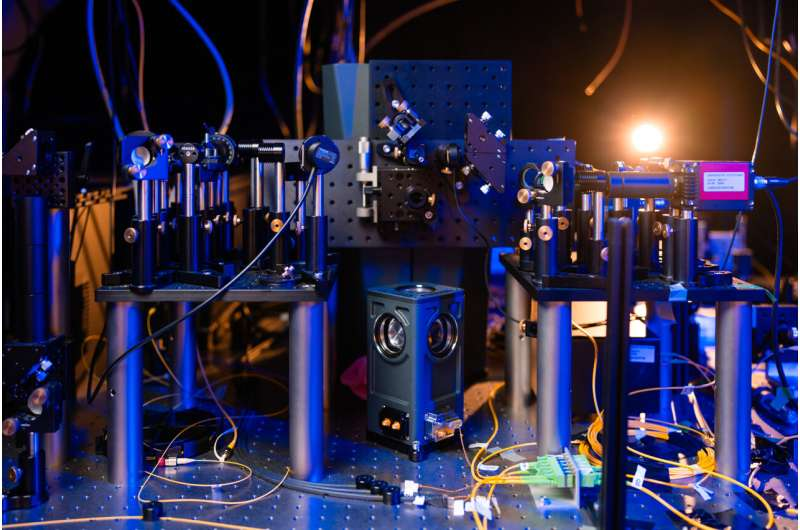
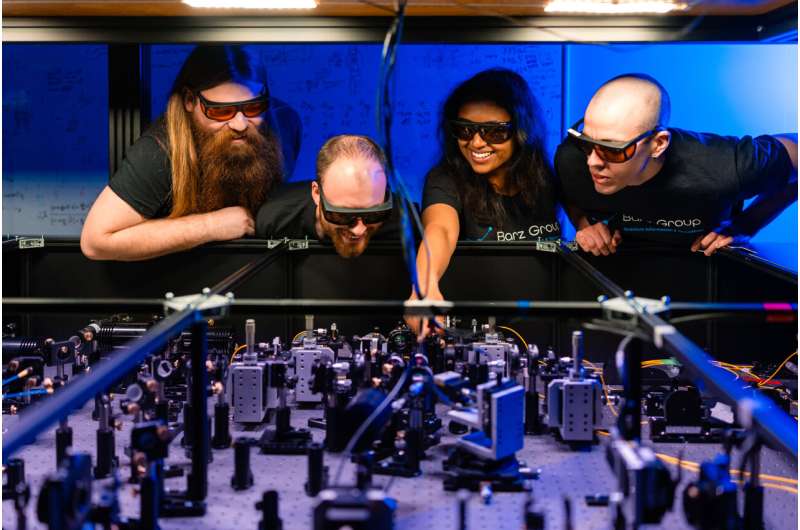
A look inside the quantum optics laboratory at the University of Stuttgart: Here, researchers are experimenting with new photon sources for quantum computing and quantum networking. Credit: Barz Group, University of Stuttgart / Ludmilla Parsyak
The telecom challenge
For photonic quantum technologies to be scalable, they must integrate with the fiber-optic infrastructure that provides the backbone of our information-hungry society. In practice, this means that photon sources should operate in the telecommunications C-band around a wavelength of 1550 nm, where optical losses in silica fibers are lowest.
This requirement has long posed a challenge: while photon sources based on so-called quantum dots—nanostructures that function like artificial atoms—have achieved near-ideal photon properties for emission at shorter wavelengths (780–960 nm), extending these results to the telecom regime proved difficult.
Photons made to order
The most practical alternative, known as spontaneous parametric down-conversion (SPDC), produces high-quality photons but does so probabilistically. That is, it is not possible to predict when exactly a desired photon is produced. This makes it impossible to synchronize multiple photons from different sources for protocols that need them simultaneously.
By contrast, so-called deterministic sources produce a photon whenever they are triggered. Quantum-dot devices exist for C-band photons; however, they achieve two-photon interference visibilities—a measure of indistinguishability—of around 72% at best. This is well below what SPDC sources routinely deliver and insufficient for demanding quantum protocols. “Our new device now lifts this roadblock,” says Stefanie Barz.
Toward scalable photonic systems
The new photon source developed by Hauser and team consists of indium arsenide quantum dots embedded within indium aluminum gallium arsenide and integrated into a circular Bragg grating resonator, which enhances photon emission.
The team systematically compared different schemes for triggering emission and found that harnessing excitations mediated by elementary vibrations in the crystal lattice—rather than pumping the quantum dots with higher-energy light—yielded the best results. In this mode, they achieved a raw two-photon interference visibility of nearly 92%, the highest reported for any deterministic single-photon source in the telecom C-band.
New applications for synchronized photons
These advances bring deterministic quantum dot sources into the same performance regime as probabilistic SPDC sources—with the crucial advantage of on-demand photon generation. “Our ability to simultaneously achieve deterministic single-photon generation, emission in the telecom C-band, and high photon indistinguishability will now enable applications that require large numbers of synchronized photons, from measurement-based quantum computing to quantum repeaters for long-distance communication,” says Hauser.
The paper is published in Nature Communications.
Publication details
Nico Hauser et al, Deterministic and highly indistinguishable single photons in the telecom C-band, Nature Communications (2026). DOI: 10.1038/s41467-026-68336-0
Journal information: Nature Communications
Leave a Reply