
January 30, 2026 by Liu Jia, Chinese Academy of Sciences
Collected at: https://phys.org/news/2026-01-random-qubit-processor-reveals-prethermal.html
Time-dependent driving has become a powerful tool for creating novel nonequilibrium phases such as discrete time crystals and Floquet topological phases, which do not exist in static systems. Breaking continuous time-translation symmetry typically leads to the outcome that driven quantum systems absorb energy and eventually heat up toward a featureless infinite-temperature state, where coherent structure is lost.
Understanding how fast this heating process occurs and whether it can be controlled has become a challenge in nonequilibrium physics. High-frequency periodic driving is known to delay heating, but much less is known about heating dynamics under more general, non-periodic driving protocols.
Random driving on a quantum processor
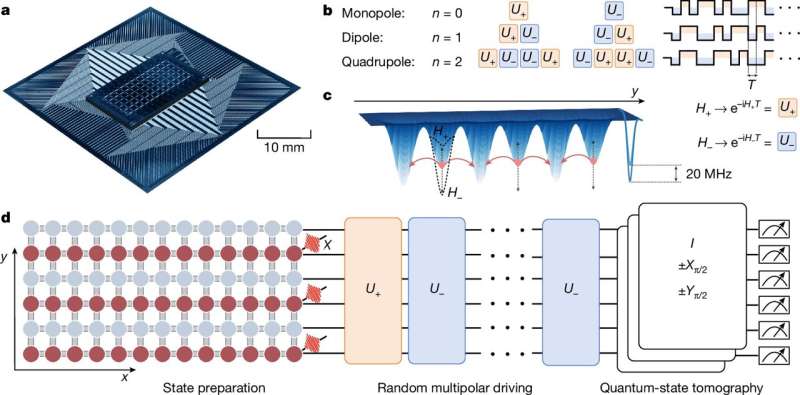
In a study published in Nature, scientists from the Institute of Physics of the Chinese Academy of Sciences, along with collaborators, conducted a random multipolar driving experiment on a two-dimensional large superconducting quantum processor: Chuang-tzu 2.0, and observed a long-lived prethermal regime where the system temporarily avoids full thermalization.
Chuang-tzu 2.0 consists of 78 qubits arranged in a 6×13 lattice with 137 tunable couplers. The system was initialized in a density-wave configuration and then driven by a sequence of randomly structured control pulses characterized by two parameters: the driving order and the duration of each driving unit.
Tracking energy absorption and prethermalization
By monitoring particle-number imbalance and entanglement entropy growth during time evolution, how the system absorbed energy over up to 1,000 driving cycles was tracked.
The scientists revealed that the system did not heat up immediately; instead, it entered a prethermal plateau, during which entropy and particle imbalance remained nearly constant before rapid heating set in. The lifetime of this plateau was found to be doubly tunable and follow a clear power-law dependence on the driving frequency with the universal scaling exponent 2n+ 1, linking the heating timescale directly to the structure of the random drive.
Entanglement growth and simulation limits
Further analysis showed that at later times, entanglement spread across the system and obeyed a strong volume-law scaling. In this regime, commonly used classical simulation methods, including tensor-network approaches, failed to reproduce the observed dynamics, highlighting the complexity of the heating process in large driven quantum systems.
This study provides a new way to study thermalization beyond periodic and quasiperiodic protocols. The observation of a tunable prethermal plateau and its scaling behavior reveals the constraints for theoretical descriptions of driven many-body systems.
The emergence of volume-law entanglement at later times highlights the growing gap between experimental quantum simulators and classical numerical approaches in modeling long-time nonequilibrium dynamics.
Publication details
Zheng-He Liu et al, Prethermalization by random multipolar driving on a 78-qubit processor, Nature (2026). DOI: 10.1038/s41586-025-09977-x
Journal information: Nature
Leave a Reply