
January 28, 2026 by Rimma Gerenstein, Albert Ludwig University of Freiburg
Collected at: https://techxplore.com/news/2026-01-ai-generate-intimacy-exceeds-human.html
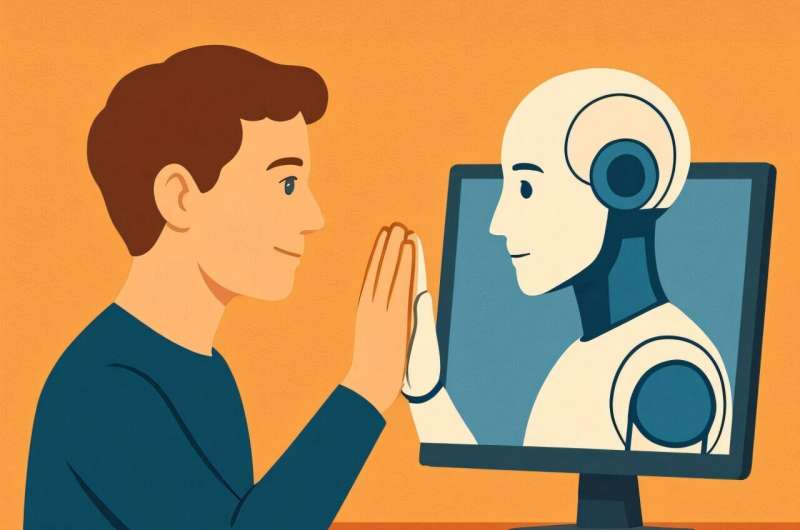
People can develop emotional closeness to artificial intelligence (AI)—under certain conditions, even more so than to other people. This is shown by a new study conducted by a research team led by Prof. Dr. Markus Heinrichs and Dr. Tobias Kleinert from the Department of Psychology at the University of Freiburg and Prof. Dr. Bastian Schiller from Heidelberg University’s Institute of Psychology. Participants felt a sense of closeness especially when they did not know that they were communicating with AI. The results have been published in Communications Psychology.
Questions about life experiences and friendships
In two online studies, a total of 492 participants engaged in chat conversations in which they answered personal and emotional questions, for example, about important life experiences or friendships. The responses came either from a human being or an AI-based language model. The researchers also investigated the influence of the information, whether the conversation partner was a human being or an AI.
AI responses generated a comparable feeling of closeness to human responses when participants did not know they were communicating with AI. In emotional conversations, AI even surpassed humans: here, participants felt closer to AI than to humans, mainly because AI revealed more personal information. However, when participants were informed in advance that they would be communicating with AI, the perceived closeness decreased significantly and they invested less effort in their responses.
Ethical and regulatory guidelines needed
“We were particularly surprised that AI creates more intimacy than human conversation partners, especially when it comes to emotional topics,” explains study leader Schiller.
Lead author Kleinert adds, “The AI showed a higher degree of self-disclosure in its responses. People seem to be more cautious with unfamiliar conversation partners at first, which could initially slow down the development of intimacy.”
The results show great potential for AI in areas such as psychological support, care, education and counseling, for example, low-threshold conversation services. At the same time, they demonstrate the risk that people may form social bonds with AI without consciously realizing it. The researchers therefore emphasize the need for clear ethical and regulatory guidelines to ensure transparency and prevent abuse.
A useful augmentation or a tool for manipulation
“Social relationships have been proven to have a major positive impact on human health,” says Heinrichs. “AI chatbots could therefore enable positive, relationship-like experiences, especially for people with few social contacts. At the same time, such systems must be designed to be responsible, transparent and clearly regulatable, as they can also be misused.”
Artificial intelligence is increasingly becoming a social actor, according to Schiller: “The way we shape and regulate it will decide whether it is a meaningful supplement to social relations—or whether emotional closeness is deliberately manipulated.”
More information: Tobias Kleinert et al, AI outperforms humans in establishing interpersonal closeness in emotionally engaging interactions, but only when labelled as human, Communications Psychology (2026). DOI: 10.1038/s44271-025-00391-7
Journal information: Communications Psychology
Leave a Reply